

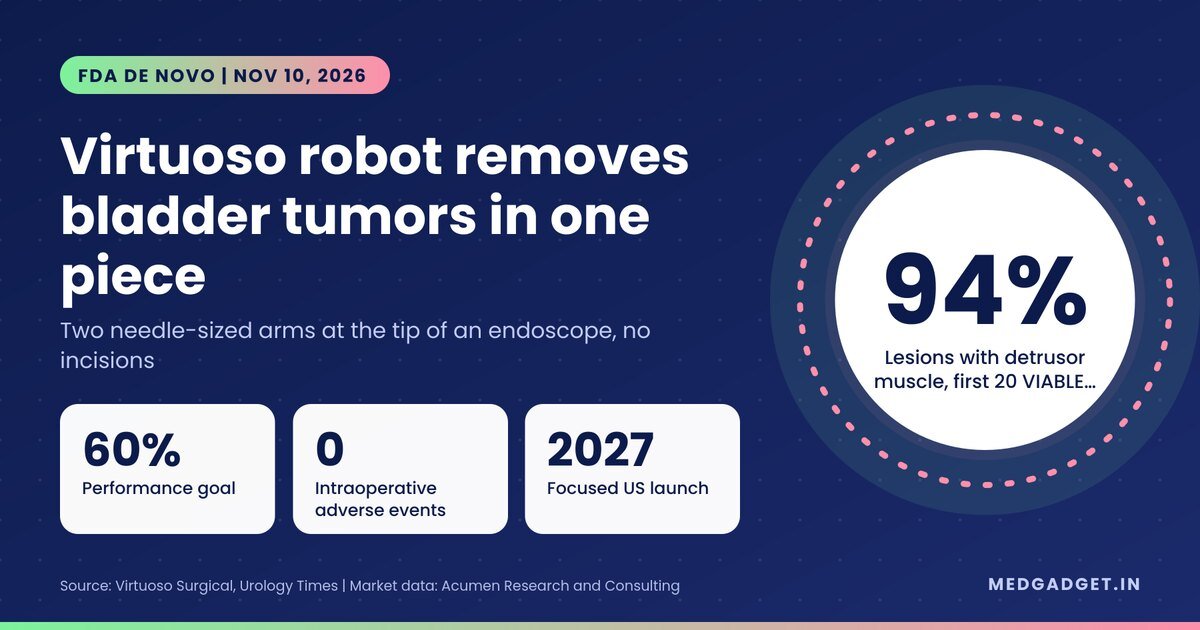
The Virtuoso robotic system from Nashville-based Virtuoso Surgical received US FDA De Novo authorization on November 10, 2026 for en bloc resection of bladder lesions in adults, making it the first device in a new FDA classification for electromechanical systems used inside natural body passages. The Virtuoso Endoscopy System places two needle-sized robotic arms at the tip of a rigid endoscope so a urologist can lift and cut out a bladder tumor in one piece through the urethra. In the first 20 patients of the VIABLE study, detrusor muscle, the tissue layer pathologists need to stage the cancer, was present in 94% of removed lesions.
Key takeaways on the Virtuoso robotic system
- FDA granted De Novo authorization on November 10, 2026; the device had Breakthrough Device Designation since September 2025.
- Indication: en bloc resection of bladder lesions in adults to obtain tissue, including detrusor muscle, for diagnosis of bladder cancer.
- Two concentric nitinol arms give the surgeon two-handed control at the tip of a standard-size scope, with no external incision.
- VIABLE, first 20 patients (company-reported): detrusor present in 94% of lesions versus a 60% performance goal; margins evaluable in 93% of malignant lesions; no intraoperative adverse events.
- A focused US launch at leading urology centers is planned for 2027.
Why removing a tumor in one piece matters
Most bladder tumors are first removed by transurethral resection of bladder tumor, or TURBT. A wire loop passed through a scope shaves the tumor away in strips. It works, but the specimen arrives at the lab in fragments, which can make it harder to judge how deep the cancer goes and whether the edges are clear. Depth is the key question: whether the tumor has invaded the detrusor muscle decides whether a patient is managed with bladder-sparing treatment or needs far more aggressive therapy.
En bloc resection, which removes the lesion intact, has been tested in randomized trials and is recognized in international guidelines, according to Urology Times. Its weakness has been the tools. Doing it with conventional straight instruments is technically demanding, and US uptake has been limited. Virtuoso’s chief executive, urologic surgeon Duke Herrell, MD, put the rationale simply: “Removing a tumor intact can provide a better tissue specimen, which supports clearer diagnosis and staging.”
How the system works
The arms are made from superelastic nitinol tubes nested inside one another. Rotating and sliding the tubes bends the arm tip, giving each arm dexterity without bulky joints, which is why they fit at the end of a rigid endoscope. During the procedure, one arm grips and retracts the tumor while the other dissects beneath it, much as a surgeon would work with two hands in open surgery. The system is intended for trained surgeons in an operating room.
The clinical evidence so far
| Measure | VIABLE phase 1 (published) | VIABLE first 20 patients (company) |
|---|---|---|
| Patients / lesions | 6 / 12 | 20 / not disclosed |
| Removed en bloc or modified en bloc | 12 of 12, no conversion | Not disclosed |
| Detrusor muscle present | 100% | 94% (goal 60%) |
| Evaluable margins | 91% | 93% of malignant lesions |
| Intraoperative adverse events | None | None reported |
| Mean procedure time | 52 minutes (±20) | Not disclosed |
The first phase was published in European Urology Oncology in February 2026. Two of the six patients had postoperative events: grade 1 urinary retention, and a chest infection linked to a newly found esophageal tumor. There were no bladder perforations, no reoperations and no deaths at 30 days. The 20-patient update, run at the Chinese University of Hong Kong, comes from the company and has not been peer reviewed. MedTech Dive reports the company compares its 94% figure with a median of roughly 70% for conventional resection.
Limits and unanswered questions
- Small numbers: 20 patients is enough for a De Novo safety and performance case, not to prove better long-term outcomes.
- No head-to-head data: there is no randomized comparison with standard TURBT using this robot, and no recurrence or survival data yet.
- Cost and workflow: pricing, capital cost and procedure time in routine practice have not been disclosed.
- Other uses are investigational: early non-human work in gynecology, pulmonary and neurosurgery is outside the authorized indication.
- Disclosure: Vanderbilt urologist Sam Chang, MD, who has praised the system, is a paid consultant to the company.
Market context
Virtuoso enters an established urology device field. Acumen Research and Consulting valued the global urology devices market at USD 35.6 billion in 2021 and projected USD 60.2 billion by 2030, a 6.1% compound annual growth rate, with Asia-Pacific the fastest-growing region. That report was last updated in 2022, so treat the figures as dated and indicative. Acumen’s separate surgical robots market report projected around USD 13.7 billion by 2026, at roughly 10.4% annual growth, with North America the largest region.
For readers in India and other Asia-Pacific markets, the device is US-authorized only for now, and the company has not announced plans for CDSCO or other regulators. Bladder cancer care in the region still relies on conventional TURBT. Our earlier coverage of Anktiva for bladder cancer and of physical AI in surgery gives more background on where treatment and surgical robotics are heading.
What to watch
The next milestones are full peer-reviewed VIABLE results, the first US cases in 2027, and any study that tracks recurrence or restaging rates after robotic en bloc resection. Those data will decide whether the system stays a specialist tool or changes routine bladder cancer staging.
FAQ
Is the Virtuoso robotic system FDA approved?
It received FDA De Novo authorization on November 10, 2026 for en bloc resection of bladder lesions in adults. De Novo is the pathway for novel, low-to-moderate risk devices with no existing equivalent.
What is en bloc resection of a bladder tumor?
Removing the tumor in a single piece, rather than shaving it out in fragments as in standard TURBT, so pathologists can better judge depth and margins.
Does the Virtuoso procedure need incisions?
No. The endoscope is passed through the urethra, and the two robotic arms work at its tip inside the bladder.
When will hospitals offer it?
Virtuoso Surgical plans a focused US launch at leading urology centers in 2027. No timeline has been given for other countries.
Sources: Virtuoso Surgical announcement (November 10, 2026); Urology Times; MedTech Dive; VIABLE phase 1, European Urology Oncology (2026). Market data: Acumen Research and Consulting. More in Medical Device. Not medical advice. Last updated: November 12, 2026.