

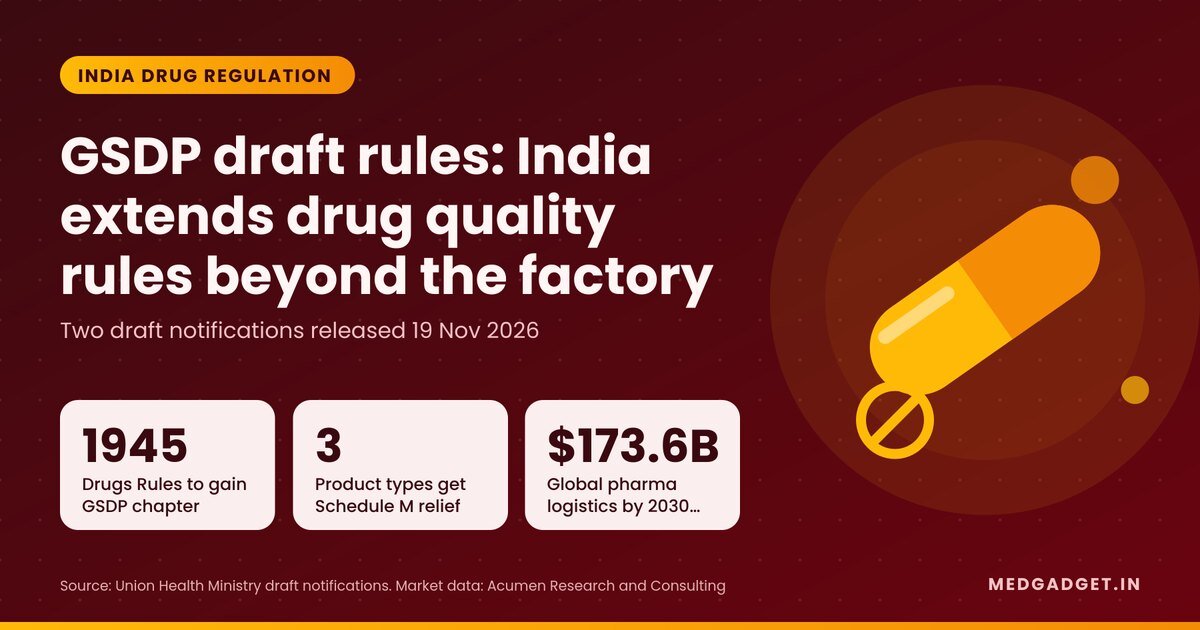
India’s Union Health Ministry has published draft GSDP draft rules that would write Good Storage and Distribution Practices into the Drugs Rules, 1945 for the first time, while a second draft notification, G.S.R. 985(E) dated 6 November 2026, proposes easing parts of revised Schedule M for medicinal gases, empty gelatin capsules and disinfectant fluids. Both drafts were made public on 19 November 2026 and now go out for stakeholder comment before any final notification.
Key takeaways on GSDP draft rules
- GSDP would become a legal requirement under the Drugs Rules, 1945, building on guidance already issued by the Central Drugs Standard Control Organisation (CDSCO).
- It covers the full chain after the factory gate: procurement, purchasing, storage, transport, distribution, documentation and record-keeping.
- Manufacturers, importers, wholesalers, distributors and stockists are named as entities in scope. Retail chemists are not named in the reports so far.
- A separate draft (G.S.R. 985(E)) would restore earlier exemptions for three product types under revised Schedule M, after the Drugs Technical Advisory Board (DTAB) backed the change at its 93rd meeting on 16 February 2026.
- Both are drafts. Nothing changes for companies until a final notification appears in the Gazette of India.
Why India is targeting the gap between factory and pharmacy
Most of India’s drug-quality reform since 2023 has focused on manufacturing. The revised Schedule M, notified as G.S.R. 922(E) on 28 December 2023, pushed plants towards WHO-aligned Good Manufacturing Practice. Yet a tablet made to that standard can still lose potency in an overheated warehouse, get swapped for a fake in a loosely tracked supply chain, or be diverted to an unlicensed seller. The ministry’s stated aim with GSDP is to protect a medicine’s quality, safety, efficacy and identity at every handover between the manufacturer or importer and the patient.
The risks it lists are specific: deterioration, contamination, mix-ups, falsification, diversion and unauthorised distribution. The draft also leans heavily on paperwork, with stronger documentation and traceability intended to help Central and State drug controllers inspect and enforce. For an industry that has faced more scrutiny from foreign regulators this year, including a sharp rise in unannounced US FDA inspections of Indian plants, the signal is that domestic oversight is extending past the plant boundary.
The two drafts side by side
| Item | GSDP draft | Schedule M draft (G.S.R. 985(E)) |
|---|---|---|
| Direction | Adds new obligations | Eases selected obligations |
| Who is affected | Manufacturers, importers, wholesalers, distributors, stockists | Makers of medicinal gases, empty gelatin capsules, disinfectant fluids |
| Basis | CDSCO GSDP guidance | DTAB 93rd meeting, 16 Feb 2026 |
| Scope | Procurement to delivery, plus records | Restores pre-revision exemptions; licensing authorities decide product by product |
| Status (19 Nov 2026) | Draft, open for comment | Draft dated 6 Nov 2026, open for comment |
What GSDP could mean on the warehouse floor
The published summaries do not yet spell out line-by-line requirements, so firms should read the Gazette text before planning spend. Based on what the ministry has described, the practical areas to review are:
- Supplier qualification: buying only from licensed sources and keeping proof of it, since procurement and purchasing are explicitly in scope.
- Storage conditions: protecting stock from deterioration, which in Indian summers usually means temperature mapping and monitoring for sensitive products.
- Transport: controls on how goods move between depots, a stage that often sits with third-party logistics firms.
- Records and traceability: documentation that lets an inspector follow a batch from receipt to dispatch, the backbone for spotting diversion and falsified stock.
The ministry has also referred to a separate licensing framework for wholesale of bulk drugs (active pharmaceutical ingredients), but details of that proposal were not included in the material released on 19 November.
Why gases, capsule shells and disinfectants get relief
Revised Schedule M was written mainly with finished dosage forms in mind. Makers of medical oxygen and other gases, empty hard gelatin capsule shells and disinfectant fluids argued that several of its provisions do not fit how their products are made. DTAB agreed that some requirements may not apply to these processes and recommended keeping the exemptions they enjoyed under the old Schedule M. Under the draft, State and Central licensing authorities would decide applicability product by product.
The ministry insists the change “does not dilute the applicable standards” for quality, safety or oversight. That claim will be tested in comments: medical oxygen shortages during the pandemic showed how critical gas supply is, so hospitals and patient groups may want clarity on which checks remain mandatory.
Market context: a fast-growing logistics layer
Distribution rules matter because the logistics business behind medicines is large and growing. According to Acumen Research and Consulting’s pharmaceutical logistics market report, the global market was worth USD 81.2 billion in 2021 and is projected to reach USD 173.6 billion by 2030, a compound annual growth rate of 8.8%. Acumen identifies cold chain logistics as the largest segment and Asia-Pacific as the fastest-growing region. The report was last updated in October 2022, so treat these figures as indicative rather than current. By our calculation, the projection implies the market roughly doubles (about 2.1 times) over the decade, which is the kind of expansion that makes common standards for warehouses and transporters more pressing.
Open questions
- Comment window and deadline: news reports on 19 November did not state the comment period; the Gazette notice will.
- Transition time: small wholesalers and stockists may need months to add temperature control and record systems. No phase-in period has been reported yet.
- Retail coverage: whether chemist shops fall under any part of GSDP is unclear from the summaries.
- Enforcement capacity: State drug control departments carry most inspection work and many are understaffed.
FAQ
What is GSDP in pharma?
Good Storage and Distribution Practices are standards for how medicines are bought, stored, transported and documented after manufacture, so that quality is kept intact until the product reaches the patient.
Is GSDP mandatory in India now?
Not yet. CDSCO has issued GSDP guidance, and the 19 November 2026 draft would make it part of the Drugs Rules, 1945. It becomes binding only after a final notification.
Which products get Schedule M relaxation?
Medicinal gases, empty gelatin capsules and disinfectant fluids, under draft notification G.S.R. 985(E). Licensing authorities would decide which provisions apply to each product.
Does this change drug prices for patients?
The drafts do not address prices. Any compliance costs for distributors would emerge only after final rules and transition timelines are set.
More from our Pharmaceutical section, including the recent Maharashtra NMN supplement seizure.
Sources: Union Ministry of Health and Family Welfare draft notifications as reported by IANS and ETV Bharat (19 Nov 2026); Gazette of India G.S.R. 985(E) and G.S.R. 922(E). Market data: Acumen Research and Consulting. This article is for information only and is not legal, medical or investment advice. Last updated 19 November 2026.
[…] Drug Wholesale Licence: India Drafts Separate Permit for API Traders GSDP Draft Rules: India Moves to Make Drug Storage and Distribution Standards Law, Eases Schedule M… FDA Unannounced Inspections in India Jump to 87%: What It Means for Indian Drugmakers […]