

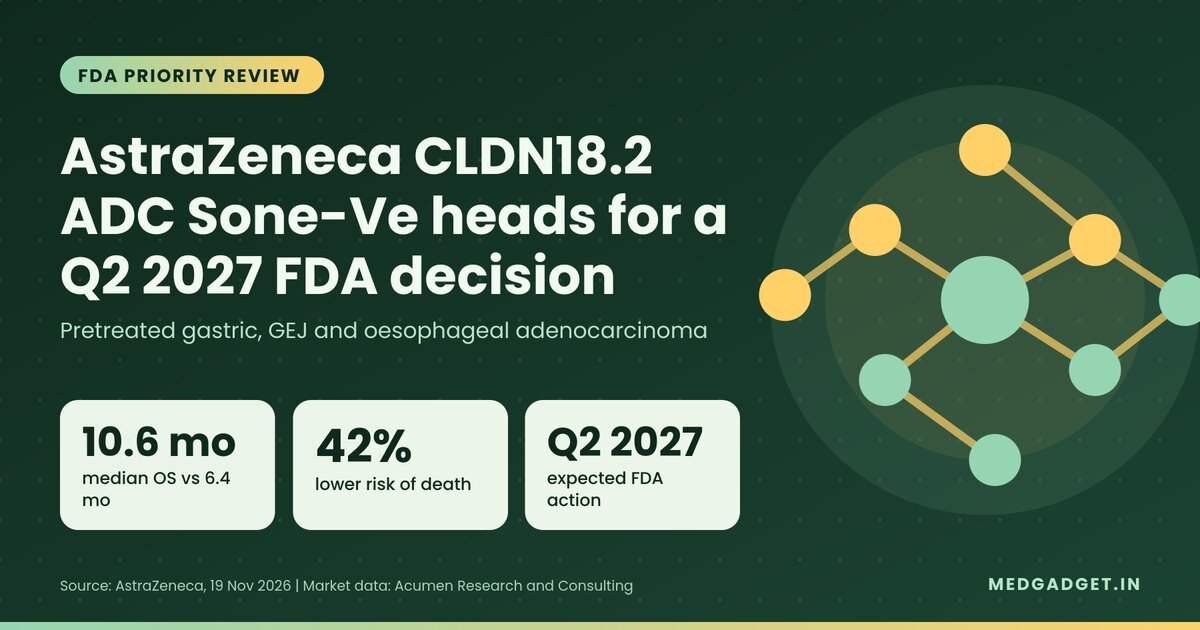
The sonesitatug vedotin priority review announced by AstraZeneca on 19 November 2026 means the US Food and Drug Administration has accepted the company’s Biologics License Application for the claudin 18.2 (CLDN18.2) antibody-drug conjugate and expects to make a decision in the second quarter of 2027. The application seeks approval for adults with locally advanced or metastatic gastric, gastroesophageal junction (GEJ) or oesophageal adenocarcinoma whose tumours express CLDN18.2 in at least 25% of cells, after at least one prior therapy. The filing rests on the Phase 3 CLARITY-Gastric01 trial, according to AstraZeneca’s announcement.
Key takeaways on the sonesitatug vedotin priority review
- FDA decision (PDUFA date) expected in Q2 2027.
- Population sought: second-line and later CLDN18.2-positive (25% or more of tumour cells, any intensity) gastric, GEJ or oesophageal adenocarcinoma.
- In CLARITY-Gastric01, median overall survival was 10.6 months with Sone-Ve versus 6.4 months with investigator’s choice therapy, hazard ratio 0.58, a 42% lower risk of death.
- Grade 3 or higher treatment-related side effects were less common with Sone-Ve than with comparator therapy.
- AstraZeneca says it would be the first CLDN18.2-targeted ADC to improve overall survival.
- Applications are also under review in the EU, China and several other countries.
What priority review means for timing
Priority review is granted to medicines that could offer a significant improvement in treating a serious condition. For a new biologic, it shortens the FDA’s review goal to six months after the 60-day filing period, compared with ten months under standard review. It does not lower the evidence bar or guarantee approval; it only speeds the clock. Sone-Ve, as AstraZeneca abbreviates it, also holds orphan drug designation from the FDA and the European Commission for gastric and GEJ cancers, and breakthrough designation in China for second-line gastric cancer.
The trial data behind the filing
CLARITY-Gastric01 is a randomised, open-label, sponsor-blinded Phase 3 study run at 175 centres in 19 countries. Its first stage compared two doses of Sone-Ve (2.2 mg/kg and 1.8 mg/kg) with investigator’s choice therapy; the second stage continued with 2.2 mg/kg. We covered the full ESMO 2026 presentation in our report on the AstraZeneca stomach cancer drug trial.
| Endpoint (CLARITY-Gastric01) | Sone-Ve | Investigator’s choice | Result |
|---|---|---|---|
| Median OS, second line and later (532 patients) | 10.6 months | 6.4 months | HR 0.58, p=0.000004 |
| Median OS, third line and later (dual primary) | 10.0 months | 5.0 months | HR 0.47 |
| Median PFS, overall population (dual primary) | 4.2 months | 3.8 months | HR 0.77, p=0.053 (not significant) |
| Grade 3+ treatment-related adverse events | 36.4% | 44.8% | Lower with Sone-Ve |
One detail is worth flagging for readers following the regulatory path. The trial had two primary endpoints: overall survival in the third-line-and-later group and progression-free survival in the whole study. The PFS endpoint narrowly missed statistical significance. The label AstraZeneca is now seeking covers the broader second-line-and-later population, where overall survival was a key secondary endpoint and the effect was highly significant. How the FDA weighs a missed PFS endpoint against a clear survival benefit will shape the final label wording. AstraZeneca says the survival benefit was consistent across most subgroups, including patients with lower and higher CLDN18.2 expression.
By our calculation, the 4.2-month gain in median overall survival in the second-line-and-later group is a relative improvement of about 66% over the comparator arm.
How Sone-Ve works
Claudin 18.2 is a tight-junction protein normally tucked away in the stomach lining but exposed on the surface of many gastric tumour cells. Sone-Ve couples an antibody that binds CLDN18.2 to a cytotoxic payload, so the drug is delivered mainly to cells carrying the target. The approach differs from Astellas’s zolbetuximab (Vyloy), an unconjugated CLDN18.2 antibody approved for first-line use with chemotherapy. AstraZeneca licensed Sone-Ve globally from KYM Biosciences in March 2023.
Who could be eligible
About 60% of gastric and GEJ cancers express CLDN18.2 in at least 25% of tumour cells, AstraZeneca says. It estimates roughly 7,500 people a year in the US, and about 183,500 across the US, EU, China and Japan, are treated in the second-line-and-later setting for CLDN18.2-positive, HER2-negative disease. By our calculation the US accounts for only about 4% of that four-region pool, underlining how much of the need lies in Asia, where gastric cancer is far more common.
Gastric cancer is the fifth most common cancer worldwide, with nearly 1 million diagnoses and about 650,000 deaths in 2024. Fewer than 20% of people diagnosed at a late stage survive beyond one year, and median survival with second-line and later treatment is typically 5 to 10 months. AstraZeneca has not disclosed an Indian filing timeline, and patients in India should not expect access soon outside clinical trials.
Market context: the ADC boom
Sone-Ve arrives in one of oncology’s fastest-growing drug classes. Acumen Research and Consulting values the global antibody-drug conjugate market at USD 16.4 billion in 2025 and USD 19.2 billion in 2026, forecasting USD 74.7 billion by 2035, a CAGR of 16.3%. Acumen expects Asia-Pacific to grow fastest, at a 20.2% CAGR, driven largely by China’s ADC pipeline. HER2-directed ADCs held 43.5% of the market in 2025, led by AstraZeneca and Daiichi Sankyo’s Enhertu, which already has a gastric cancer indication. A CLDN18.2 ADC would add a new target to that mix.
What to watch before the decision
- Whether the FDA convenes an advisory committee, given the missed PFS endpoint.
- EU and China decisions, which could come before or around the US date.
- First-line data: a Phase 3 study is testing Sone-Ve with capecitabine, with or without rilvegostomig, in untreated patients.
- Companion diagnostic approval for CLDN18.2 testing at the 25% threshold.
For more cancer drug news, see our Oncology section.
FAQ
When will the FDA decide on sonesitatug vedotin?
AstraZeneca expects an FDA action date in the second quarter of 2027.
What is sonesitatug vedotin used for?
It is an investigational treatment for advanced gastric, GEJ or oesophageal adenocarcinoma expressing CLDN18.2, in patients who have had at least one prior therapy. It is not yet approved anywhere.
How much did Sone-Ve extend survival?
Median overall survival was 10.6 months versus 6.4 months with standard options in the second-line-and-later group, a 42% lower risk of death.
Is Sone-Ve the same as zolbetuximab?
No. Both target CLDN18.2, but zolbetuximab is a plain antibody, while Sone-Ve is an antibody-drug conjugate that carries a toxic payload into the tumour cell.
Sources: AstraZeneca press release (19 Nov 2026); CLARITY-Gastric01 ESMO 2026 data. Market data: Acumen Research and Consulting, Antibody Drug Conjugate Market report. Not medical or investment advice. Last updated 19 November 2026.