

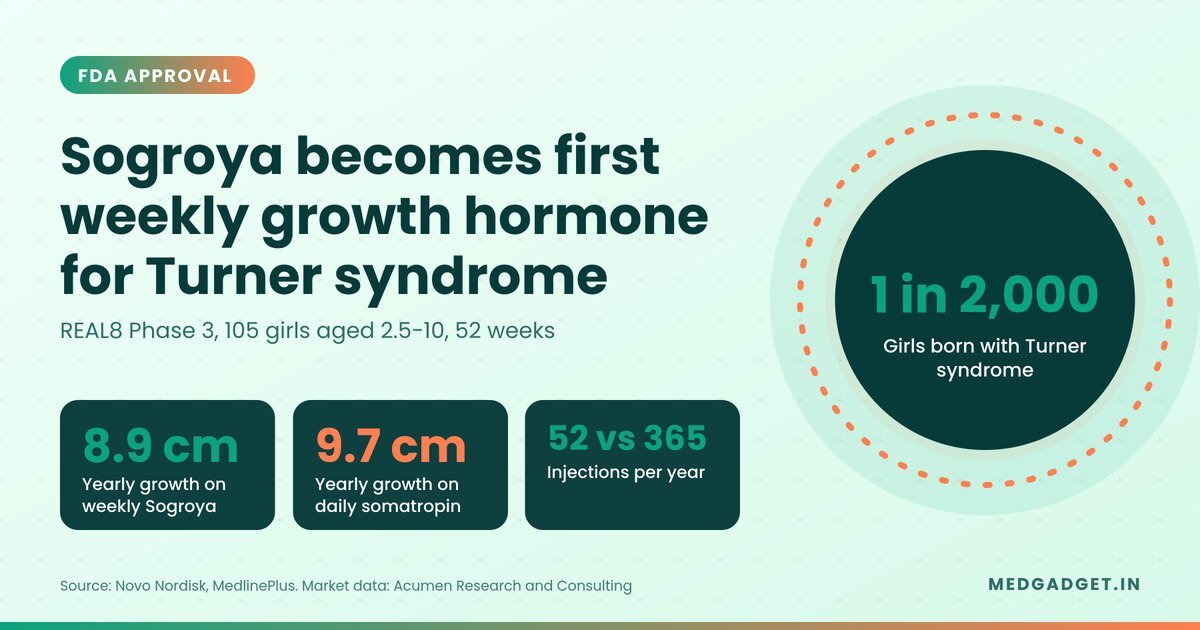
The FDA has approved Sogroya for Turner syndrome, making Novo Nordisk’s once-weekly somapacitan-beco the first long-acting growth hormone cleared in the US for children aged 2.5 years and older whose growth failure is caused by the condition. Novo Nordisk announced the decision on 20 November 2026. The approval rests on the Turner syndrome arm of the Phase 3 REAL8 study, in which 105 young girls received either weekly Sogroya or a standard daily somatropin injection for 52 weeks, and the two groups grew at broadly similar rates.
Key takeaways on Sogroya for Turner syndrome
- Sogroya is now FDA-approved for growth failure associated with Turner syndrome in children 2.5 years and older, dosed once a week.
- In REAL8, children on Sogroya grew 8.9 cm per year versus 9.7 cm per year on daily somatropin at week 52, a gap of 0.8 cm per year that Novo describes as comparable.
- The case for switching is convenience: one injection a week instead of seven, which by our calculation means 313 fewer injection days a year.
- Common side effects in the Turner cohort included respiratory and ear infections, fever, diarrhoea, vomiting and injection-site reactions.
- Turner syndrome affects roughly 1 in 2,000 girls at birth, according to MedlinePlus Genetics.
- This is Sogroya’s sixth US indication, after adult growth hormone deficiency and four other paediatric growth disorders.
Why weekly dosing matters in Turner syndrome
Turner syndrome is a chromosomal condition in which a girl is born with one X chromosome missing or partly missing. Short stature is its most consistent feature, and growth hormone therapy is the standard way paediatric endocrinologists try to improve final adult height. The catch is time: treatment usually starts in early childhood and continues for years, and until now it has meant a daily injection, often given by a parent at home.
Missed doses are a known problem with daily growth hormone over long courses, and families frequently describe injection fatigue as children get older. A weekly option does not change the biology of Turner syndrome, but it can make a multi-year plan easier to stick to, which is the practical argument Novo is making. Somapacitan works by binding reversibly to albumin in the blood, which slows its clearance and lets one dose last a week.
REAL8 Turner syndrome results at a glance
REAL8 is a randomised, open-label, active-controlled Phase 3 “basket” trial that tests somapacitan in several growth disorders at once. The Turner syndrome cohort enrolled girls aged 2.5 to 10 years who had not previously received growth hormone and had not started puberty. They were randomised 2:1 to weekly Sogroya or daily somatropin.
| Measure (week 52) | Sogroya, once weekly | Daily somatropin |
|---|---|---|
| Children randomised | 68 | 37 |
| Dose | 0.24 mg/kg per week | 0.05 mg/kg per day |
| Annualised height velocity (primary endpoint) | 8.9 cm/year | 9.7 cm/year |
| Change in height SDS from baseline | 0.77 | 0.86 |
| Baseline height SDS | -2.8 | -3.0 |
| Injections per year | 52 | 365 |
Height standard deviation scores moved by similar amounts in both groups. The numerical edge sat with daily therapy, by 0.8 cm per year. Novo frames the result as comparable growth; readers should treat it as “broadly similar, not better”.
What the data do not show
Three limits are worth knowing before reading too much into the approval:
- Comparator dose. The daily arm used 0.05 mg/kg per day, below the 0.067 mg/kg per day maximum allowed in US Turner syndrome labelling. Many US children are treated at the higher dose, so real-world daily therapy may outpace the trial comparator.
- Short follow-up. The primary analysis is one year. Adult height, the outcome families care most about, will take many more years to measure. A two-year safety extension is under way.
- Open-label design. Families and doctors knew which treatment was given, which is normal for injection-schedule comparisons but worth noting.
Safety profile
Adverse reactions reported in at least 10% of Sogroya-treated children with Turner syndrome were respiratory tract infection, nasopharyngitis, ear infection, fever, diarrhoea, vomiting and injection-site reactions. The prescribing information carries the same class warnings as other growth hormones, including intracranial hypertension, pancreatitis, worsening scoliosis, slipped capital femoral epiphysis and fluid retention. Growth hormone is not used in children with active cancer or closed growth plates. If a weekly dose is missed, the label allows it to be given within 72 hours; after that it is skipped. Dosing decisions belong with the child’s endocrinologist.
Where Sogroya now sits among growth therapies
Sogroya was first approved in the US for adults with growth hormone deficiency in 2020, then for children with growth hormone deficiency in 2023. In February 2026 the FDA added idiopathic short stature, short stature after being born small for gestational age, and Noonan syndrome. Turner syndrome now joins that list, giving Sogroya five paediatric growth indications in the US. Novo also markets daily Norditropin, so part of the commercial story is moving existing patients onto the weekly product. For broader context on Novo’s pipeline, see our coverage of Novo’s monthly haemophilia A shot and our FDA approvals section.
Market context
According to Acumen Research and Consulting’s human growth hormone market report, the global market was worth USD 5.3 billion in 2022 and is projected to reach USD 11.8 billion by 2032, an 8.4% compound annual growth rate. North America held more than 42% of revenue in 2022, and Asia-Pacific is expected to grow fastest at over 8.9% a year. Growth hormone deficiency is the largest application at over 49% share, with Turner syndrome tracked as a separate segment. Weekly products that widen their label set are one of the levers behind that forecast growth.
India angle
The US decision does not make Sogroya available for Turner syndrome in India. Any Indian use would need a separate CDSCO approval for this indication, and Novo has not announced an Indian filing. Indian families currently rely on daily somatropin products, and cost is often the bigger barrier than injection frequency. Asia-Pacific’s faster projected growth in the Acumen data suggests that access, not science, will decide how quickly weekly options reach patients here.
FAQ
Is Sogroya approved for Turner syndrome?
Yes. The FDA approved it on 20 November 2026 for growth failure associated with Turner syndrome in children aged 2.5 years and older.
How often is Sogroya given?
Once a week by injection under the skin, using a prefilled pen in 5, 10 or 15 mg strengths. Daily growth hormone requires an injection every day.
Does weekly Sogroya work as well as daily growth hormone?
In REAL8, growth over one year was broadly similar: 8.9 cm per year with Sogroya versus 9.7 cm per year with daily somatropin. Long-term adult height data are not yet available.
Is Sogroya available in India for Turner syndrome?
Not for this indication. The approval is US-only, and an Indian launch would need CDSCO approval.
Sources: Novo Nordisk release, Sogroya prescribing information, MedlinePlus Genetics. Market data: Acumen Research and Consulting. This article is for information only and is not medical advice. Last updated 20 November 2026.