

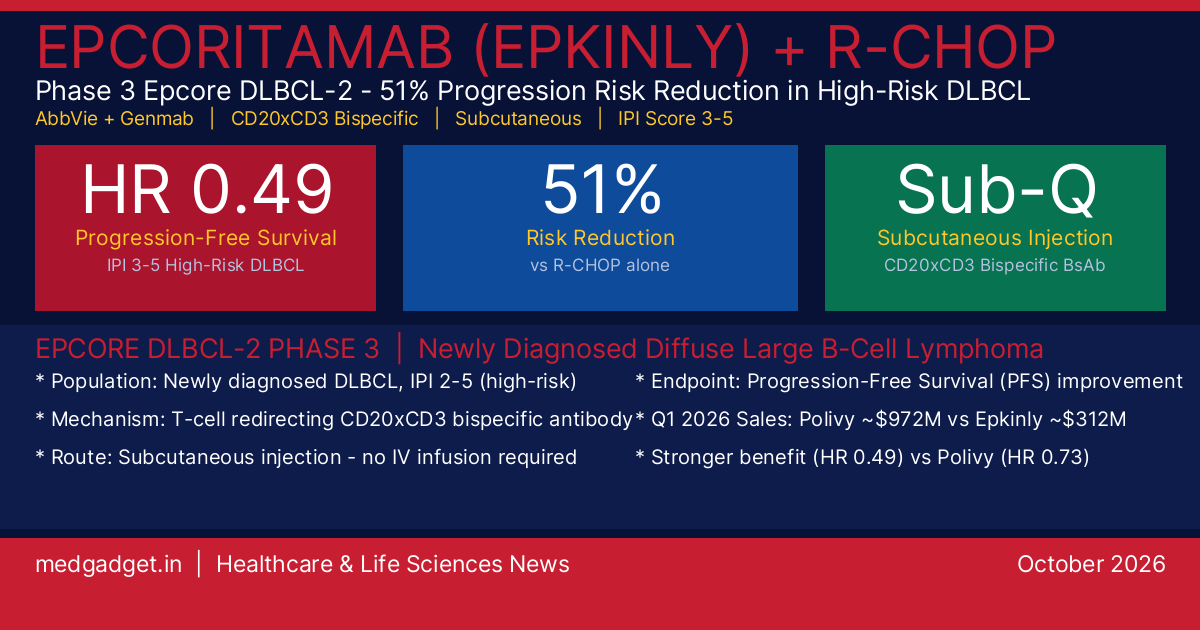
AbbVie and Genmab announced topline results from the Phase 3 Epcore DLBCL-2 trial showing that adding epcoritamab (Epkinly) to standard first-line R-CHOP chemotherapy reduced the risk of disease progression or death by 51 percent compared to R-CHOP alone in newly diagnosed patients with diffuse large B-cell lymphoma. The result, driven by a hazard ratio of 0.49 in the trial’s primary population, positions epcoritamab as a potential new cornerstone of first-line DLBCL treatment and sets up a direct competitive challenge to Roche’s Polivy, the only drug currently approved in this combination-chemotherapy setting.
Understanding DLBCL and Why First-Line Treatment Matters
Diffuse large B-cell lymphoma is the most common type of non-Hodgkin lymphoma, accounting for roughly 30 percent of all lymphoma cases globally. In the United States alone, approximately 18,000 to 20,000 new cases are diagnosed each year. DLBCL is an aggressive malignancy that can progress rapidly if untreated, but it is also potentially curable—approximately 60 to 65 percent of patients treated with R-CHOP achieve long-term remission. The problem is the remaining 35 to 40 percent who relapse or whose disease is refractory to initial treatment. For those patients, outcomes are poor.
Polivy (polatuzumab vedotin), approved in 2023 as part of R-CHP, improved progression-free survival with a hazard ratio of 0.73 versus R-CHOP in the Polarix trial. The Epcore DLBCL-2 data showing a hazard ratio of 0.49—while the trials cannot be directly compared—represents a numerically larger apparent effect and will attract considerable attention from the lymphoma community.
What Is Epcoritamab?
Epcoritamab (brand names Epkinly in the United States and Tepkinly in Europe) is a subcutaneous bispecific antibody developed jointly by Genmab and AbbVie. Bispecific antibodies are engineered to bind two different targets simultaneously: epcoritamab engages CD3 on T cells with one arm and CD20 on B cells with the other. By physically linking a patient’s own T cells to malignant B cells, it redirects cytotoxic immune activity directly at the tumor—a mechanism entirely distinct from conventional chemotherapy or the antibody-drug conjugate approach used by Polivy.
The subcutaneous route of administration is a practical advantage over many cancer biologics that require intravenous infusion. Epcoritamab is currently FDA-approved under accelerated approval for third-line DLBCL based on earlier single-arm data. The Epcore DLBCL-2 trial tests it in the newly diagnosed, first-line setting—a substantially larger patient population and a far more commercially significant indication.
The Epcore DLBCL-2 Trial
Epcore DLBCL-2 is a randomized Phase 3 trial studying epcoritamab added to R-CHOP (rituximab, cyclophosphamide, doxorubicin, vincristine, prednisone) in newly diagnosed DLBCL patients. The primary efficacy population for the reported results is patients with an International Prognostic Index score of 3 to 5, representing intermediate-to-high-risk disease—the patients most in need of treatment intensification beyond standard R-CHOP.
The hazard ratio of 0.49 means that at any given point in time during the study, a patient treated with epcoritamab plus R-CHOP was approximately half as likely to experience disease progression or death compared to a patient receiving R-CHOP alone. The 51 percent risk reduction in the IPI 3–5 population was also observed across the broader IPI 2–5 group, suggesting the benefit is not confined to the highest-risk subset. AbbVie and Genmab described the combination as generally well tolerated, with a safety profile consistent with previously reported data.
Competitive Landscape: Epkinly vs. Polivy
The rivalry between epcoritamab and polatuzumab vedotin in first-line DLBCL will be one of the most closely watched contests in oncology over the next several years. Polivy generated approximately $972 million in global sales in the first half of 2026. Epcoritamab’s approved third-line and later indications generated $312 million in the same period—smaller, but growing rapidly.
It is worth noting that Roche’s own CD20xCD3 bispecific, Columvi (glofitamab), is also approved in later-line DLBCL, but the FDA rejected its second-line combination with GemOx in 2025. That setback leaves polatuzumab vedotin as Roche’s sole approved first-line option—a position epcoritamab is now directly challenging with randomized Phase 3 data.
What Comes Next
AbbVie and Genmab have stated they plan to work with regulatory agencies on next steps following the Epcore DLBCL-2 data. A regulatory submission to the FDA for a first-line DLBCL indication could follow. If approved, epcoritamab would become the first bispecific antibody approved in the first-line DLBCL setting and would compete head-to-head with Polivy across a patient population of tens of thousands annually in the United States alone.
For the lymphoma community, Epcore DLBCL-2 represents the most significant first-line efficacy signal since Polarix, and its clinical implications will be scrutinized in depth once full data are available at a forthcoming scientific congress.
Medical Disclaimer: This article is for informational purposes only and does not constitute medical advice. Patients with lymphoma or other cancers should consult a qualified oncologist or hematologist about their individual treatment options.