

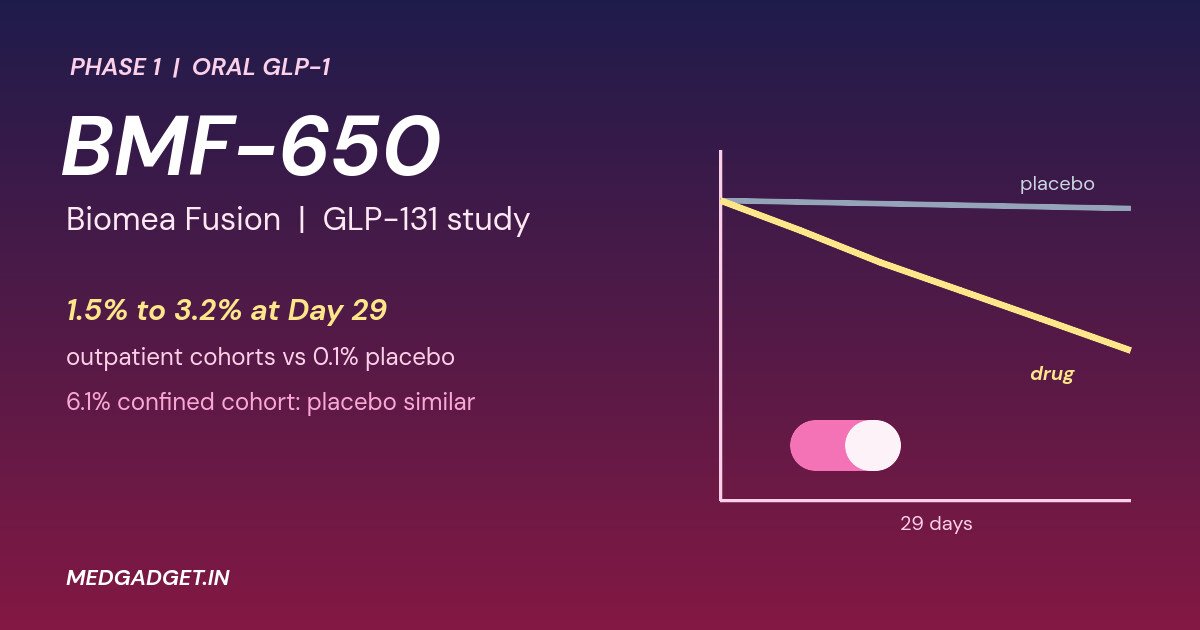
The BMF-650 Phase 1 clinical trial results show an experimental daily pill for weight loss that looks tolerable in a small, short study, with a weight signal that is hard to read. On 13 October 2026, Biomea Fusion reported results from its GLP-131 study of BMF-650, an investigational oral GLP-1 receptor agonist, in adults with overweight or obesity. In four outpatient cohorts, average weight fell 1.5 to 3.2 percent after 29 days, against 0.1 percent for pooled placebo. A fifth cohort showed 6.1 percent, but participants on placebo in that group lost a similar amount.
That last point is the one to hold on to. The 6.1 percent figure comes from eight people on drug and two on placebo, living under confinement, and the company itself says that eating behaviour complicated interpretation. This article explains what was measured, what the safety data show and why the results are preliminary.
Key takeaways
- Outpatient cohorts 1 to 4: mean weight reduction of 1.5 to 3.2 percent at Day 29, versus 0.1 percent for pooled placebo.
- Cohort 5 (confined): 6.1 percent mean reduction, but the two placebo participants lost a similar amount, so the figure cannot be attributed to the drug.
- Among 40 participants on active treatment in the multiple-dose cohorts, no severe or serious adverse events were reported.
- BMF-650 is investigational, not approved, and the company has disclosed no Phase 2 plans.
Design behind the BMF-650 Phase 1 clinical trial results
According to the company, GLP-131 (registered as NCT07223216) is a randomised, double-blind, placebo-controlled Phase 1 study. It began with a single ascending dose part, followed by five multiple ascending dose cohorts, and enrolled otherwise healthy adults with overweight or obesity. Safety and tolerability were the co-primary endpoints. Pharmacokinetics (how the drug moves through the body), pharmacodynamics and weight change were key secondary endpoints.
Cohorts 1 to 4 were outpatient, with once-daily doses from below up to at least 200 mg, assessed at Day 29. The release does not give each cohort’s dose or size. Cohort 5 was confined: 200 mg daily for one week, then 400 mg daily for three weeks, with eight participants on BMF-650 and two on placebo. By our arithmetic, the 40 active participants imply 32 in cohorts 1 to 4, although the release does not state that directly.
As the US Food and Drug Administration explains, Phase 1 studies typically involve 20 to 100 participants and are designed mainly to establish safety and dosage, not to prove efficacy. That framing is important for every number below.
What the BMF-650 Phase 1 clinical trial results show on weight
In the outpatient cohorts, the company reports mean weight reductions of 1.5 to 3.2 percent at Day 29, which it describes as about 0.97 kg per week at doses of 200 mg or more. Pooled placebo participants lost 0.1 percent. No statistical comparison, confidence intervals or individual cohort results were included in the release.
Cohort 5 posted a 6.1 percent mean reduction, about 6.2 kg, or roughly 1.55 kg per week, with no sign of the effect fading during treatment. But the placebo participants in the same cohort lost a similar amount. The company attributes this to low food intake: they ate only about a third of the 2,100 calories per day provided. It says Cohort 5 should be interpreted separately from the outpatient cohorts.
We read this plainly. The confined-cohort number should not be compared with other oral GLP-1 results, and the outpatient range is the more meaningful signal, though still small and short. The company also says BMF-650 was not designed to maximise weight loss relative to other oral GLP-1 drugs.
Safety and tolerability in the BMF-650 Phase 1 clinical trial results
Across all 40 active participants in the multiple-dose cohorts, the company reports that adverse events were mild or moderate, with no severe or serious events and no dose changes or discontinuations linked to adverse events. No increases in liver enzymes (ALT or AST) were reported as adverse events.
Gut-related effects, common with GLP-1 drugs, were reported at these rates across active cohorts: nausea 17.5 percent, vomiting 7.5 percent, constipation 10 percent and diarrhoea 5 percent. By our calculation, those equal 7, 3, 4 and 2 of 40 participants. In Cohort 5, one participant had nausea, one vomiting and two constipation, all mild. Four weeks of dosing cannot reveal longer-term or rarer effects.
What it means for the oral GLP-1 field
The US National Institute of Diabetes and Digestive and Kidney Diseases lists approved weight-loss medicines that mimic gut hormones such as GLP-1 and says adults on medication plus lifestyle programmes lose roughly 3 to 12 percent more of their starting weight after a year than with lifestyle changes alone. BMF-650 is still far from that comparison. For wider context, see our reports on petrelintide’s Phase 2 results in obesity and type 2 diabetes and Novo’s drug-discovery deal for oral cardiometabolic drugs.
Biomea’s stated aim is to remove slow dose titration, which its programme lead said can take five months or more with other GLP-1 drugs. Participants moving from 200 mg to 400 mg after a week reported gut tolerability similar to slower titration, the company says. That claim needs larger, longer testing.
Our assessment of the BMF-650 Phase 1 clinical trial results
In our assessment, the BMF-650 Phase 1 clinical trial results support continuing development but not much more. The safety picture in 40 people over four weeks is encouraging, and the outpatient weight range is modest and plausible. The headline 6.1 percent is not evidence of efficacy because of the matching placebo response. The next questions are the optimal dose, longer-term safety including liver and heart effects, and whether benefits persist beyond a month.
The company says further development needs longer toxicology studies, that it plans to seek a strategic partner, possibly for late-stage development and commercialisation, and that its main focus remains icovamenib in diabetes. It disclosed no Phase 2 timeline.
Risks and caveats of the BMF-650 Phase 1 clinical trial results
- Results come from a company release and have not been peer reviewed.
- Treatment lasted about four weeks in small groups.
- Cohort 5 was confined and its placebo group lost similar weight.
- Doses, cohort sizes and statistics for outpatient cohorts were not fully reported.
What to watch after the BMF-650 Phase 1 clinical trial results
- Full data at a future medical meeting.
- Any no-titration regimen testing.
- Longer toxicology work and a Phase 2 plan.
- A partnership or licensing deal.
Frequently asked questions about the BMF-650 Phase 1 clinical trial results
What is BMF-650?
An investigational once-daily oral GLP-1 receptor agonist developed by Biomea Fusion for obesity and metabolic disease.
What do the BMF-650 Phase 1 clinical trial results say about weight loss?
The company reports 1.5 to 3.2 percent on average in the four outpatient cohorts at Day 29, versus 0.1 percent for placebo. A fifth confined cohort lost 6.1 percent, but placebo participants lost a similar amount.
Do the BMF-650 Phase 1 clinical trial results show it is safe?
In 40 active participants, no severe or serious adverse events were reported, but the study was small and short.
Is BMF-650 approved?
No. It is investigational and not approved by the FDA or any regulator.
How we reported this: we relied on Biomea Fusion’s 13 October 2026 release and US government health information. These are company statements and results are preliminary. Last updated: 14 October 2026. This article is news reporting and not medical or investment advice.