

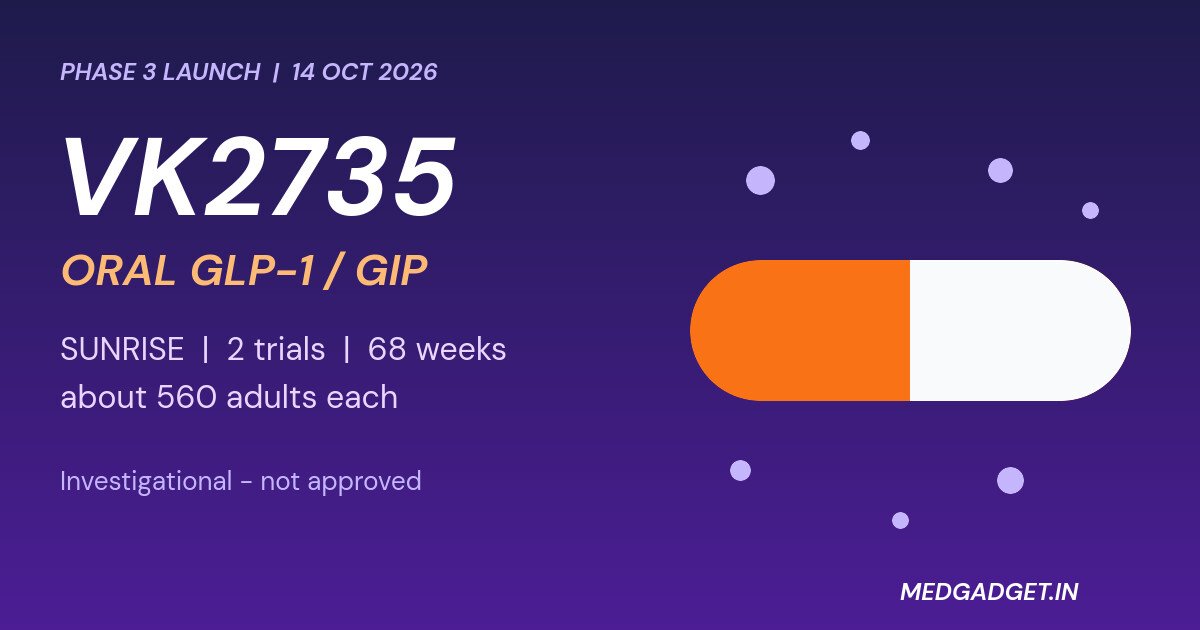
The Viking Therapeutics VK2735 Phase 3 trial programme is under way. On 14 October 2026 the company Viking announced the start of SUNRISE, two Phase 3 studies of once-daily oral VK2735, an investigational drug that activates both the GLP-1 and GIP hormone receptors, in adults with obesity or overweight. Each study aims to enrol about 560 people and treat them for 68 weeks, with the change in body weight against placebo as the main measure.
Launching a Phase 3 programme is a milestone, but it does not show that the drug works or that it will be approved. VK2735 remains investigational, and the oral efficacy data so far come from a 13-week Phase 2 trial. Below we set out the design, what Phase 2 showed, and what could go wrong.
Viking Therapeutics VK2735 Phase 3 trial: key takeaways
- Programme: SUNRISE, two randomised, double-blind, placebo-controlled, multicentre studies of oral VK2735.
- Size and length: about 560 adults each, 68 weeks of treatment.
- Populations: adults with obesity or overweight without type 2 diabetes (SUNRISE-1) and with type 2 diabetes (SUNRISE-2).
- Primary endpoint: percentage change in body weight from baseline versus placebo at 68 weeks.
- Status: investigational, not approved anywhere, and Phase 3 initiation says nothing yet about efficacy.
Inside the Viking Therapeutics VK2735 Phase 3 trial design
According to the company, each SUNRISE study has four arms: once-daily oral VK2735 at 27.5 mg, 35 mg or 55 mg, or placebo. The release does not state the allocation ratio. By our calculation, the two studies together aim to enrol about 1,120 adults.
- SUNRISE-1: adults with obesity (BMI of 30 or more) or overweight (BMI of 27 or more) who do not have type 2 diabetes and have at least one weight-related condition. The registry entry for SUNRISE 1 lists the study.
- SUNRISE-2: adults with type 2 diabetes who are also obese or overweight, listed as SUNRISE 2 in the same registry.
- Primary endpoint (both): percentage change in body weight from baseline, oral VK2735 versus placebo, after 68 weeks.
- Secondary and exploratory measures: further safety and efficacy outcomes, including the share of participants losing at least 5%, 10%, 15% or 20% of body weight.
The release announces initiation but does not say when the first participant was dosed, so we have not reported a start date for dosing. Treatment duration is a clear step up from Phase 2: 68 weeks is more than five times the 13 weeks tested so far.
What the Phase 2 oral data showed before the Viking Therapeutics VK2735 Phase 3 trial
The Phase 2 VENTURE-Oral trial enrolled 280 adults with obesity or overweight and at least one weight-related condition, and tested once-daily tablets of 15, 30, 60, 90 and 120 mg against placebo for 13 weeks. Viking reported dose-dependent weight loss with no plateau at the end of the study.
- 120 mg: mean weight loss of 12.2% versus 1.3% on placebo, a placebo-adjusted difference of 10.9 percentage points.
- 60 mg: 8.7% weight loss; 30 mg: 7.0%, a placebo-adjusted 5.7 points.
- 15 mg: 2.3%, only one point better than placebo, and the release says significant differences from placebo held for doses above 15 mg.
- Tolerability: vomiting affected 26% of VK2735 participants versus 10% on placebo, and 28% of participants on VK2735 stopped treatment early versus 18% on placebo, rising to 38% in the 120 mg group. Viking said 98% of drug-related adverse events were mild or moderate and that stomach and gut effects mostly came early.
One point deserves attention. The SUNRISE doses of 27.5, 35 and 55 mg sit at the lower and middle end of the Phase 2 range, and the closest Phase 2 arms, 30 mg and 60 mg, produced 7.0% and 8.7% mean weight loss over 13 weeks. The reports we reviewed do not say how the Phase 3 doses relate to those tablets, so we do not infer what weight loss SUNRISE will show.
Why the Viking Therapeutics VK2735 Phase 3 trial matters
Obesity is common: the US National Center for Health Statistics reported that 40.3% of US adults aged 20 and over had obesity in August 2021 to August 2023, and 9.4% had severe obesity. Viking’s release notes that marketed drugs in this class include semaglutide, which activates GLP-1, and tirzepatide, which activates GLP-1 and GIP. Viking’s chief executive, Brian Lian, called oral VK2735 the most advanced oral dual GLP-1/GIP agonist in clinical development and said a daily pill could support adherence. That is the company’s description, not an independent finding.
Viking is also running a subcutaneous programme. Its VANQUISH-1 and VANQUISH-2 Phase 3 studies of weekly injections, in about 4,500 and 1,000 adults respectively, are fully enrolled and run for 78 weeks, and an oral maintenance dosing trial is ongoing. For another oral incretin-style programme, see our report on Biomea Fusion’s BMF-650 results, and browse more pharmaceutical news.
Risks and caveats for the Viking Therapeutics VK2735 Phase 3 trial
- Not evidence of efficacy: starting a trial is not a result.
- Short Phase 2: only 13 weeks of oral data, in 280 people, so long-term weight loss and safety are untested.
- Tolerability: early stopping was higher on VK2735 than on placebo in Phase 2.
- Cross-trial comparisons: trials of different drugs differ in design, population and duration, so results should not be compared directly.
- Forward-looking statements: Viking itself warns that prior results may not be replicated.
In our assessment, the 68-week design is the real test. A dose that works at 13 weeks must show it can be taken for more than a year, with acceptable tolerability, before the programme can support an approval filing. The type 2 diabetes study adds a population where weight loss is usually harder to achieve, so SUNRISE-2 is worth watching on its own.
What to watch next after the Viking Therapeutics VK2735 Phase 3 trial launch
- Registry updates showing recruitment status and sites for both SUNRISE studies.
- Any timeline Viking gives for completing enrolment.
- Data from the oral maintenance dosing trial.
- Progress of the 78-week VANQUISH injection studies.
- Any disclosure of how the SUNRISE doses relate to the Phase 2 tablets.
Frequently asked questions
What is the Viking Therapeutics VK2735 Phase 3 trial?
It is the SUNRISE programme: two 68-week, placebo-controlled studies of once-daily oral VK2735, each aiming to enrol about 560 adults with obesity or overweight, one including people with type 2 diabetes.
Does the Viking Therapeutics VK2735 Phase 3 trial show that VK2735 works?
No. The trial has only been initiated. Efficacy and safety will be known only when results are reported.
What is VK2735?
An investigational drug that activates the GLP-1 and GIP receptors. Viking is developing oral and subcutaneous forms for obesity and other metabolic conditions.
Is oral VK2735 approved?
No. It has not been approved by any regulator.
How is the Viking Therapeutics VK2735 Phase 3 trial different from VANQUISH?
SUNRISE tests the daily oral tablet for 68 weeks. VANQUISH tests a weekly injection for 78 weeks.
How we reported this: we relied on Viking Therapeutics’ announcement of 14 October 2026, its earlier Phase 2 results release, the ClinicalTrials.gov listings and US National Center for Health Statistics data. Figures labelled as ours are our own calculations. Last updated: 14 October 2026. This article is news reporting and not medical or investment advice.