

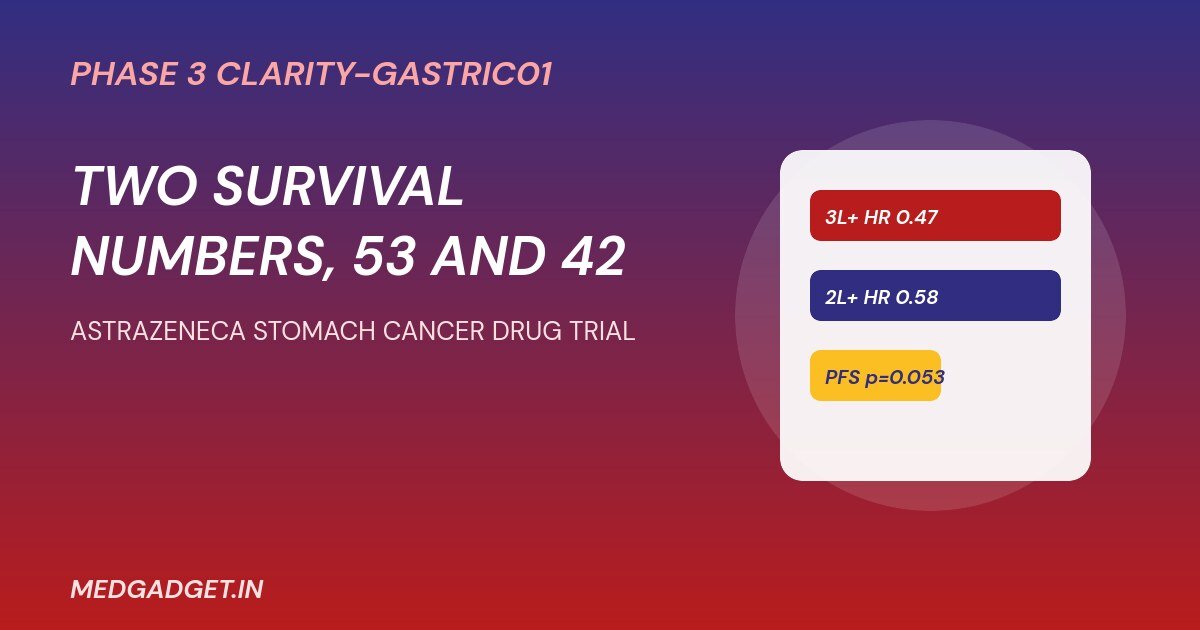
The AstraZeneca stomach cancer drug trial reported that sonesitatug vedotin (Sone-Ve), an experimental claudin 18.2 antibody-drug conjugate, cut the risk of death by 53% in patients treated in the third line or later, with median overall survival of 10.0 months versus 5.0 months for physician-selected therapy. In the wider group of patients treated from the second line onward, the reduction was 42%. Progression-free survival did not reach statistical significance. The data were presented at the ESMO 2026 congress on 25 October, and the drug is investigational.
Key takeaways from the AstraZeneca stomach cancer drug trial
- Third line and later: 10.0 versus 5.0 months median survival, hazard ratio 0.47, a 53% lower risk of death.
- Second line and later (the overall trial population): 10.6 versus 6.4 months, hazard ratio 0.58, a 42% lower risk of death.
- Progression-free survival by independent review in the overall population was 4.2 versus 3.8 months (hazard ratio 0.77, p=0.053), not statistically significant.
- Grade 3 or higher treatment-related adverse events were 36.4% versus 44.8%.
- The company has not announced a filing date, and no response-rate figure was reported in the material we read.
Correcting the numbers in the AstraZeneca stomach cancer drug trial brief
The brief described 532 patients who had received at least two prior treatments, with 10 months versus 5 months survival and a 53% reduction in risk of death. Those figures come from two different groups. The 532 patients (267 on Sone-Ve and 265 on comparator) are the second-line-and-later population, in which the results were 10.6 versus 6.4 months and a 42% reduction. The 10-versus-5-month result and the 53% reduction apply to the third-line-and-later subgroup of 355 patients (178 versus 177), a number we calculate by adding the two arms. We report each result against its own population.
Trial design of the AstraZeneca stomach cancer drug trial
CLARITY-Gastric01 (NCT06346392) is a global, randomised, open-label, sponsor-blinded Phase 3 trial run at 175 centres in 19 countries. Patients had locally advanced or metastatic adenocarcinoma of the stomach, the gastroesophageal junction or the oesophagus, with claudin 18.2 expression in at least 25% of tumour cells. The registry entry is on ClinicalTrials.gov. The comparator was investigator’s choice of therapy, which includes regionally accepted chemotherapies or targeted drugs.
The dual primary endpoints were overall survival in the third-line-and-later group and progression-free survival by blinded independent review in the overall population. Overall survival in the second-line-and-later group was a key secondary endpoint. Data were cut off on 31 May 2026.
Survival results in the AstraZeneca stomach cancer drug trial
- Third line and later: median 10.0 months (95% CI 7.2 to 11.4) versus 5.0 months (95% CI 4.2 to 6.4); 12-month survival 38.1% versus 18.1%; 85 versus 122 deaths.
- Second line and later: median 10.6 months (95% CI 9.1 to 12.0) versus 6.4 months (95% CI 5.8 to 7.6); 12-month survival 42.6% versus 27.8%; 139 versus 174 deaths.
- Subgroups by claudin 18.2 level: hazard ratio 0.59 where 75% or more of cells were positive and 0.63 where 25% to under 75% were positive.
By our own subtraction, the median survival gain is 5.0 months in the third-line group and 4.2 months in the second-line group.
Why progression-free survival missed in the AstraZeneca stomach cancer drug trial
Median progression-free survival by independent review was 4.2 months versus 3.8 months, a hazard ratio of 0.77 (95% CI 0.62 to 0.96) with a p-value of 0.053, just above the conventional 0.05 threshold. Investigator-assessed progression-free survival was 4.4 versus 3.0 months (hazard ratio 0.59), but that analysis was exploratory. The company describes a trend toward improvement. The result means one of the two primary endpoints was not met on its own terms, and the survival results should be read with that in mind.
Safety in the AstraZeneca stomach cancer drug trial
Grade 3 or higher treatment-related adverse events occurred in 36.4% of patients on Sone-Ve and 44.8% on comparator therapy. The company reports no new safety signals and describes the drug as well tolerated, but the sources we read give no detail on specific side effects. Sone-Ve uses the cytotoxic payload monomethyl auristatin E with a protease-degradable linker.
Timeline of the AstraZeneca stomach cancer drug trial
- March 2023: AstraZeneca takes a global exclusive licence from KYM Biosciences.
- 31 May 2026: data cutoff.
- 25 October 2026: topline announcement and ESMO Presidential Symposium presentation (LBA7).
Market context for the AstraZeneca stomach cancer drug trial
Acumen Research and Consulting’s report Antibody Drug Conjugate Market Size, Share, Analysis, Trends and Forecast 2024 to 2032 values the global antibody-drug conjugate market at USD 10.3 billion in 2023 and projects USD 30.9 billion by 2032, a CAGR of 13.2% from 2024 to 2032. The page’s updated date is inconsistent with its forecast period, so treat the figures as estimates. See more in our Pharmaceutical coverage.
General background: claudin 18.2 and stomach cancer
According to AstraZeneca, fewer than 20% of patients with advanced gastric or junction cancer survive beyond a year, and about 60% of these cancers express claudin 18.2 in at least a quarter of tumour cells. A drug that targets the protein could help a large share of patients, if testing identifies them. Another company, Takeda, reported positive Phase 3 data for a different claudin 18.2 conjugate in Japan and China days earlier; see our report on that trial.
Our analysis: a real survival signal with a soft endpoint
In our assessment, the AstraZeneca stomach cancer drug trial is persuasive on survival and less convincing on progression. A hazard ratio of 0.58 in the second-line-and-later population is a large effect, and the third-line result is larger still. But a progression-free survival p-value of 0.053 means the trial did not meet one of its two primary endpoints, and the open-label design is a caution for any measure involving investigator judgement. Regulators will weigh the consistency of the survival result.
A researcher quoted by the company said Sone-Ve is the first claudin 18.2-targeted conjugate to show a survival benefit in this setting. That is a statement from the investigator and the company, and a rival has reported similar survival data in another population.
What is not disclosed
- Response rate and duration of response.
- Rates of specific side effects, such as eye or nerve effects often seen with this class.
- Regulatory filing dates.
- The comparator drugs actually received.
Risks and caveats of the AstraZeneca stomach cancer drug trial
The drug is investigational and not approved. The figures come from the company announcement as reported, and we have not reviewed a peer-reviewed paper. The progression-free survival endpoint missed statistical significance. Acumen figures are market estimates. This article is news reporting and not medical advice.
What to watch next after the AstraZeneca stomach cancer drug trial
- Regulatory submissions to the FDA, the European Medicines Agency and Chinese authorities.
- Publication of the full data and detailed safety.
- Final survival analyses.
- Trials in earlier lines of treatment.
FAQ
What did the AstraZeneca stomach cancer drug trial show?
A 53% lower risk of death in third-line-and-later patients and 42% in the second-line-and-later population, with progression-free survival not statistically significant.
Is sonesitatug vedotin approved?
No. It is investigational.
How many patients were in the trial?
532 in the second-line-and-later analysis, of whom 355 were in the third-line-and-later group.
How we reported this: we relied on the AstraZeneca announcement and ESMO presentation as reported, the trial registry and the Acumen Research and Consulting report cited above, and attributed every claim. Last updated 26 October 2026. This is news reporting and not advice.