

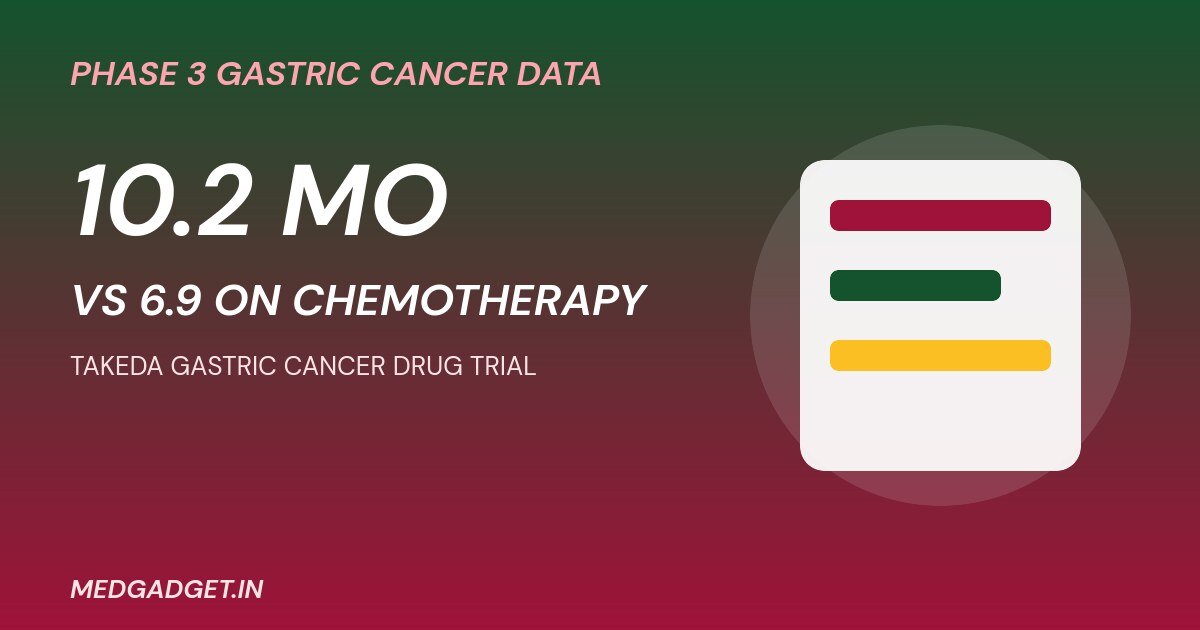
The Takeda gastric cancer drug trial reported that arcotatug tavatecan (TAK-921), an experimental antibody-drug conjugate, extended median overall survival to 10.2 months compared with 6.9 months for physician-selected chemotherapy in 464 patients with previously treated advanced gastric or gastroesophageal junction cancer. Takeda announced the Phase 3 G-HOPE-001 results on 23 October 2026, and they were presented as a late-breaking oral at the ESMO 2026 congress. The drug is investigational and is not approved by any regulator.
Key takeaways from the Takeda gastric cancer drug trial
- Median overall survival was 10.2 months versus 6.9 months (hazard ratio 0.57, 95% confidence interval 0.45 to 0.73).
- Median progression-free survival by independent review was 7.1 months versus 3.1 months (hazard ratio 0.45).
- Confirmed response rate was 37.4% versus 7.7%.
- Grade 3 or higher treatment-related adverse events were 47.4% with the drug versus 55.9% with chemotherapy, and one treatment-related death of unknown cause was reported.
- Takeda plans a regulatory filing in Japan; the source we read gave no date for it.
Who was studied in the Takeda gastric cancer drug trial
G-HOPE-001 (NCT06238843) is an international, multicentre, randomised, open-label Phase 3 trial run in Japan and China. It enrolled 464 adults with unresectable, locally advanced or metastatic gastric or gastroesophageal junction adenocarcinoma that was positive for claudin 18.2 and who had already progressed on two to four earlier systemic treatments. Claudin 18.2 positivity was defined as staining of 2+ or higher in at least 75% of tumour cells. The registry entry is on ClinicalTrials.gov.
Patients were randomised one to one. One group received arcotatug tavatecan 6 mg/kg every three weeks. The other received treatment of the physician’s choice: irinotecan, paclitaxel or trifluridine/tipiracil. According to a trade report, 92.2% of the chemotherapy group received irinotecan.
Survival and response in the Takeda gastric cancer drug trial
- Overall survival at the second interim analysis (data cutoff 3 September 2026): 10.2 months versus 6.9 months, a difference of 3.3 months by our own subtraction.
- Progression-free survival by independent review committee: 7.1 months versus 3.1 months, a 4.0-month difference by our subtraction.
- Confirmed objective response rate: 37.4% versus 7.7%.
- At the first interim analysis (cutoff 13 February 2026), median progression-free survival was 5.5 months versus 2.9 months (hazard ratio 0.47).
Overall survival and progression-free survival were the dual primary endpoints, and the company says both were met. Because the analyses were interim, final figures may differ.
Safety: what the brief got wrong and what the data show
Early coverage described serious side effects in about 47% of patients. The company release actually reports that 47.4% of patients on the drug had grade 3 or higher treatment-related adverse events, which is a measure of severity and not the same as serious adverse events, and the figure was lower than the 55.9% on chemotherapy. We therefore report the severity figure as stated.
Anaemia of grade 3 or higher was more common with the drug (20.4% versus 13.1%), while low neutrophil counts (17.4% versus 32.0%), low white cell counts (11.7% versus 22.5%) and diarrhoea (1.3% versus 4.1%) were less common. Dose reductions occurred in 17.8% versus 35.1%. One treatment-related death, described as a sudden death of unknown cause, occurred in the drug arm, which is about 0.4% of those patients.
Timeline of the Takeda gastric cancer drug trial
- 13 February 2026: first interim analysis of progression-free survival.
- 3 September 2026: data cutoff for the second interim analysis of survival.
- 23 October 2026: Takeda announces the results.
- ESMO 2026: late-breaking oral presentation of the data.
The drug and partnership behind the Takeda gastric cancer drug trial
Arcotatug tavatecan is also known as IBI343 and was developed with Innovent. Takeda holds rights outside greater China, and Innovent’s application in China has been accepted with priority review. Takeda plans global Phase 3 trials in gastric and pancreatic cancer, and the US FDA has granted Fast Track designation for claudin 18.2-positive pancreatic cancer after two prior therapies. Company details are at takeda.com.
Market context for the Takeda gastric cancer drug trial
Acumen Research and Consulting’s report Cancer Therapeutics Market Size, Share, Analysis, Trends and Forecast 2025 to 2033 values the global cancer therapeutics market at USD 193.7 billion in 2024 and projects USD 381.5 billion by 2033, a CAGR of 7.9% from 2025 to 2033. The page carries an inconsistent updated date, so we treat the figures as estimates, and they are not specific to gastric cancer. See more in our Pharmaceutical coverage.
General background: why claudin 18.2 matters
Claudin 18.2 is a protein found on the surface of some gastric and gastroesophageal junction tumour cells. An antibody-drug conjugate pairs an antibody that finds the protein with a chemotherapy payload, so the toxic drug is delivered to the tumour. Patients with gastric cancer whose disease has progressed after several treatments have limited options, and chemotherapy typically offers survival of a few months.
Our analysis: a clear signal in a narrow population
In our assessment, the Takeda gastric cancer drug trial shows a convincing benefit on all three efficacy measures against chemotherapy in people with claudin 18.2-positive disease. A hazard ratio of 0.57 for survival is substantial in a late-line setting. The limits are the trial’s location, the open-label design and the interim analysis. Results from Japan and China may not translate directly to Western patients, who differ in disease characteristics and prior care, and the sources do not say.
The subgroup without prior immunotherapy showed no survival benefit (hazard ratio 1.17), but it included only 26 patients per arm, so we do not draw a conclusion from it.
What is not disclosed about the Takeda gastric cancer drug trial
- The timing of the Japan filing, which the sources we read do not give.
- Final overall survival results.
- Details of the treatment-related death.
- Pricing and any plan for filings outside Japan and China.
Risks and caveats of the Takeda gastric cancer drug trial
The investigational drug is not approved, and the figures come from the company and a congress presentation as reported. The trial was open-label. Acumen figures are broad market estimates. This article is news reporting and not medical advice; patients should speak to their oncologist.
What to watch next after the Takeda gastric cancer drug trial
- Takeda’s Japan regulatory filing and any approval decision in China.
- Final survival data.
- Global Phase 3 trials in gastric and pancreatic cancer.
- Safety updates with longer follow-up.
FAQ
What did the Takeda gastric cancer drug trial find?
Median survival of 10.2 months with arcotatug tavatecan versus 6.9 months with chemotherapy.
Is arcotatug tavatecan approved?
No. It is investigational.
Where was the trial run?
In Japan and China, according to the company.
How we reported this: we relied on the Takeda announcement, the congress presentation as reported, the trial registry and the Acumen Research and Consulting report cited above, and attributed every claim. Last updated 26 October 2026. This is news reporting and not advice.
[…] Stomach Cancer Drug Trial: 53% Lower Death Risk, But PFS Misses Takeda Gastric Cancer Drug Trial: Survival Reaches 10.2 Months Roche Divarasib Phase 3 Trial: 44% Lower Risk of Death in Lung Cancer Bepirovirsen Market: Size, […]