

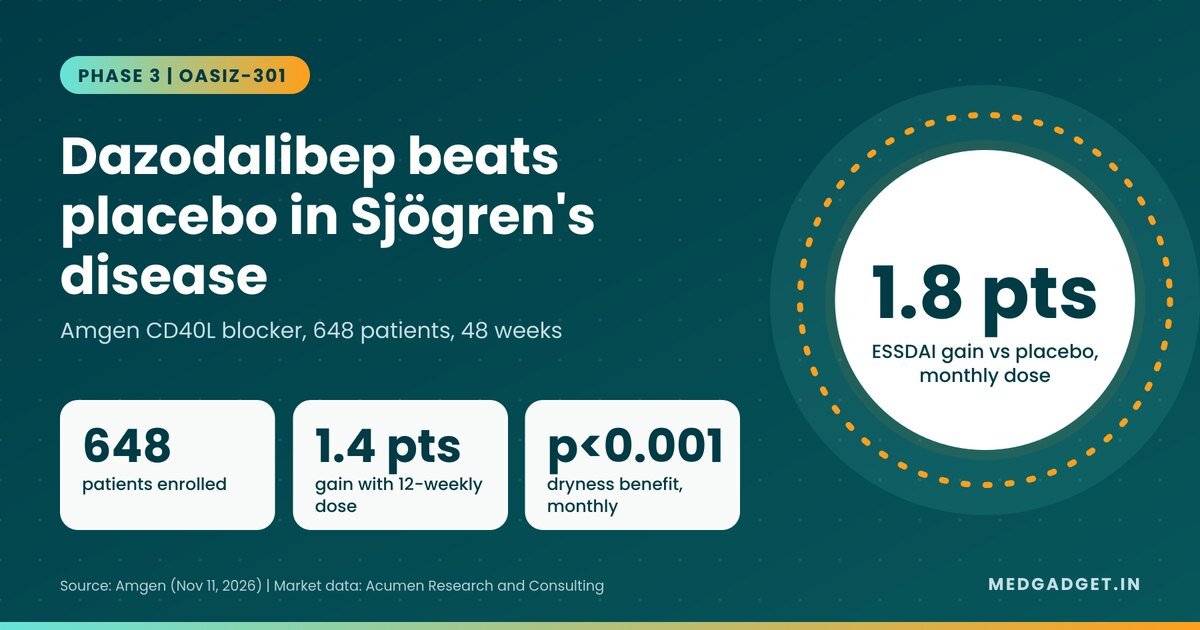
Amgen’s dazodalibep Sjögren’s disease program now has full numbers behind it: on November 11, 2026, the company detailed the Phase 3 OASIZ-301 trial, in which both dosing regimens of the CD40 ligand blocker reduced systemic disease activity more than placebo over 48 weeks in 648 adults with moderate-to-severe Sjögren’s. The monthly 1,500 mg dose cut the ESSDAI score by 5.6 points against 3.8 on placebo (p<0.001), and it also eased patient-reported dryness. The data are slated for a late-breaking session at ACR Convergence 2026.
Key takeaways on dazodalibep Sjögren’s disease data
- OASIZ-301 met its primary endpoint, change in ESSDAI at Week 48, on both regimens: 1,500 mg every 4 weeks and 3,000 mg every 12 weeks.
- The placebo-adjusted gap was 1.8 points for monthly dosing and 1.4 points for quarterly dosing.
- Only the monthly regimen showed statistically significant dryness benefits on ESSPRI and DASPRI scales.
- Infusion reactions, nasopharyngitis, urinary tract infection and hypertension were the main side effects; serious events were balanced across arms.
- No therapy is approved specifically for Sjögren’s; Amgen has not given a filing date.
Inside the OASIZ-301 trial
OASIZ-301 was a randomized, double-blind, placebo-controlled study that enrolled patients with an ESSDAI of at least 5, meaning measurable involvement beyond dry eyes and mouth, such as joint, gland, skin or blood abnormalities. The mean baseline ESSDAI was 10.2. Patients were split into three arms: 217 on dazodalibep 1,500 mg every four weeks, 217 on 3,000 mg every 12 weeks, and roughly 214 on placebo (by our calculation, from the 648 total). The ESSDAI is a physician-scored index across 12 organ domains, and it is the standard primary endpoint regulators have accepted in recent Sjögren’s trials.
| Arm (48 weeks) | ESSDAI change | Gap vs placebo | Adjusted p-value |
|---|---|---|---|
| Dazodalibep 1,500 mg every 4 weeks | -5.6 | 1.8 points | <0.001 |
| Dazodalibep 3,000 mg every 12 weeks | -5.2 | 1.4 points | 0.010 |
| Placebo | -3.8 | n/a | n/a |
Amgen says separation from placebo appeared as early as Week 4 and held through Week 48. More patients on dazodalibep reached ESSDAI reductions of at least 3, 5 and 7 points, and more met STAR composite response criteria, but the company did not publish p-values for these supportive analyses, so they should be read as directional until the full presentation.
Dryness: the symptom patients care about most
For many people with Sjögren’s, the daily burden is dryness, fatigue and pain rather than the organ findings the ESSDAI captures. That gap between physician scores and lived experience has tripped up earlier drug candidates. Here, the monthly regimen improved the dryness domain of the ESSPRI questionnaire by 1.17 points versus placebo and the dryness domain of the newer DASPRI scale by 0.93 points, both with adjusted p<0.001. Amgen reports that total ESSPRI scores improved by more than 1.5 points on both doses, and stimulated saliva flow increased versus placebo. The quarterly regimen did not show the same statistically confirmed dryness benefit, which may matter when doctors weigh convenience against symptom relief.
How dazodalibep works
Dazodalibep is a fusion protein that blocks CD40 ligand, a signal on activated T cells that switches on B cells through the CD40 receptor. In Sjögren’s, that conversation drives autoantibody production and the immune infiltrates that damage salivary and tear glands. Earlier attempts to block CD40L with antibodies ran into blood clotting problems linked to the antibody’s Fc region. Dazodalibep is built without that region, and in OASIZ-301 Amgen reports no imbalance in thromboembolic events, a point specialists will scrutinize closely in the full data. No excess in opportunistic infections was seen, and malignancy rates were low and similar across arms.
Why this readout stands out in a crowded field
Sjögren’s has become a busy target, but it has also produced high-profile failures. Earlier this year argenx halted its Phase 3 UNITY study of efgartigimod in Sjögren’s for futility, a reminder that a plausible mechanism does not guarantee separation from placebo. OASIZ-301 is notable because the placebo arm improved substantially, by 3.8 ESSDAI points, and dazodalibep still beat it on both regimens. Critics will note that a 1.4 to 1.8 point difference on a scale where a 3-point drop is often used as the minimum meaningful change is modest; supporters will point to the early onset, the dryness data and the absence of a clotting signal.
For India, where Sjögren’s is underdiagnosed and often managed with hydroxychloroquine, steroids and symptomatic eye drops, a targeted biologic would likely arrive years after any US approval and at a price that limits use to specialist centres. Indian patients are not identified among trial sites in the materials Amgen has released.
Market context
Sjögren’s sits within the broader autoimmune therapeutics market. Acumen Research and Consulting projected that market to reach around USD 155 billion by 2027, growing at about 4% a year, with North America holding the largest share. That report dates from 2020, so the figures are indicative only, but they illustrate why large companies are pursuing autoimmune conditions with no approved targeted options.
Next steps to watch
- The late-breaking presentation (LB22) at ACR Convergence 2026 by Dr. Ghaith Noaiseh of the University of Kansas Medical Center, with fuller safety tables.
- OASIZ-303, the sister Phase 3 trial in patients with high symptom burden but low systemic activity, which will test the dryness and fatigue story directly.
- The OASIZ-304 open-label extension for longer-term safety.
- Any regulatory submission timeline from Amgen, which has not yet been disclosed.
FAQ
What is dazodalibep?
It is an investigational Amgen fusion protein that blocks CD40 ligand, aiming to calm the T cell and B cell activity that drives Sjögren’s disease. It is given by infusion.
Did dazodalibep work in Phase 3 for Sjögren’s?
Yes. In OASIZ-301 both doses beat placebo on the ESSDAI at 48 weeks, by 1.8 points (monthly) and 1.4 points (every 12 weeks).
Is there an approved drug for Sjögren’s disease?
There is no therapy approved specifically to treat Sjögren’s disease itself; current care focuses on symptoms and off-label immunosuppressants.
When could dazodalibep be approved?
Amgen has not announced a filing date. Results from OASIZ-303 and regulator feedback will shape the timing.
Follow more trial readouts in our Clinical Trials section.
Sources: Amgen press release (November 11, 2026) on OASIZ-301 results; Amgen topline release (September 2026). Market data: Acumen Research and Consulting, Autoimmune Disease Therapeutics Market report (2020, indicative). Data are from company releases and have not been peer reviewed. Not medical or investment advice. Last updated: November 11, 2026.