

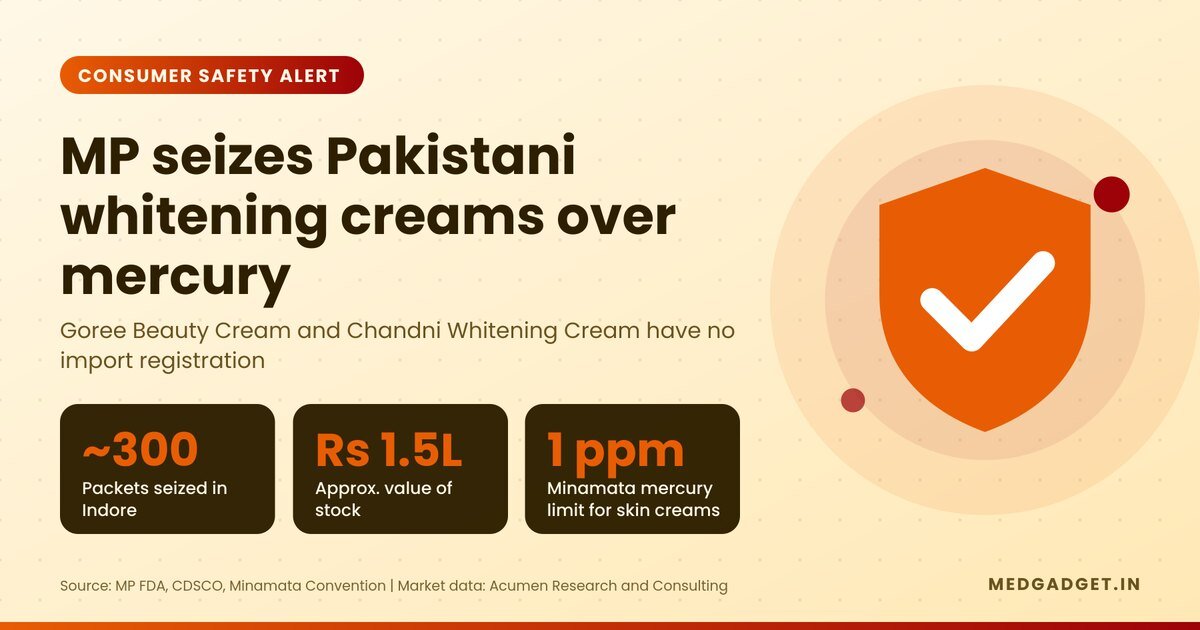
The Goree Beauty Cream ban has moved from paper to enforcement in Madhya Pradesh. In a public notice dated 14 November 2026, the state’s Food and Drug Administration told people to stop buying and using two Pakistan-made skin whitening products, Goree (also sold as Gori) Beauty Cream and Chandni Whitening Cream, after drug officials in Indore seized roughly 300 packets worth about Rs 1.5 lakh. Both creams were first flagged by the Central Drugs Standard Control Organisation (CDSCO) on 8 September for heavy metals, mainly mercury, above permitted limits, and neither has ever been registered for import into India.
Key takeaways on Goree Beauty Cream ban
- CDSCO’s Cosmetics Division issued a national public health alert on 8 September 2026 naming Goree Beauty Cream and Chandni Whitening Cream.
- Testing found heavy metals beyond specified limits; state officials say the main concern is mercury.
- Neither product holds an import registration certificate, so any sale in India is unauthorised.
- Indore officials seized about 300 packets of Goree Beauty Cream from one distributor, plus a few packets from a retail beauty store.
- Consumers are told to stop using the creams immediately, including look-alike products with similar names.
What the Madhya Pradesh FDA found in Indore
According to the state notice, reported by Medical Dialogues on 22 November, Indore drug officials found the bulk of the stock at a distributor, Padmashree Agency, and a smaller quantity at a retail outlet in the Ranipura area. The seizure matters because it shows the products were not only appearing in isolated shops but moving through a distribution chain more than two months after the national alert.
The Controller’s office has asked anyone who sees these creams on sale to report it to the district drug inspector or the state FDA. It also warned that prolonged exposure to the heavy metals involved can harm the kidneys and nervous system, which is consistent with what international health agencies say about mercury in skin products.
How the alert unfolded: a timeline
| Date (2026) | Event | Authority / source |
|---|---|---|
| 8 September | Public health alert names Goree Beauty Cream and Chandni Whitening Cream for excess heavy metals and no import registration | CDSCO Cosmetics Division |
| 15-16 September | Alert widely reported; consumers told not to buy or use the creams | National media |
| 21 September | Creams reported on open sale in several Ahmedabad markets despite the warning | Local media in Gujarat |
| 14 November | Madhya Pradesh FDA public notice after Indore seizures | MP FDA, Controller’s office |
| 22 November | Seizure details published: about 300 packets, roughly Rs 1.5 lakh | Medical Dialogues |
The gap between the September alert and the November seizures is the most telling part of this story. National alerts depend on state drug control departments to inspect markets, and these products tend to travel through informal channels, small cosmetics wholesalers and online sellers rather than pharmacies.
Why mercury turns up in skin whitening creams
Mercury compounds lighten skin by interfering with melanin production; dermatologists explain that they inhibit tyrosinase, the enzyme that drives pigment formation. The effect can look fast and dramatic, which is why such products sell despite the danger. The trade-off is that mercury is absorbed through the skin and can accumulate in the body.
The World Health Organization lists kidney damage, skin rashes, discolouration and scarring, lowered resistance to infection, and nervous system effects such as anxiety, depression and numbness among the harms linked to mercury in skin lightening products. Pregnant and breastfeeding women face extra risk because mercury can reach the baby. Household members, including children, can also be exposed through contact with the cream or contaminated towels and surfaces.
Globally, the Minamata Convention on Mercury, which India has ratified, required parties to stop the manufacture, import and export of skin lightening cosmetics containing more than 1 part per million of mercury from 2020. Indian cosmetics rules likewise bar mercury compounds in cosmetics, apart from tightly limited preservative use in eye-area products. A whitening cream that relies on mercury for its effect would be expected to contain far more than trace levels.
How to check whether a cream is legal in India
Under the Drugs and Cosmetics Act, 1940 and the Cosmetics Rules, 2020, cosmetics made in India need a licence from the State Licensing Authority, and imported cosmetics must be registered with the Central Licensing Authority, which is CDSCO. Before buying any whitening or fairness product, especially from a roadside stall, social media seller or small wholesaler, check that the pack shows:
- The manufacturer’s name and full address.
- A manufacturing licence number (for Indian products) or an import registration number (for imported products).
- A batch number, manufacturing date and expiry date.
- A full ingredient list. Words such as mercurous chloride, calomel, mercuric, mercurio or mercury are red flags.
Missing details, labels only in a foreign script, or a promise of very fast whitening are warning signs in themselves. If you have used either named cream, stop, wash the skin, keep the product away from children, and tell a doctor about any rash, tingling, tremor, mood change or swelling. A doctor can order blood or urine mercury tests if needed. Do not try home remedies to remove mercury.
Market context: why fake fairness products keep finding buyers
Demand for skin care products is huge and still growing, which gives unregistered sellers room to operate. According to Acumen Research and Consulting, the global cosmetic skin care market was worth USD 148.2 billion in 2022 and is projected to reach USD 243.7 billion by 2032, a compound annual growth rate of 5.2%. Acumen reports that Asia-Pacific held the largest share of the market in 2022, and that face creams and moisturisers were the biggest product segment.
By our calculation, that forecast implies roughly USD 95 billion of extra annual sales over the decade. Most of that growth goes to licensed brands, but high demand for quick whitening results in South Asia keeps a grey market alive, and enforcement has to keep pace. For more on how India is tightening oversight of what reaches shelves, see our reports on the draft GSDP rules for drug storage and distribution and the proposed bulk drug wholesale licence.
What is still unclear
Neither CDSCO nor the state has published the measured mercury concentrations, so it is not possible to say how far above the limit the samples were. Officials have also not said how the creams entered India, whether other states have made seizures, or whether criminal prosecution will follow under the Drugs and Cosmetics Act. We will update this article if regulators release lab values or further enforcement figures.
FAQ
Is Goree Beauty Cream banned in India?
It has no import registration, so it cannot be legally sold in India. CDSCO issued a public health alert against it on 8 September 2026, and Madhya Pradesh has seized stock and told consumers to stop using it.
Does Chandni Whitening Cream contain mercury?
Testing found heavy metals above permitted limits, and the Madhya Pradesh FDA says mercury is the main concern. Exact concentrations have not been released.
What are the symptoms of mercury poisoning from cream?
Reported effects include skin rashes and discolouration, swelling linked to kidney damage, tingling or numbness, tremor, irritability, anxiety and memory problems. Anyone with symptoms after using such creams should see a doctor.
How do I report illegal cosmetics in India?
Contact your district drug inspector or the state drug control department. In Madhya Pradesh, the state FDA has asked people to report sales of these creams directly to its Controller’s office.
Sources: Madhya Pradesh FDA public notice (14 November 2026) as reported by Medical Dialogues; CDSCO public health alert (8 September 2026); WHO guidance on mercury in skin lightening products; Minamata Convention on Mercury. Market data: Acumen Research and Consulting. More in Healthcare Services. This article is for information only and is not medical advice. Last updated 22 November 2026.