

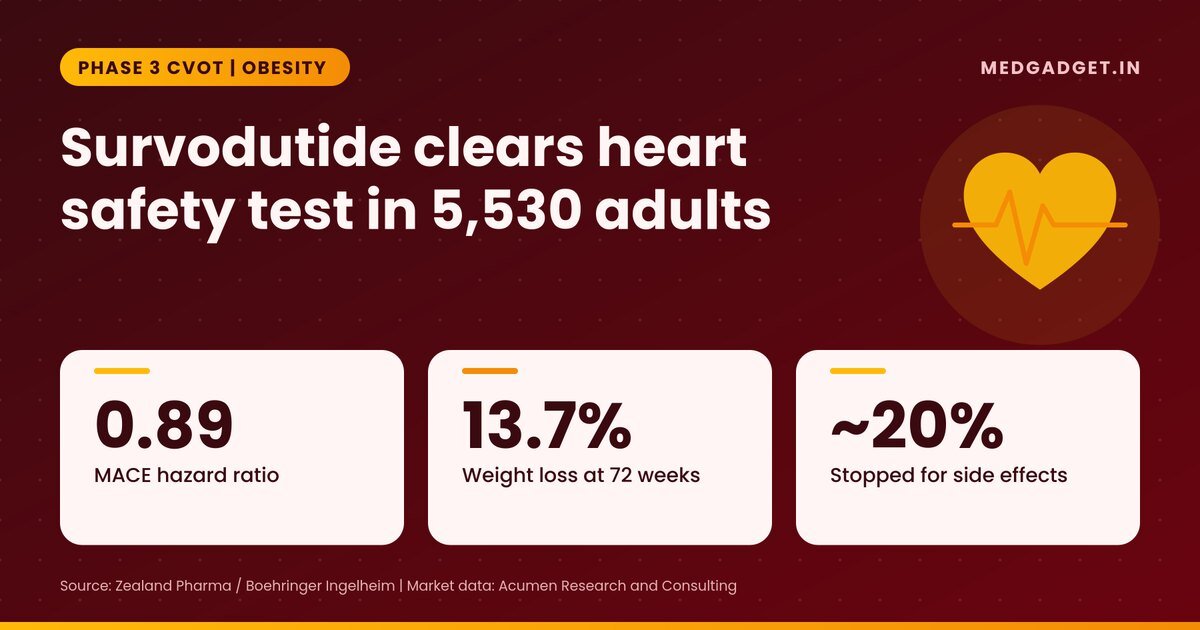
Survodutide cardiovascular safety has been established in the Phase 3 SYNCHRONIZE-CVOT trial: Boehringer Ingelheim and Zealand Pharma reported on November 9, 2026 that the weekly glucagon/GLP-1 dual agonist did not increase major cardiovascular events versus placebo in 5,530 adults with overweight or obesity (hazard ratio 0.89). The results, presented at the American Heart Association Scientific Sessions and published in The Lancet, clear a key regulatory hurdle, but roughly one in five patients on survodutide stopped treatment because of side effects.
Key takeaways on survodutide cardiovascular safety
- Major adverse cardiovascular events occurred in 3.7% of survodutide patients versus 4.1% on placebo (HR 0.89; 95% CI 0.67 to 1.18).
- The trial met its non-inferiority margin of 1.65, meaning no excess heart risk, but did not show the drug lowers cardiovascular events.
- Weight loss averaged 13.7% at 72 weeks versus 2.0% on placebo, in an analysis assuming continued treatment.
- Discontinuation for adverse events was 19.3% (3.6 mg) and 20.8% (6.0 mg) versus 1.9% on placebo, driven by nausea and vomiting.
- Survodutide is the first glucagon/GLP-1 dual agonist to complete a cardiovascular safety study; Boehringer is preparing obesity filings, reportedly targeting 2027.
Why a cardiovascular outcomes trial was required
Glucagon receptor activation can raise heart rate and has metabolic effects that regulators want to understand before a drug is used long term by millions of people. SYNCHRONIZE-CVOT (NCT06077864) was built to rule out unacceptable cardiovascular harm. It enrolled adults with overweight or obesity who also had established cardiovascular disease, chronic kidney disease, or at least two weight-related risk factors, a population at meaningful risk of heart attack and stroke. Patients were randomised to weekly survodutide at 3.6 mg or 6.0 mg, or to placebo.
The primary endpoint was time to first major event, a composite including heart attack, stroke, cardiovascular death and heart failure events. No new arrhythmia signal was reported, which addresses one of the theoretical concerns with glucagon agonism.
SYNCHRONIZE-CVOT results at a glance
| Outcome | Survodutide | Placebo |
|---|---|---|
| Patients dosed | 3,671 | 1,836 |
| Major cardiovascular events | 136 (3.7%) | 76 (4.1%) |
| Hazard ratio (95% CI) | 0.89 (0.67 to 1.18); non-inferiority margin 1.65 | |
| Weight change at 72 weeks* | -13.7% | -2.0% |
| Stopped due to adverse events | 19.3% (3.6 mg) / 20.8% (6.0 mg) | 1.9% |
| Nausea | 48% to 49% | 12.1% |
| Vomiting | 31.7% to 34% | 4.8% |
By our calculation, the absolute difference in event rates was about 0.4 percentage points in survodutide’s favour. Because the confidence interval crosses 1.0, that gap could be chance, which is why the companies describe the result as a safety win rather than a heart-protection claim. Survodutide did lower systolic blood pressure and waist circumference versus placebo, among 27 secondary endpoints.
The tolerability problem
Dropouts are the weak spot. Around 20% of patients on either dose stopped because of adverse events, about ten times the placebo rate, with gastrointestinal effects concentrated during dose escalation. Serious adverse events were not more frequent than on placebo. Boehringer attributes part of the problem to a strict titration protocol that required patients to discontinue in situations where a dose adjustment would normally be allowed, and says later trials use more flexible schedules. Independent cardiologist Sanjay Kaul questioned whether the drug is sufficiently differentiated given its higher gastrointestinal event rates than established GLP-1 medicines; Boehringer counters that cross-trial comparisons are not valid.
The CVOT weight loss figure is consistent with earlier data. Our report on survodutide’s SYNCHRONIZE-2 Phase 3 weight loss results covered a readout of up to 13.1%, below the roughly 20% analysts associate with semaglutide and tirzepatide in their pivotal programs.
Where survodutide could fit
Analysts at William Blair expect approval but see use concentrated in patients with elevated liver risk, because glucagon activity acts directly on liver fat. Survodutide is also being tested in metabolic dysfunction-associated steatohepatitis (MASH) and liver fibrosis, where that mechanism may matter more than headline weight loss. That positioning would set it apart from pure incretin drugs rather than competing head-on for general weight management. Zealand’s broader obesity pipeline includes the amylin analog petrelintide; see our coverage of petrelintide’s ZUPREME-2 Phase 2 results.
Market context
According to Acumen Research and Consulting’s anti-obesity drugs market report, the global market was USD 2.1 billion in 2022 and is projected to reach USD 8.2 billion by 2032, a 14.6% compound annual growth rate, with prescription drugs holding the largest share and Asia-Pacific the fastest-growing region. The report was last updated in September 2023, before the most recent wave of incretin launches, so its figures should be read as indicative of direction rather than current scale.
Open questions
- Will flexible titration in later studies bring discontinuation rates closer to approved GLP-1 drugs?
- How will regulators weigh a neutral heart result against higher dropout rates?
- Can MASH data give survodutide a distinct label?
- When exactly will Boehringer file, and in which markets first?
Follow more late-stage readouts in our Clinical Trials section.
FAQ
Is survodutide safe for the heart?
In SYNCHRONIZE-CVOT it did not increase major cardiovascular events compared with placebo (HR 0.89). It did not prove that it reduces heart events.
How much weight do people lose on survodutide?
Average weight loss was 13.7% at 72 weeks in the cardiovascular trial, versus 2.0% on placebo, in an analysis assuming patients stayed on treatment.
What are the side effects of survodutide?
Mainly gastrointestinal: nausea affected about half of patients and vomiting about a third, and around 20% stopped treatment because of side effects.
When will survodutide be approved?
It is not approved anywhere yet. Boehringer is preparing regulatory submissions for obesity, reportedly aiming to file in 2027.
Sources: Zealand Pharma announcement (November 9, 2026); ClinicalTrials.gov NCT06077864; results published in The Lancet. Market data: Acumen Research and Consulting. Not medical or investment advice. Last updated November 11, 2026.