

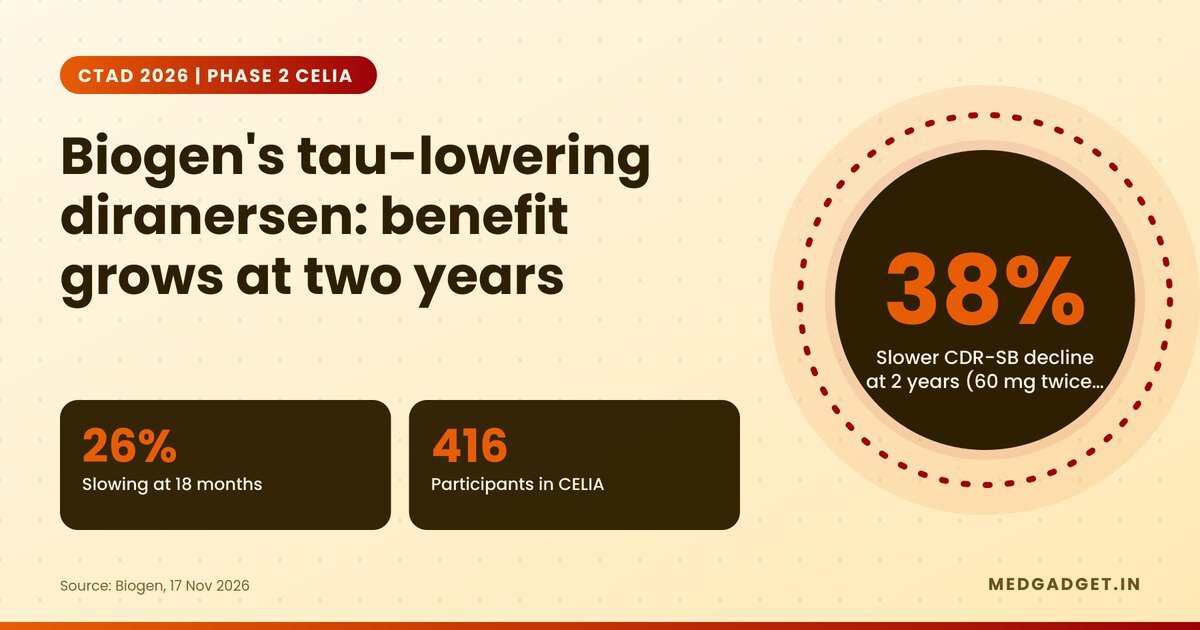
New diranersen Alzheimer’s results show that Biogen’s tau-lowering drug slowed decline on the CDR-SB scale by 38% at two years in people with early Alzheimer’s disease, up from 26% at 18 months. Biogen presented the open-label extension data from the Phase 2 CELIA trial at the CTAD 2026 conference on November 17, 2026. The effect was seen at the lowest dose, 60 mg given into the spinal fluid twice a year, and the company says the findings support a Phase 3 trial.
Key takeaways on diranersen Alzheimer’s results
- Diranersen (BIIB080) is an antisense oligonucleotide that lowers production of all forms of tau protein, a different target from approved anti-amyloid antibodies.
- At 60 mg every six months, CDR-SB decline slowed 38% at week 96, a 1.09-point difference, versus participants who started on placebo.
- Benefit grew between 18 and 24 months on five of six clinical measures; MMSE was the exception.
- Biogen reports no new safety signals through two years, but has not published detailed adverse event rates.
- The drug is investigational. Phase 3 is planned but its design and timing have not been announced.
The numbers at 18 and 24 months
CELIA enrolled 416 people with mild cognitive impairment due to Alzheimer’s or mild Alzheimer’s dementia who had not received anti-amyloid therapy. They were randomised to one of three diranersen regimens or placebo for 18 months, then could enter an open-label extension. The figures below compare the 60 mg twice-yearly group (n=60) with the 115 participants originally assigned to placebo, according to Biogen’s release.
| Measure (slowing vs placebo-start) | Week 76 (18 months) | Week 96 (24 months) |
|---|---|---|
| CDR-SB (global function) | 26% | 38% |
| ADAS-Cog13 (cognition) | 42% | 54% |
| MMSE (cognition) | 50% | 38% |
| ADCS-ADL-MCI (daily activities) | 0% | 30% |
| ADCOMS (composite) | 23% | 38% |
| Modified iADRS (composite) | 30% | 46% |
The daily activities line is the one many clinicians will look at first: no separation at 18 months, then 30% slowing at two years. Biogen’s head of development, Priya Singhal, described an “increasing magnitude of effect at two years.” Biogen also reported reductions in tau PET signal across the brain, and in CSF p-tau181 and plasma p-tau217 at 18 months in the 60 mg group, without giving figures.
How a tau-lowering ASO works
Alzheimer’s involves two hallmark proteins: amyloid plaques and tangles of tau. Approved disease-modifying drugs, lecanemab (Leqembi) and donanemab (Kisunla), are antibodies that clear amyloid. Tau tangles track more closely with symptoms and spread through the brain as the disease advances, which makes tau an attractive target, but antibodies against tau have repeatedly failed.
Diranersen takes another route. It is a short strand of synthetic genetic material that binds MAPT messenger RNA, the instructions for making tau, and prompts its breakdown. Less tau is produced in the first place, inside and outside cells. Because ASOs do not cross the blood-brain barrier well, it is given by lumbar puncture. Ionis discovered the drug and Biogen licensed global rights in 2019; the FDA granted Fast Track designation in 2025.
Reasons for caution
- Small, extension-phase comparison. The two-year result covers 60 people on one dose. The comparator group is participants originally on placebo who received no dose or one dose after switching, not a fully blinded placebo arm.
- Dose puzzle. Biogen says benefit was seen across all doses but gave no figures for the two higher 115 mg regimens. A clear dose response would be more convincing.
- Limited safety detail. Repeated lumbar punctures carry their own burden. Detailed adverse event data have not been published in the release.
- Not head-to-head. The percentages cannot be compared directly with anti-amyloid trials, which used different populations, designs and durations.
Our read: the trend over time is the encouraging part, since a drug acting upstream of tau spread might be expected to separate more slowly. Only a properly powered Phase 3 will show whether that pattern holds.
Market context and the India angle
The need is large. Data cited by Acumen Research and Consulting put people living with dementia worldwide at around 50 million, with nearly 10 million new cases each year. Acumen valued the global dementia drugs market at USD 15.5 billion in 2021 and projected USD 32.3 billion by 2030, a CAGR of 8.7%. That report was last updated in 2022, so treat the figures as indicative; they predate full anti-amyloid launches.
For India, where anti-amyloid antibodies are costly and require repeated MRI safety monitoring, a twice-yearly treatment without the brain swelling risk of amyloid drugs would be attractive if Phase 3 confirms safety. Practical hurdles remain: intrathecal dosing needs trained clinicians, and no trial sites or timelines have been announced for India.
What to watch next
- Phase 3 design, including dose choice and whether it enrols people with very early or preclinical disease.
- Peer-reviewed publication of full CELIA data, including safety tables.
- Possible combination studies with anti-amyloid antibodies.
For more from CTAD 2026, read our report on AriBio’s AR1001 Phase 3 results and our coverage of a blood-brain barrier Alzheimer’s study, or browse Clinical Trials.
FAQ
What is diranersen?
Diranersen (BIIB080) is Biogen’s investigational antisense drug for Alzheimer’s disease. It reduces production of tau protein and is given by injection into the spinal fluid.
How much did diranersen slow Alzheimer’s?
At the 60 mg twice-yearly dose, decline on the CDR-SB scale was 38% slower at two years than in participants who started on placebo, a 1.09-point difference.
Is diranersen approved?
No. It is investigational and not approved by any regulator. Biogen plans a Phase 3 trial to confirm efficacy and safety.
How is diranersen different from Leqembi and Kisunla?
Leqembi and Kisunla are antibodies that remove amyloid plaques. Diranersen targets tau, the protein that forms tangles inside nerve cells, by blocking its production.
Sources: Biogen press release (November 17, 2026) and CTAD 2026 presentation; Reuters reporting. Market data: Acumen Research and Consulting. Not medical or investment advice. Last updated November 18, 2026.
[…] Stage Lembaz FDA Approval: First Drug to Extend Survival in Infantile Niemann-Pick Type C Diranersen Alzheimer’s Results: Biogen Tau Drug Slows Decline 38% at Two Years Nelkarmi FDA Approval: GSK’s Neladalkib Offers a New Option After ALK Lung Cancer Resistance […]
[…] Biogen’s tau-lowering drug diranersen showed a 38% slowing of decline at two years (see our diranersen results report), while AriBio’s oral AR1001 missed its overall Phase 3 goal but showed a subgroup signal […]