

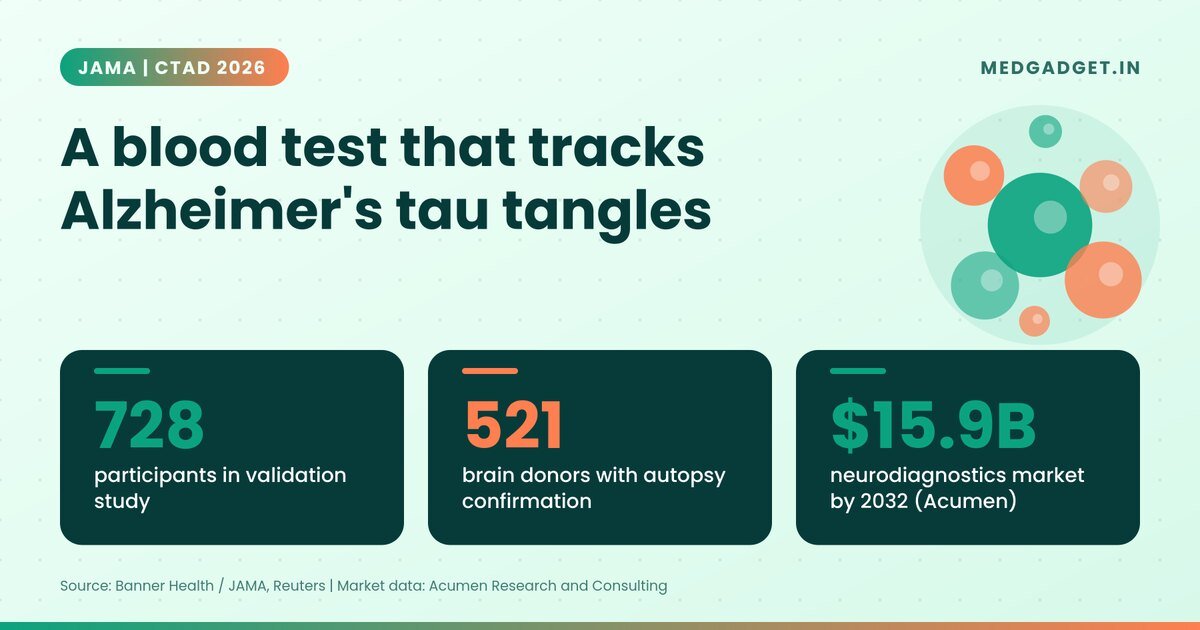
A new Alzheimer’s blood test for tau tangles, published in JAMA on 16 November 2026 and presented at the CTAD conference in Boston, measures a protein fragment called eMTBR-tau that tracks how far tangle pathology has spread in the brain. Researchers from Banner Health, Lund University, McGill University and UC Irvine, working with assay developer Alamar Biosciences, validated it in 728 people, and found it identified advanced tau pathology about as well as established methods such as tau PET imaging. It is not yet available to patients.
Key takeaways on the Alzheimer’s blood test for tau tangles
- The test targets eMTBR-tau, a fragment linked to insoluble tau tangles, rather than the amyloid-linked markers used in today’s blood tests.
- It was validated in 521 brain donors and 207 living participants from the BioFINDER-2 (Sweden) and TRIAD (Canada) imaging cohorts.
- In brain tissue, eMTBR-tau reflected overall tangle load better than existing blood markers, according to the investigators.
- It is designed to stage disease, not to diagnose Alzheimer’s on its own, and is intended to be used alongside p-tau217.
- Likely first uses: selecting and monitoring participants in clinical trials, especially for tau-targeting drugs.
The gap this test is trying to fill
Alzheimer’s disease leaves two signatures in the brain: amyloid plaques, which build up years before symptoms, and tau tangles, which spread later and track more closely with memory loss and decline. Blood tests that reached clinics over the past two years, chiefly those measuring phosphorylated tau 217 (p-tau217) and amyloid ratios, are very good at answering one question: is Alzheimer’s pathology present? They are far less useful for the next question doctors and drug developers ask, which is how advanced it is. p-tau217 rises early and largely mirrors amyloid, then tends to level off.
Today, the tangle burden is usually measured with tau PET scans, which are expensive, involve radiation and are concentrated in specialist centres. A blood marker that tracks tangle spread could make biological staging far more accessible, including in health systems where PET capacity is scarce.
How the study was built
| Cohort | Participants | What it tested |
|---|---|---|
| Arizona Study of Aging and Brain and Body Donation Program (Banner) plus UC Irvine ADRC | 521 brain donors | Blood eMTBR-tau versus tangles counted directly in autopsy tissue |
| BioFINDER-2 (Lund) and TRIAD (McGill) | 207 living participants | Blood eMTBR-tau versus tau PET imaging |
| Total | 728 | Detection of advanced insoluble tau pathology |
Pairing autopsy confirmation with imaging is a strength: autopsy is the gold standard for how many tangles are really there, while the PET cohorts show how the test behaves in living people. By our calculation, though, about 72% of the participants (521 of 728) were brain donors, so performance in the kind of memory-clinic population a doctor actually sees still needs to be confirmed. The public summaries also did not include headline accuracy figures such as area under the curve or sensitivity; those are in the full paper.
Why staging matters for treatment
The two marketed anti-amyloid antibodies work best early, and trial data suggest people with lower tau burden gain more. A cheap way to separate early from advanced tangle stages could help doctors decide who is most likely to benefit, and help trial sponsors enrol the right patients. Senior author Nicholas Ashton of Banner Sun Health Research Institute called the result “a major step forward in our understanding of Alzheimer’s”, and said that combined with existing blood tests it could support treatment decisions and trial selection.
The timing also lines up with a wave of tau-directed therapies. At the same CTAD meeting, Biogen reported two-year data for its tau antisense drug, covered in our story on diranersen’s 38% slowing of decline. Drugs like that need a way to show tau burden is actually changing, and a repeatable blood test would be far easier to use than serial PET scans. For more on how blood and brain interact in early disease, see our report on the blood-brain barrier study.
Limits and open questions
- Not a diagnostic: the researchers stress it is not meant to diagnose Alzheimer’s on its own.
- Not on the market: no regulatory clearance or commercial launch has been announced.
- Late-stage focus: it is built to detect advanced tangle pathology, so it adds little for the earliest preclinical stage, where p-tau217 remains the key marker.
- Diversity: cohorts came from the US, Sweden and Canada; performance in South Asian and other populations, including in India, has not been reported.
- Other diseases: how it behaves in non-Alzheimer tau disorders and mixed dementias is not yet clear from the public summary.
Market context
Blood-based staging tools fit into a fast-growing diagnostics segment. Acumen Research and Consulting valued the global neurodiagnostics market at US$7.8 billion in 2022 and projects US$15.9 billion by 2032, a 7.5% compound annual growth rate, with Asia-Pacific expected to grow fastest. A low-cost blood assay could shift some of that spending away from imaging, particularly in markets such as India where specialist scanners are concentrated in large cities.
FAQ
Can a blood test show how advanced Alzheimer’s is?
That is what the eMTBR-tau test aims to do. In the JAMA study it detected advanced tau tangle pathology with accuracy similar to established methods, but it is still a research tool.
How is eMTBR-tau different from p-tau217?
p-tau217 rises early and mainly reflects amyloid plaques, so it is good for detecting Alzheimer’s. eMTBR-tau reflects the later spread of tau tangles, so it is aimed at staging. Researchers expect the two to be used together.
Can I get this Alzheimer’s blood test now?
No. The test is not available for clinical use in any country yet. Anyone worried about memory changes should speak to a doctor about currently approved assessments.
Sources: Banner Health announcement of “A Plasma eMTBR-Tau Immunoassay for Detection of Advanced Insoluble Tau Pathology” (JAMA, 16 November 2026) and Reuters coverage. Market data: Acumen Research and Consulting. More in Life Science. Not medical advice. Last updated 19 November 2026.