

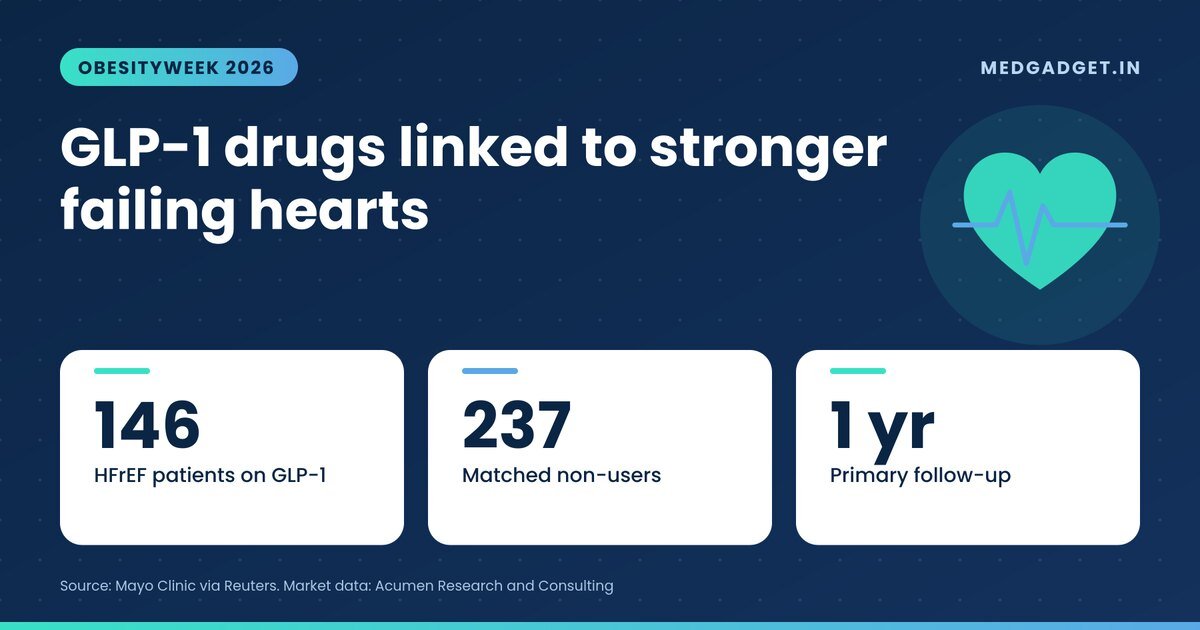
New GLP-1 heart failure data from Mayo Clinic, presented at ObesityWeek 2026 in Washington and reported by Reuters on 20 November, suggest semaglutide and tirzepatide do more than shrink waistlines in people whose hearts are already failing. Among 146 patients with obesity and heart failure with reduced ejection fraction (HFrEF) who took a GLP-1 drug, the left ventricle improved significantly more in size, shape and pumping function over one year than in 237 closely matched patients who did not, and most of those gains held after researchers adjusted for weight lost.
Key takeaways on GLP-1 heart failure research
- In HFrEF, the weaker-pumping form of heart failure, GLP-1 users showed greater one-year improvement in left ventricular structure and function than matched non-users.
- Most improvements stayed statistically significant after adjusting for weight change, hinting at a direct drug effect on the heart.
- Exploratory two-year data pointed to continued gains in ejection fraction and heart size, but these are hypothesis-generating only.
- A separate 81-patient randomised Mayo trial in HFpEF, the stiff-heart form, found semaglutide lowered pressures inside the heart at rest and during exercise.
- The HFrEF study was observational, so it cannot prove cause and effect, and patients should not start or change these drugs without their cardiologist.
Two studies, two kinds of failing heart
Heart failure comes in two broad types. In HFrEF the left ventricle has become enlarged and pumps weakly; in heart failure with preserved ejection fraction (HFpEF) it squeezes normally but is stiff and fills poorly, a pattern closely tied to obesity. GLP-1 drugs already have trial evidence for symptom relief in obesity-related HFpEF. The HFrEF question has been more contentious, because earlier small trials of older GLP-1 drugs in that group were neutral. That is what makes the new Mayo data worth attention.
| HFrEF study | HFpEF study | |
|---|---|---|
| Where presented | ObesityWeek 2026, Washington | AHA Scientific Sessions, Chicago; Nature Medicine |
| Design | Observational, matched controls | Randomised, placebo-controlled |
| Patients | 146 on GLP-1 vs 237 not | 81 adults with obesity |
| Drugs | Semaglutide or tirzepatide | Semaglutide |
| Duration | 1 year (exploratory 2-year) | 52 weeks |
| Main finding | Greater improvement in left ventricular size, shape and function | Lower heart pressures at rest and exercise; heart failure remission reported in more than half of treated patients |
Drug effect or weight-loss effect?
This is the central question. Losing a lot of weight reduces the workload on the heart, lowers blood pressure and blood volume, and can by itself let an overstretched ventricle shrink back. GLP-1 users in the HFrEF study did lose significantly more weight than controls. But the researchers report that most of the structural and functional improvements remained significant after statistical adjustment for that weight change, which they read as evidence that part of the benefit comes from the drugs themselves. GLP-1 receptors are found in cardiovascular tissue, and the drugs also affect inflammation, blood pressure and blood sugar, so a direct effect is biologically plausible. Still, statistical adjustment cannot fully remove the differences between people who choose to take these drugs and those who do not. Only a randomised trial in HFrEF can settle it.
Other ObesityWeek signals worth noting
- Falls in older adults: in more than 122,000 people aged 65 and over with obesity, GLP-1 use was linked to a 13% lower risk of falls and a 37% lower risk of new wheelchair dependence over two years compared with metformin, an association that does not prove prevention.
- Healthcare use: a Lilly-funded analysis of over 171,000 adults on Zepbound for at least a year found hospitalisations and emergency visits 34% lower than in matched untreated people at 12 to 18 months, though it did not show whether savings offset drug costs.
Why it matters for patients in India
India carries a large and growing burden of both obesity and heart failure, and Indian patients tend to develop heart failure at younger ages than those in Western countries. Access to semaglutide is widening as Indian manufacturers move into the category, as seen with the first India-made generic semaglutide approvals abroad. If heart benefits beyond weight loss are confirmed, cardiologists could gain a stronger case for using these drugs in obese patients with weakened hearts. For now, guideline-directed heart failure medicines remain the foundation of treatment. Readers following the brain side of this story can see our report on GLP-1 drugs and dementia.
Market context
Evidence that obesity drugs can treat heart disease would push them into one of the largest therapy areas in cardiology. Acumen Research and Consulting values the global congestive heart failure drugs market at USD 6.9 billion in 2022 and projects USD 26.1 billion by 2032, a 14.3% compound annual growth rate, with Asia-Pacific the fastest-growing region. Those September 2023 estimates are indicative and largely reflect established drug classes such as ACE inhibitors, so a confirmed GLP-1 role in heart failure would be an addition not yet captured in them.
What we still do not know
The HFrEF results were presented at a meeting and have not yet been published in full, so exact ejection fraction changes, side effects and how patients were matched are unknown. The study did not report hospitalisation or death, the outcomes that ultimately count. And the two-year findings were outside the original analysis plan. The next step would be a randomised outcomes trial of a modern GLP-1 drug in obese patients with HFrEF.
FAQ
Can Ozempic or Wegovy help heart failure?
In obesity-related HFpEF, randomised data show semaglutide improves heart pressures and symptoms. In HFrEF, the new Mayo data are encouraging but observational and need confirmation.
Do GLP-1 drugs help the heart only through weight loss?
Not entirely, according to this study: most heart improvements remained after adjusting for weight change, suggesting some direct effect. This has not been proven.
Is Mounjaro safe for people with heart failure?
Tirzepatide was included in the HFrEF study, but safety data from it have not been released. Anyone with heart failure should discuss these drugs with their cardiologist.
Sources: Reuters Health Rounds, 20 November 2026, reporting Mayo Clinic research at ObesityWeek 2026 and AHA Scientific Sessions. Market data: Acumen Research and Consulting. More in Clinical Trials. Not medical advice. Last updated 21 November 2026.
[…] Rezatapopt Ovarian Cancer Data: p53 Pill Shrinks Tumours in 48% of Platinum-Resistant Patients GLP-1 Heart Failure Study: Semaglutide and Tirzepatide Remodel Weak Hearts Beyond Weight Loss Manipur Liquor Tragedy: Toll Hits 15 as 300+ Treated for Suspected Methanol […]