

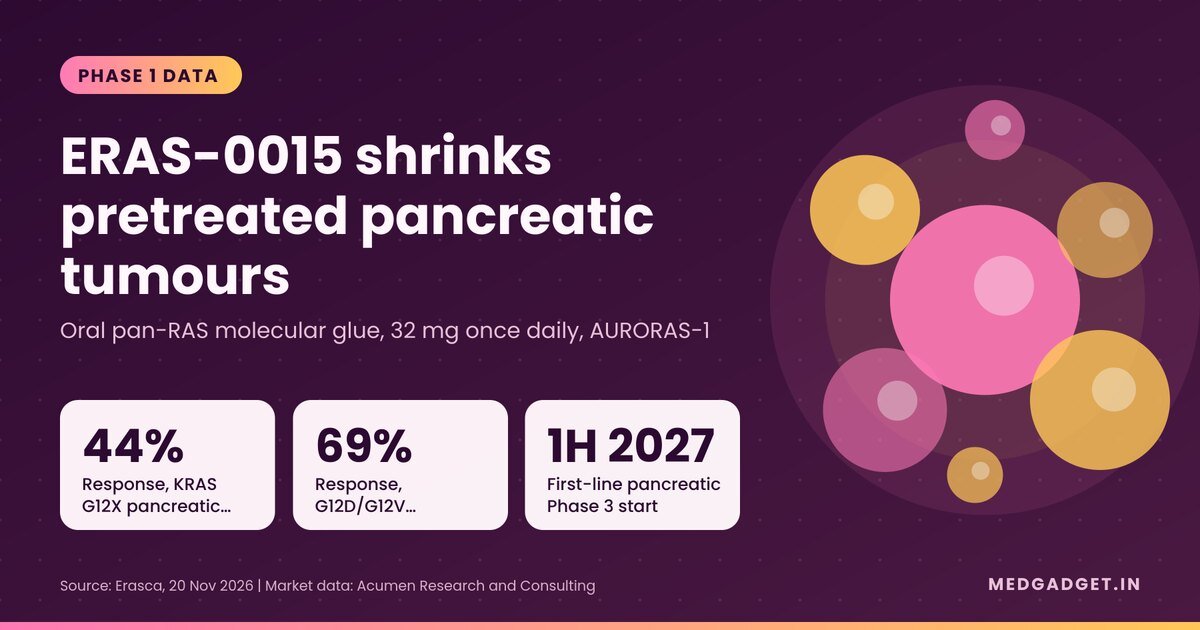
New ERAS-0015 pancreatic cancer data show Erasca’s once-daily pill shrank tumours in 11 of 25 previously treated patients (44%) with KRAS G12-mutated pancreatic cancer at the 32 mg dose, according to Phase 1 AURORAS-1 results released on 20 November 2026 and presented at the EORTC-NCI-AACR symposium in Barcelona. In the subgroup carrying the common G12D or G12V mutations, the confirmed response rate was 69% (9 of 13). Erasca is now pulling its first-line pancreatic cancer Phase 3 trial forward to the first half of 2027.
Key takeaways on ERAS-0015 pancreatic cancer results
- ERAS-0015 is an oral pan-RAS molecular glue with FDA Fast Track designation for metastatic pancreatic adenocarcinoma.
- 84% of the 25 pancreatic patients had received two or more prior treatment lines, a setting where chemotherapy responses are uncommon.
- All 11 responders were still on treatment at the data cut, but median follow-up was only just over four months.
- Responses were also seen in KRAS-mutant lung cancer (3 of 5 at 32 mg) and biliary tract cancer (3 of 4).
- At 32 mg no patient stopped treatment for side effects, though one earlier death from pneumonitis at 24 mg remains part of the safety record.
- This is an uncontrolled early study; it cannot show the drug extends survival.
Response rates by tumour and mutation
The numbers below are confirmed objective responses, meaning a tumour shrinkage of at least 30% seen on two consecutive scans, from Erasca’s release. Subgroups are small, so a single patient moves the percentage substantially.
| Group (32 mg once daily unless noted) | Patients | Confirmed response rate |
|---|---|---|
| KRAS G12X pancreatic cancer, 2nd line or later | 25 | 44% |
| Of which KRAS G12D or G12V | 13 | 69% |
| KRAS G12D pancreatic only | 8 | 63% |
| KRAS G12V pancreatic only | 5 | 80% |
| KRAS G12X lung cancer after immunotherapy and platinum | 5 | 60% |
| Same, all doses 16 to 32 mg | 12 | 58% |
| KRAS G12X biliary tract cancer | 4 | 75% |
One detail worth noting: 44% of the pancreatic patients had the G12R mutation, which tends to respond less well to some RAS drugs. That helps explain why the overall 44% figure sits well below the 69% seen in G12D and G12V tumours.
How a molecular glue attacks RAS
KRAS mutations drive more than 90% of pancreatic ductal adenocarcinomas, and for decades the protein was called undruggable because it lacked an obvious pocket for a drug to bind. The first wave of approved KRAS inhibitors only hit a single variant, G12C, which is rare in pancreatic cancer. ERAS-0015 works differently: like a glue, it makes RAS stick to a helper protein inside the cell, forming a complex that blocks RAS from switching on growth signals. Because it targets the active form of RAS across many variants, it is described as pan-RAS rather than mutation-specific.
That is the same broad approach as daraxonrasib (Rasonque), which the FDA approved on 26 August 2026 for previously treated metastatic pancreatic cancer and which we covered after its EMA recommendation. No head-to-head data exist, and comparing response rates across separate trials with different patients is unreliable. Erasca’s pitch is a cleaner tolerability profile; whether that holds will only be clear in larger studies. Revolution Medicines has also alleged that ERAS-0015 infringes its patents, a dispute that remains unresolved.
Side effects reported so far
Across 16 to 32 mg, the most common side effects were rash, diarrhoea, nausea and mouth inflammation. Grade 3 or worse treatment-related events occurred in 12 patients (9.8%), according to the symposium data reported by Medical Daily. Among 54 patients at 32 mg, Erasca reported no dose-limiting toxicities, dose interruptions in 13.0%, dose reductions in 16.7% and no discontinuations. In April 2026 the company disclosed a fatal pneumonitis case in a heavily pretreated 66-year-old patient on 24 mg; no other treatment-related deaths have been reported. Lung inflammation is therefore a side effect clinicians will monitor closely.
Independent symposium chair Prof. Elena Garralda, who was not involved in the study, said ERAS-0015 “has encouraging anti-tumour activity in cancers that are hard to treat successfully.”
Erasca’s 2027 development plan
- First half of 2027: Phase 3 in first-line pancreatic cancer (accelerated) and a potentially registration-enabling trial in second-line or later RAS-mutant lung cancer.
- Second half of 2027 to first half of 2028: Phase 3 in first-line RAS-mutant lung cancer.
- Combinations under way with gemcitabine plus nab-paclitaxel (cleared through 16 mg, 24 mg now dosing), pembrolizumab (cleared through 32 mg) and panitumumab in colorectal cancer.
- Pairing with Erasca’s pan-KRAS inhibitor ERAS-4001 planned for 2027.
Market context
According to Acumen Research and Consulting, the global pancreatic cancer therapeutics market was worth USD 3,582 million in 2021 and was forecast to reach USD 6,575 million by 2030, growing at 7.2% a year, with North America the largest region and Asia-Pacific the fastest growing. That report was last updated in 2022, so treat the figures as indicative: they predate the arrival of approved RAS-targeted pills, which could expand the market faster than forecast if drugs like ERAS-0015 reach first-line use.
What these results can and cannot tell patients
Tumour shrinkage in a small single-arm study is a signal, not proof of longer life. There is no comparison group, results are not yet peer reviewed and follow-up is short, so durability is unknown. For patients and families, the practical message is that RAS-directed trials are expanding quickly, and KRAS mutation testing of a pancreatic tumour now matters for trial eligibility. Readers following other recent KRAS work can see our report on Roche’s divarasib Phase 3 lung cancer trial.
FAQ
What is ERAS-0015?
An experimental once-daily oral pan-RAS molecular glue from Erasca, being tested in pancreatic, lung, biliary and colorectal cancers with RAS mutations.
How well did ERAS-0015 work in pancreatic cancer?
At 32 mg, 44% of 25 pretreated KRAS G12-mutant patients had confirmed tumour shrinkage, rising to 69% in G12D or G12V tumours.
Is ERAS-0015 approved?
No. It is in Phase 1, with Phase 3 trials planned from 2027. It is available only through clinical trials.
Is it better than daraxonrasib?
That cannot be judged yet. The drugs have not been compared directly, and cross-trial comparisons are unreliable.
Sources: Erasca press release (20 November 2026), EORTC-NCI-AACR Symposium presentation as reported by Medical Daily. Market data: Acumen Research and Consulting, Pancreatic Cancer Therapeutics Market (dated, indicative). More in Oncology. Not medical or investment advice. Last updated 20 November 2026.
[…] Markets Sogroya for Turner Syndrome: FDA Approves First Weekly Growth Hormone for Girls With TS ERAS-0015 Pancreatic Cancer Pill Shrinks Tumours in 44% of Pretreated Patients Ozempic and Dementia: What a New Science Review Says About GLP-1 Drugs and the […]