

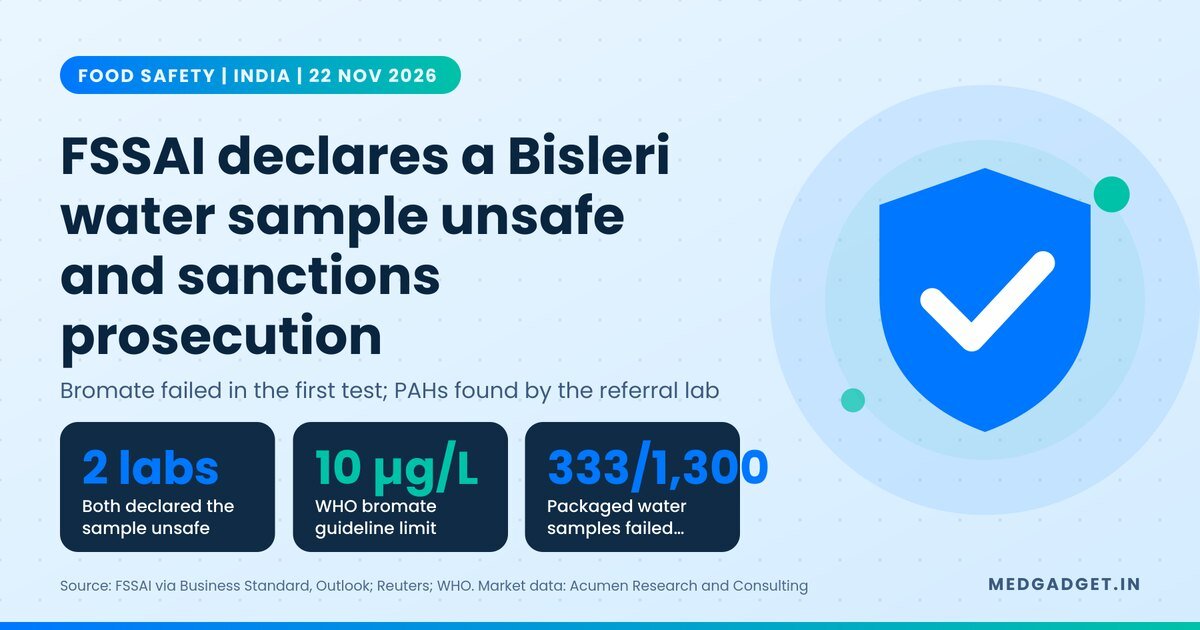
India’s food regulator has declared a sample of Bisleri water unsafe and sanctioned prosecution against Bisleri International under the Food Safety and Standards Act, 2006, after two laboratories flagged chemical contaminants in the same packaged drinking water sample. The Food Safety and Standards Authority of India (FSSAI) announced the action on Sunday, 22 November 2026, saying the first test found bromate above the prescribed limit and a referral laboratory, on Bisleri’s appeal, then detected polynuclear aromatic hydrocarbons (PAHs). Reuters reported that testing will now be widened to samples from all companies.
Key takeaways on Bisleri water unsafe finding
- What failed: one sample of “Packaged Drinking Water (other than Mineral Water)” collected from Bisleri International’s premises.
- First lab: bromate non-compliant with prescribed limits. Referral lab on appeal: unsafe due to PAHs.
- Action: FSSAI has sanctioned prosecution, the step that allows a case to be filed in court. It is not a conviction.
- Not disclosed: the batch, plant, bottle size, sampling date or the measured contaminant levels.
- Bisleri had not responded to media requests for comment at the time of reporting.
- Wider checks: the regulator plans to test packaged water samples from all companies, according to Reuters.
What FSSAI actually found
The sequence matters. Under the FSS Act, a company whose sample fails can appeal and have a retained portion re-tested at a referral food laboratory. Bisleri did that. The first analysis found the water non-compliant on bromate. The referral laboratory then declared it unsafe for a different reason, the presence of PAHs. Two independent results pointing to chemical contamination, even on different parameters, is why FSSAI moved to prosecution rather than a warning. The same week, the regulator suspended licences or sanctioned prosecution against several other food businesses, including two spice makers over pesticide residues and tin in turmeric, showing the Bisleri case is part of a broader enforcement push rather than a one-off.
What FSSAI has not said is just as important for consumers. It has published no contaminant levels, so it is impossible to know whether the sample was marginally or substantially over the limit. It has not identified the batch or the plant, and it has not ordered a recall. Large brands bottle water at many sites, so a single failing sample does not by itself show a problem across the brand.
Bromate and PAHs: how worried should you be?
| Contaminant | How it gets into bottled water | Reference limit | Main health concern |
|---|---|---|---|
| Bromate | Forms when water containing natural bromide is disinfected with ozone, a common step in bottling plants | WHO guideline value 10 micrograms per litre | Potassium bromate is classed by IARC as possibly carcinogenic to humans (Group 2B); risk rises with long-term exposure |
| Polynuclear aromatic hydrocarbons (PAHs) | Combustion by-products; in water, often from coal-tar pipe coatings, contaminated sources or fuel residues | Limits apply to marker compounds such as benzo[a]pyrene | Benzo[a]pyrene is a known human carcinogen (IARC Group 1) with long-term exposure |
For both contaminants, the risk is about repeated exposure over years, not a single bottle. Drinking water that exceeded a limit once is very unlikely to cause acute illness; regulators set these limits with wide safety margins against lifetime cancer risk. The practical concern is whether a plant has a systematic problem, such as poorly controlled ozonation that keeps producing bromate, which only repeated testing can answer. People who buy large jars for daily household use from one local supplier have more reason to ask questions than someone who occasionally buys a bottle while travelling.
A wider problem with packaged water in India
Government data presented in Parliament in February 2025 show bottled water failures are not rare. Of 1,776 enforcement samples of packaged drinking water tested in 2022-23, 650 failed; in 2023-24, 333 of 1,300 failed. By our calculation, that is a failure rate of about 37% and 26% respectively, although enforcement sampling targets suspect products and overstates the risk for the market as a whole.
The rules have also shifted. In October 2024 the government removed mandatory BIS certification for packaged drinking water and mineral water, placing the burden on FSSAI licensing and inspection, and FSSAI introduced a dedicated testing scheme for the category from 1 January 2026. The Bisleri case is the most prominent test yet of whether that system catches problems at the largest brands, not only at small unbranded bottlers. Recent FSSAI and state actions we have covered include the Maharashtra NMN supplement seizure and the suspension of a hospital kitchen licence.
Market context
The stakes are high because bottled water is a mass-market staple. Acumen Research and Consulting estimates the global bottled water market at USD 305.5 billion in 2023, rising to USD 520.6 billion by 2032 at a 6.1% compound annual growth rate. The report page carries an older update stamp, so treat the figures as indicative. Bisleri is widely reported to hold roughly a third of India’s organised packaged water market, which is why a quality finding against the brand reaches far more households than one against a regional bottler.
What consumers can do now
- Check that any packaged water carries a valid FSSAI licence number, batch number and manufacturing date on the label.
- Buy sealed bottles from established retailers and avoid jars with damaged or re-fitted seals.
- Do not store bottles in direct sunlight or hot vehicles; heat degrades plastic and quality.
- Report a suspect product through FSSAI’s Food Safety Connect app or helpline.
- Watch for an FSSAI or company statement naming any affected batch; no recall has been announced so far.
Follow more regulatory updates in our healthcare services section.
FAQ
Is Bisleri water safe to drink?
FSSAI declared one specific sample unsafe; it has not banned the brand or ordered a recall. The batch and contaminant levels have not been disclosed, so the finding cannot be applied to all Bisleri products.
Why did FSSAI declare Bisleri water unsafe?
The first laboratory found bromate above the prescribed limit. After Bisleri appealed, a referral laboratory declared the sample unsafe because it detected polynuclear aromatic hydrocarbons.
What is bromate in drinking water?
Bromate is a by-product formed when water containing bromide is treated with ozone. The WHO guideline limit is 10 micrograms per litre because long-term exposure is linked to cancer risk in animal studies.
What happens after FSSAI sanctions prosecution?
The authority can file a case before a court under the FSS Act, 2006. Penalties depend on the court’s findings; the company can contest the case.
Sources: FSSAI statements (22 Nov 2026) as reported by Business Standard and Outlook India (22-23 Nov 2026); Reuters (23 Nov 2026); WHO and IARC. Market data: Acumen Research and Consulting, Bottled Water Market report. Not medical advice. Last updated 24 November 2026.