

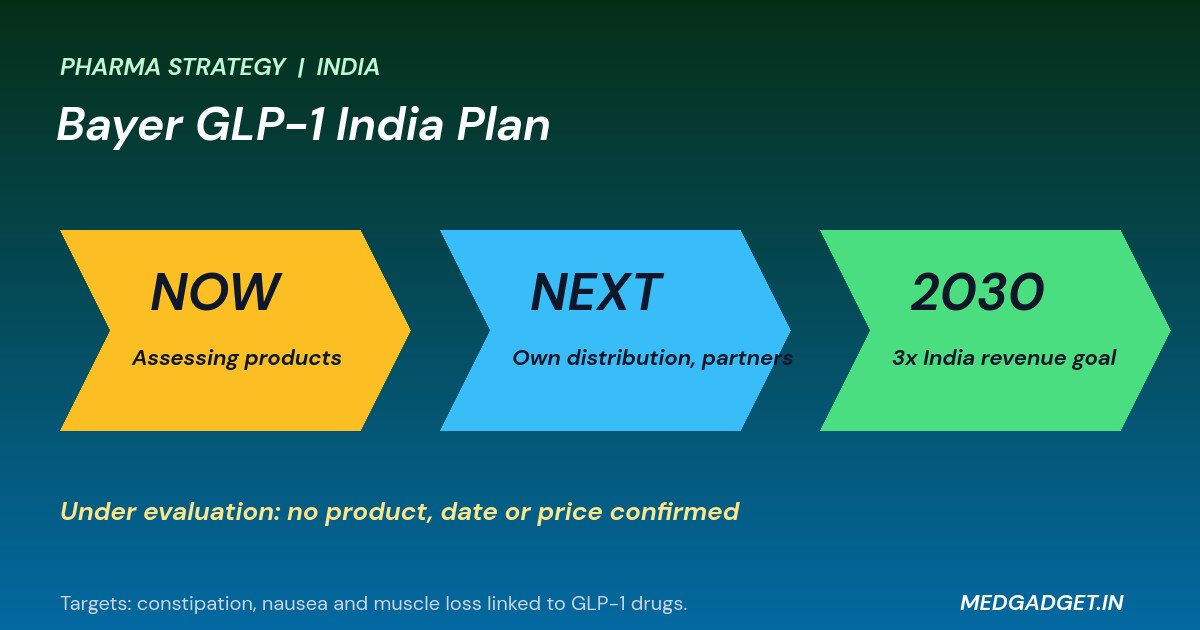
The Bayer GLP-1 India plan is a strategy under evaluation, not a product launch: Bayer’s consumer-health division says it is assessing whether to bring products to India that ease side effects of GLP-1 weight-loss drugs, while aiming to triple its Indian consumer-health revenue by 2030. Reports of the interview with Bayer Consumer Health President Julio Triana name constipation, nausea and muscle loss as the side effects in focus.
No specific product, launch date or price has been confirmed. This article separates what Bayer says it is considering from what is actually on sale, and explains why the idea matters in a country where interest in obesity treatment is growing.
Bayer GLP-1 India plan: key points
- What: Bayer is evaluating consumer-health products for India that address GLP-1 side effects.
- Side effects named: constipation, nausea and muscle loss.
- Categories mentioned: digestive health, nutrition, multivitamins and protein supplements.
- Goal: triple Indian consumer-health revenue by 2030 and make India Bayer’s third-largest consumer-health market.
- Status: under market assessment; no products, dates or prices confirmed.
Bayer GLP-1 India: what is available now versus under review
This distinction is the most important one for readers. Based on the reports we reviewed, Bayer has not announced any GLP-1-specific product for India. The brands that Triana discussed include established Indian names such as Supradyn, a multivitamin, and Saridon, in the pain category. Those are existing products, and they are not described as GLP-1 treatments.
What is new is the intention. Bayer says its local team is carrying out a market assessment to decide which formulations to introduce. Reports say the time from planning to market could be short, but they give no date, and any product would need to meet Indian regulatory requirements before sale.
What Julio Triana said about the Bayer GLP-1 India opportunity
According to reports of the interview, Triana said Bayer is exploring additions in digestive health, nutrition, multivitamins and protein supplements. He also pointed to dermatology and nutritional supplements as areas for rapid growth. Dermatology is reported to account for roughly a quarter of Bayer’s consumer-health business worldwide but is still small in India.
He said India’s over-the-counter framework is not an obstacle to expansion, that self-care must come with a high level of responsibility, and that local competitors are often closer to consumers. He used the phrase “snake oil” for substandard products sold in less regulated markets, and described a “road to billions” strategy to make products accessible to broad populations. Different reports vary in how much of this they attribute directly to him, so we quote only the phrases that appear in more than one account.
Why GLP-1 side effects create an opening for Bayer GLP-1 India products
GLP-1 medicines slow digestion and reduce appetite. Common side effects include nausea, vomiting, diarrhoea and constipation, and rapid weight loss can include loss of lean muscle. Our reports on a drug to preserve muscle during semaglutide weight loss and on survodutide trial results show how much drug research now aims at the same problem.
The opening for consumer-health companies is the space around the prescription: products that help people manage digestive symptoms or get enough protein and micronutrients while eating less. Whether such products help GLP-1 users is a clinical question, and anyone on these drugs should talk to their prescriber before adding supplements or remedies.
Obesity treatment market India: the demand backdrop
Interest in weight-loss drugs in India has grown with the arrival of newer medicines, which we covered in our comparison of Mounjaro, Ozempic and Wegovy in India. The World Health Organization (WHO) fact sheet on obesity and overweight describes obesity as a global public-health problem linked to diabetes, heart disease and some cancers. Indian national survey data from 2019–21 found that roughly one in four adults aged 15 to 49 was overweight or obese, a figure that has likely risen since.
More patients on GLP-1 drugs means more people dealing with side effects, and that is the logic behind Bayer GLP-1 India. That is the logic behind Bayer’s interest, although the size of the opportunity in India has not been published and we do not estimate it.
Bayer India healthcare expansion: how it plans to grow
- Own distribution: Bayer plans to build its own distribution network instead of relying on third-party distributors, for more control over brand positioning.
- Local manufacturing partners: it is open to partnerships with local manufacturers to lower costs and compete on price, and already has a network of contract manufacturers in India.
- Acquisitions: it is open to inorganic growth, meaning acquisitions or similar deals.
- Priority market: India is described as one of Bayer’s top five consumer-health priority markets.
Reports do not give Bayer’s current Indian consumer-health revenue, so the size of the “triple” goal is unknown. Readers should also note that this plan belongs to Bayer AG, the global group, and not to the separately listed Bayer CropScience in India.
Risks and open questions for Bayer GLP-1 India
- Competition: India’s consumer-health market is crowded and fragmented, with many low-cost makers.
- Regulation: products would have to comply with rules from the Central Drugs Standard Control Organisation (CDSCO) and food-safety regulators, depending on whether they are drugs, supplements or foods.
- Evidence: claims that a product helps with GLP-1 side effects should be backed by clinical data.
- Corporate pressure: reports note Bayer’s net debt of more than €33 billion at the end of June 2026 and ongoing litigation over legacy products, which could shape how fast it invests.
Our assessment of Bayer GLP-1 India
In our assessment, the Bayer GLP-1 India story is best read as a signal of direction and not as news about a product. A large multinational is saying that GLP-1 users are a customer group worth designing for, and that India matters for its consumer-health ambitions. The evidence for specific products, and for how many people will want them, is still missing.
For related Bayer coverage, see our report on its $2.2 billion Ohio plant, or browse our pharmaceutical news section. You can also find company information on Bayer’s corporate website.
What to watch next in Bayer GLP-1 India
- Whether Bayer names specific products or brands for India.
- Any partnership or acquisition with an Indian manufacturer.
- The regulatory category and claims of any new product.
- Disclosure of Bayer’s current Indian consumer-health revenue and the size of the 2030 goal.
Frequently asked questions
What is the Bayer GLP-1 India plan?
Bayer is assessing consumer-health products for India that ease side effects of GLP-1 obesity drugs, as part of a goal to triple Indian consumer-health revenue by 2030.
Has Bayer GLP-1 India launched any product?
No. The plans are under evaluation, and no products, dates or prices have been confirmed.
Which side effects does Bayer GLP-1 India target?
Constipation, nausea and muscle loss, according to reports.
Does Bayer make a GLP-1 drug?
The reports we reviewed describe supportive consumer-health products, not a GLP-1 medicine.
Should GLP-1 users take supplements now?
Speak to your doctor first. Nothing in this plan is a recommendation to use any product.
How we reported this: we relied on public reports of an interview with Bayer Consumer Health President Julio Triana, published on 11 and 12 October 2026, and on public WHO and company pages. Reports differ in detail and we have not seen a Bayer press release. Statements about plans are Bayer’s and unconfirmed by us. Last updated: 12 October 2026. This article is news reporting and not medical or investment advice.
[…] is still early, so announcements should be read as testing and not as proven solutions. See also Bayer GLP-1 India Plan: Eyes 3x Revenue by 2030. More in our pharmaceutical […]