

If you are worried you were exposed to measles, the key is to work out three things quickly: whether you shared air with an infected person, whether you are protected by vaccination or past infection, and how many days have passed. With US cases above 4,000 in 2026 and Pennsylvania reporting its largest outbreak in decades, more people are being told they may have been in the same place as a case.
This guide explains how health officials decide who was exposed, the symptoms and timeline to watch, and what to do next. It is general information based on public health guidance and not medical advice.
Key points if you may have been exposed to measles
- Exposure means shared air: measles virus can hang in a room for up to two hours after an infected person leaves.
- Symptoms start late: usually 7 to 14 days after exposure, and sometimes as late as 21 days.
- Protection matters most: two documented MMR doses give about 97% protection.
- Call ahead: phone a doctor or health department before visiting a clinic so others are not exposed.
- Act fast: MMR given within 72 hours of exposure, or immune globulin within six days, can help some people.
How do you know if you were exposed to measles?
Measles spreads through the air when an infected person coughs, sneezes or even breathes. The Centers for Disease Control and Prevention (CDC) says the virus can stay in the air and on surfaces for up to two hours, and that up to nine in ten unprotected people who are near an infected person will catch it. So you do not need to touch the person. Sharing a room, a waiting area, a school bus, a church or a plane can be enough.
The clearest sign you were exposed to measles is a call from your local health department. When a case is confirmed, officials trace contacts and publish exposure locations with dates and times. Check those lists if you live in or have travelled through an area with an outbreak.
Situations that count as an exposure
- Spending time in the same room, home, classroom or vehicle as someone with measles, including up to two hours after they left.
- Being at a listed exposure site during the dates and times published by health officials.
- Sitting near an infected traveller on a flight or in a station, as advised by health authorities.
- Living with, or caring for, a person who has a confirmed or suspected case.
When are people with measles contagious?
A person with measles can spread it from about four days before the rash appears until four days after. That is the reason many exposures are unknown: the infected person may feel only like they have a cold at first. If you met someone who was later diagnosed, ask the health department which dates they count as the contagious period.
Measles symptoms and timeline after exposure
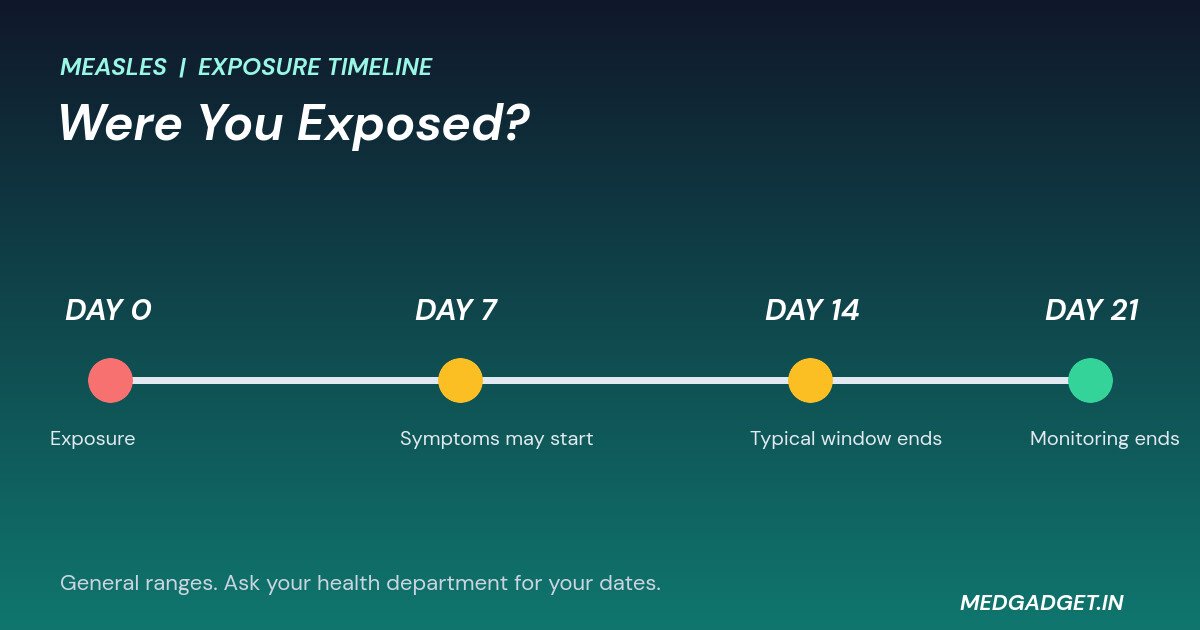
After you are exposed to measles, nothing happens for days. By our calculation from the standard ranges, the earliest symptoms appear about a week after exposure, and the monitoring period runs for three weeks (21 days). Those are our own date calculations, so ask your health department for your exact end date.
- Days 7 to 14 (typical start): fever that can climb above 104 degrees Fahrenheit, cough, runny nose and red, watery eyes.
- Two to three days later: tiny white spots inside the mouth, known as Koplik spots, may appear.
- Three to five days after the first symptoms: a flat red rash begins on the face and hairline and spreads down the body.
- Up to day 21: the last point at which symptoms can still appear after an exposure.
Early measles looks like many respiratory illnesses, as Pennsylvania’s health secretary has warned during the state’s outbreak. A rash after a fever, in someone who may have been exposed to measles, should be treated as measles until a test says otherwise.
Are you protected? Check your immunity
Not everyone who is exposed to measles gets sick. Health officials generally treat a person as immune if they have any of the following.
- Written proof of two doses of MMR vaccine, or one dose for some low-risk adults.
- Laboratory evidence of immunity from a blood test.
- Laboratory confirmation that they had measles in the past.
- Birth in the United States before 1957, which is treated as presumptive immunity in most settings.
If you cannot find your records, ask your doctor, school or state immunization registry. A blood test for measles antibodies can show whether you are protected. Vaccination is not complete after one dose for most children and adults; the second dose raises protection from roughly 93% to about 97%.
What to do if you were exposed to measles
1. Call before you go anywhere
Phone your doctor, urgent care or health department first. Staff can arrange a separate entrance or a test without putting other patients at risk, including babies and people with weakened immune systems.
2. Find out your vaccination status
Look for your vaccine card or registry record. If you are unsure, tell your clinician that you have been exposed to measles and cannot confirm your doses.
3. Ask about preventive treatment
Unprotected people may be offered MMR vaccine within 72 hours of exposure, which can reduce the chance of illness. Immune globulin, an antibody injection, can be given up to six days after exposure to infants, pregnant women who are not immune and people with weakened immune systems.
4. Watch for symptoms for 21 days
Check your temperature daily. Fever, cough, a runny nose, red eyes or a rash are reasons to call your clinician the same day, not to walk in.
5. Limit contact if you are not immune
Health departments often ask non-immune contacts to stay away from school, work and public places until day 21, because they could become contagious before they feel ill. Follow the instructions you are given.
6. Get vaccinated if you are not protected
MMR vaccination does not treat measles that has already started, but it protects you against future exposures and helps your community. Children aged 18 and under in some states can receive it at no cost.
When measles becomes an emergency
Most people recover, but measles can cause pneumonia, brain swelling and death, and the risk is highest in young children, pregnant women and people with weak immunity. Seek emergency care and tell staff in advance that you may have measles if you have trouble breathing, a stiff neck, confusion, seizures or a fever that will not come down.
Why the question matters now
Pennsylvania has reported more than 1,000 cases in its outbreak, covered in our report on the largest measles outbreak in decades, and the national count is covered in US measles cases passing 4,000. Our earlier reports on the state’s outbreak include 1,078 cases on 7 October and 977 cases on 2 October. More cases mean more public exposure sites, so knowing your immunity before a notice arrives saves time.
Global guidance matches the US advice. The World Health Organization describes measles as one of the most contagious diseases and says vaccination is the main protection.
In our assessment, the most useful step for most readers is not waiting for a symptom: find your vaccine record this week, so that if you are told you were exposed to measles, you can answer the first question health staff ask. For more public-health coverage, browse our pharmaceutical news section.
Frequently asked questions
How soon after being exposed to measles do symptoms start?
Usually 7 to 14 days, and occasionally up to 21 days after exposure.
Can I get measles if I am vaccinated?
It is uncommon. Two doses of MMR give about 97% protection, so a small number of vaccinated people can still get ill, and their illness is usually milder.
Can I spread measles before I have a rash?
Yes. People are contagious from about four days before the rash appears to four days after.
What should I do first if I think I was exposed to measles?
Call your doctor or local health department before visiting, and have your vaccination records ready.
Is there a test for measles?
Yes. Clinicians use a throat or nose swab and a blood test, arranged in advance so other patients are not exposed.
How we reported this: we used public guidance from the CDC and the World Health Organization, and published health-department updates from September and October 2026. Timelines are general ranges, and your own situation may differ. Figures labelled as ours are our own calculations. Last updated: 10 October 2026. This article is news reporting and not medical advice; contact a clinician about your own health.