

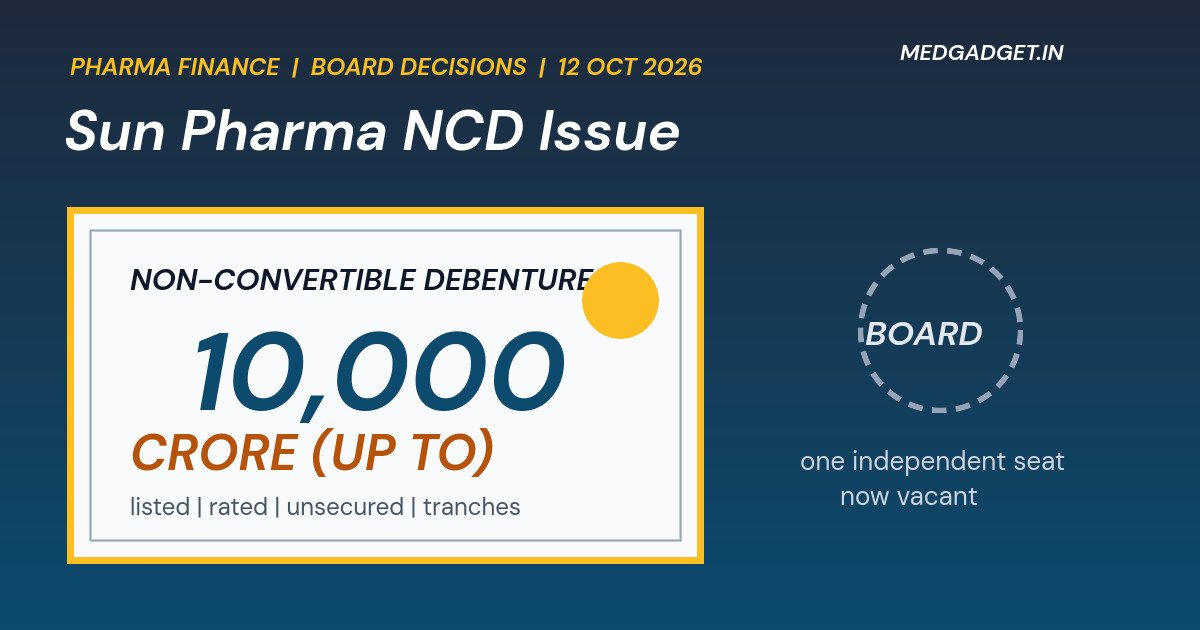
The Sun Pharma ₹10,000 crore NCD issue is smaller than the one investors were told to expect. On 12 October 2026, the board of Sun Pharmaceutical Industries approved raising up to ₹10,000 crore through non-convertible debentures, five days after the company had flagged a proposal of up to ₹15,000 crore. The same day, the company disclosed that independent director Gautam Doshi had resigned from the board with immediate effect, citing personal reasons.
Both items came in a stock exchange disclosure and appear to be separate decisions. The company has not said what the money will be used for, and nothing in the disclosure ties the debentures to its pending purchase of Organon, although the timing invites the question. This report sets out what was approved, how it differs from the earlier proposal, what the resignation does and does not mean, and what remains unknown.
Sun Pharma ₹10,000 crore NCD issue: what the board approved
- Amount: up to ₹10,000 crore.
- Instrument: listed, rated, unsecured and redeemable non-convertible debentures (NCDs), meaning they cannot be turned into shares.
- Method: private placement, in one or more tranches or series.
- Who sets the terms: the board delegated the terms of each issuance to its finance committee.
- Not yet stated: tenure, coupon, investors, and the intended use of proceeds.
How the Sun Pharma ₹10,000 crore NCD issue differs from ₹15,000 crore
On 7 October, the company told the exchanges that the board would meet on 12 October to consider issuing NCDs of up to ₹15,000 crore. The approved ceiling for the Sun Pharma ₹10,000 crore NCD issue is ₹5,000 crore, or one-third, lower. That is our own arithmetic. The company has not explained the reduction, and a ceiling is a maximum, not a promise to borrow that much. The final amount could be lower still, depending on what the finance committee decides tranche by tranche.
One report says the rating agencies CRISIL and ICRA assigned an AAA rating with a stable outlook to a proposed ₹15,000 crore NCD programme, while keeping Sun Pharma’s existing long-term AAA and short-term A1+ ratings. We could not confirm that rating from the agencies’ own releases, so please check the original documents before relying on it. It is also unclear whether the rating will be re-issued for the lower amount.
Gautam Doshi resignation and the Sun Pharma ₹10,000 crore NCD issue
Gautam Doshi was a non-executive independent director. He resigned from the board and from his board committees effective 12 October. The company said he cited personal reasons, that he reported no other material reasons, and that the board thanked him for his contribution. His tenure and committee roles were not given in the reports we reviewed.
A board is more than a list of names, and independent directors matter in large listed companies because they sit on audit and risk committees and are meant to guard minority shareholders. A resignation on the same day as a financing approval draws attention, but the company’s statement gives no link between the two, and we have found none. In our assessment, readers should wait for the company’s next filing on board composition. Under Indian listing rules, companies must disclose resignations and the reasons given, which is why this reached the exchanges so quickly. Rules are set by the Securities and Exchange Board of India (SEBI).
Organon context for the Sun Pharma ₹10,000 crore NCD issue
Sun Pharma signed a definitive agreement in April 2026 to acquire the US-listed Organon & Co. in an all-cash deal at $14 a share, valued at about $11.75 billion including debt. Organon’s shareholders approved the merger on 24 July 2026, and Sun Pharma has said it hopes to close by early 2027, subject to regulatory approvals.
Reports describe the financing in different ways. One says a group of 11 Indian and international banks is syndicating a loan of more than $10 billion, with the rest paid from Sun Pharma’s own cash; another describes options such as a euro bond and offshore loans of $3 billion to $4 billion. We therefore cannot say how a domestic rupee debenture issue might fit in, if at all. The company would need to state its purpose, which it has not yet done.
Why the Sun Pharma ₹10,000 crore NCD issue matters for India’s pharma sector
A ceiling of ₹10,000 crore is a large debt-raising authority for a single pharma company, and it comes as other Indian companies restructure, as we reported in our story on the Emcure Pharmaceuticals merger. Domestic debentures can also broaden a company’s funding sources beyond bank loans. Unsecured debentures carry no pledge of assets, so investors rely on the issuer’s credit standing and rating. Private placement means the offer goes to a limited set of institutional investors instead of the general public, which is a common route for large corporate bond issues in India, and “redeemable” means the principal is repaid at maturity. For policy context, see our report on the PRIP scheme backing 41 pharma and medtech R&D projects and our wider pharmaceutical coverage.
On the day after the disclosure, the stock traded at about ₹1,768 on the NSE, up less than half a percent, according to one report, which did not link the move to either announcement. Documents for the debentures, when issued, would normally be public through the BSE as well.
What we do not know about the Sun Pharma ₹10,000 crore NCD issue
- Why the ceiling was cut from ₹15,000 crore to ₹10,000 crore.
- When the first tranche will be issued, and at what coupon and tenure.
- Whether the proceeds are linked to the Organon acquisition, refinancing, or general purposes.
- Whether shareholders must approve the issue, and whether the rating covers the lower amount.
- Whether the board will appoint a replacement for Doshi.
What to watch next on the Sun Pharma ₹10,000 crore NCD issue
- The first finance committee decision on a tranche and its terms.
- A formal rating letter for the ₹10,000 crore programme.
- Regulatory approvals for the Organon deal.
- Any board reshuffle announcement.
Frequently asked questions
How big is the Sun Pharma ₹10,000 crore NCD issue?
Up to ₹10,000 crore, issued in one or more tranches by private placement.
Why did Sun Pharma cut the plan from ₹15,000 crore?
The company has not said. The earlier figure was a proposal to be considered, and the board approved a lower ceiling.
Why did Gautam Doshi resign?
The company said he cited personal reasons and no other material reasons.
Are the NCDs convertible into shares?
No. They are non-convertible, unsecured and redeemable.
Is the Sun Pharma ₹10,000 crore NCD issue for the Organon deal?
Not stated. The disclosure does not give a use of proceeds.
How we reported this: we relied on the company’s 7 and 12 October 2026 disclosures as reported, and on public reports about the Organon transaction. We did not read the filings themselves. Figures labelled as ours are our own calculations. Last updated: 13 October 2026. This article is news reporting and not investment advice.