

An experimental antipsychotic has cleared its first big efficacy test. In the obuprazine schizophrenia clinical trial, a Phase 2b study run in China by Hansoh Pharma, all three dose ranges of the drug beat placebo on the main symptom scale after 42 days. Tortugas Neuroscience, which holds the rights outside Greater China, announced the results on 12 October 2026 and says it will now prepare a US investigational new drug (IND) application. Obuprazine, also called TRTL-107, is investigational and has not been approved anywhere on the strength of these data.
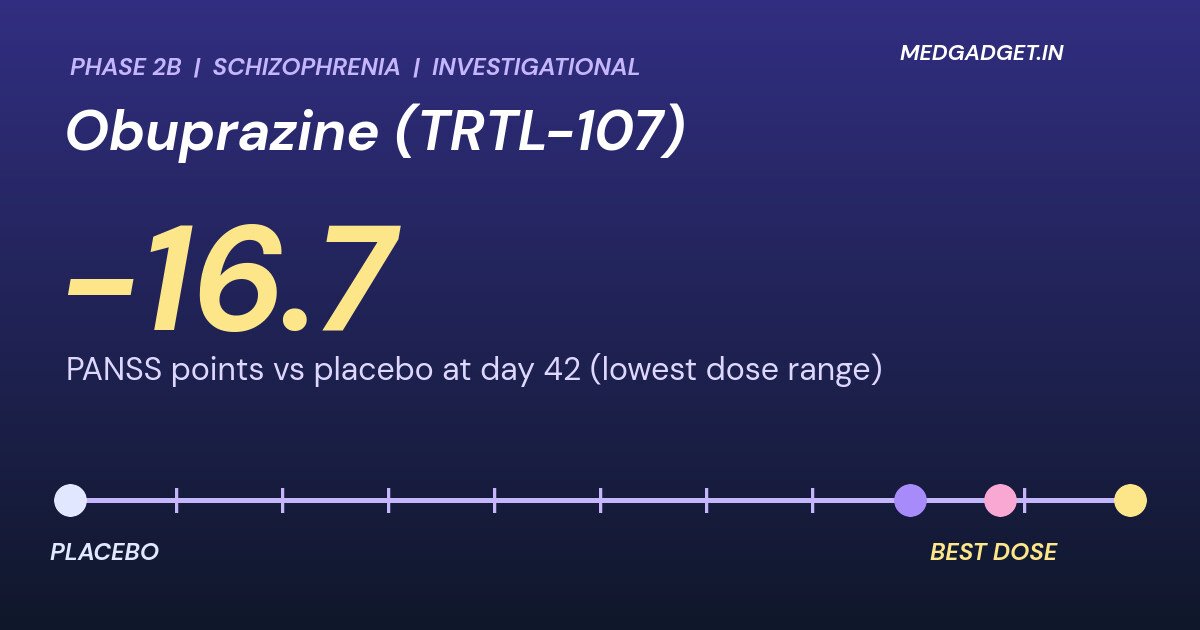
The headline figure is a placebo-adjusted improvement of 16.7 points on the Positive and Negative Syndrome Scale (PANSS) at the lowest dose range. That is a strong number on paper, but it comes from a company announcement, a six-week study and a single country. This report walks through the results, the arithmetic, the safety information that was and was not shared, and what must happen before a patient in the US could ever receive the drug.
Obuprazine schizophrenia clinical trial: the key results
- Design: randomised, double-blind, placebo- and active-controlled Phase 2b.
- Patients: 363 adults with acute schizophrenia, hospitalised within two months before screening, at 24 centres in China.
- Arms: obuprazine at 1.5 to 3.0 mg, 4.5 to 6.0 mg and 6.0 to 9.0 mg; aripiprazole as an active reference; and placebo.
- Primary endpoint: change in PANSS total score at day 42.
- Result: placebo-adjusted improvements of 16.7 points (1.5 to 3.0 mg), 13.2 points (4.5 to 6.0 mg) and 14.7 points (6.0 to 9.0 mg), each reported at p below 0.0001.
- Next step: a US IND submission and peer-reviewed publication of the full data.
Reading the PANSS numbers in the obuprazine schizophrenia clinical trial
PANSS rates 30 symptoms of schizophrenia, each from 1 to 7, so the total runs from 30 to 210, and a bigger fall means fewer symptoms. At the lowest obuprazine range, patients improved by an average of 28.6 points against 11.9 for placebo, which is where the 16.7-point gap comes from (28.6 minus 11.9).
Two details deserve attention. First, the placebo group improved a lot. By our calculation, the placebo change equals about 42% of the change seen on the lowest obuprazine range, a reminder that people in hospital trials often get better with care and structure alone. Second, there is no tidy dose-response: the lowest range did best and the middle range did least. One summary of the data also reports a placebo-adjusted effect of 12.1 points for aripiprazole. The company says obuprazine was numerically better than aripiprazole on several measures, but the announcement does not claim that this difference was statistically significant, and the confidence intervals reported for the two overlap.
Obuprazine schizophrenia clinical trial: symptom domains and speed
At day 42, all three obuprazine dose ranges improved positive symptoms such as hallucinations, negative symptoms such as withdrawal, and the Marder cognitive factor compared with placebo. At the lowest range, the placebo-adjusted gains were 5.3 points on the positive subscale and 4.4 points on the negative subscale. The company also reports that the share of patients with at least a 50% PANSS reduction was higher in the two lower dose groups than with placebo or aripiprazole by day 14, offered as evidence of fast onset. No responder percentages were given in the summaries we reviewed.
What the obuprazine schizophrenia clinical trial says about safety
Safety information is thin. About 2.1% of obuprazine patients and 2.5% of placebo patients stopped treatment because of adverse events. Hansoh describes events as mostly mild to moderate with no new significant concerns. What was not disclosed matters just as much to prescribers: rates of weight gain, restlessness (akathisia), movement side effects, sedation and prolactin changes. In schizophrenia, tolerability often decides whether patients keep taking a drug, so those figures will be scrutinised when the full paper appears.
How the drug is meant to work
Obuprazine is described as a dopamine D2/D3 partial agonist, a serotonin 5-HT1A partial agonist and a serotonin 5-HT2A antagonist. In plain terms, it is designed to dial dopamine signalling up or down depending on need rather than blocking it outright, while also acting on serotonin pathways linked to mood and cognition. That profile overlaps with existing partial-agonist antipsychotics, which is why the aripiprazole comparison is the one analysts will watch.
Limits of the obuprazine schizophrenia clinical trial evidence
- The study lasted six weeks, so durability and relapse prevention are untested.
- All patients were adults in China, and results may differ in other populations.
- The data come from a company announcement and are not yet peer reviewed.
- Per-arm patient numbers, detailed safety data and responder rates were not in the summaries we reviewed. If the 363 patients were split evenly, that would be roughly 70 per arm, but that is our estimate only.
- The chief executive of Tortugas called the data one of the most compelling efficacy datasets in recent years. That is the company’s view, not an independent assessment.
Where the obuprazine schizophrenia clinical trial leads next
Tortugas holds global commercial development rights excluding Greater China, where Hansoh retains them, and obuprazine is the most advanced of four assets in the companies’ agreement. Financial terms were not disclosed. The results were presented at the European College of Neuropsychopharmacology (ECNP) Congress in 2026. A US IND is a prerequisite for testing a new drug in American patients, but it is only a permission to start trials, not a step towards approval. No timeline for the IND or the next study was given.
The market context is active. We recently reported on the FDA approval of Teva’s monthly olanzapine injection Weltruza, an example of how formulation, not just new molecules, is changing schizophrenia care, and on the safety questions around the Newron evenamide clinical hold. See more in our pharmaceutical coverage.
Our assessment of the obuprazine schizophrenia clinical trial
In our assessment, the numbers are encouraging but incomplete. A 16.7-point gap is large, and the fact that every dose range separated from placebo supports a real drug effect. Still, the lack of a clear dose-response, high placebo response, short duration and missing safety detail mean this is a Phase 2b signal, not proof of benefit over existing medicines. The obuprazine schizophrenia clinical trial will matter most when it is repeated in a larger, more diverse population.
Frequently asked questions
Is obuprazine approved?
No. It is an investigational drug and has not been approved by the FDA or any other regulator on the basis of this study.
What did the obuprazine schizophrenia clinical trial show?
All three dose ranges lowered PANSS total scores more than placebo at day 42, by 13.2 to 16.7 points after adjusting for placebo.
Who ran the trial?
Hansoh Pharma ran the study in China. Tortugas Neuroscience holds rights outside Greater China.
What is next after the obuprazine schizophrenia clinical trial?
Tortugas plans to submit a US IND application and publish the full results in a peer-reviewed journal.
Is obuprazine better than aripiprazole?
Not shown. The company reports numerically larger effects on some measures but no statistical superiority.
How we reported this: we relied on the company announcement of 12 October 2026 and on summaries of the trial data. We did not read the full study. Figures labelled as ours are our own calculations. Last updated: 13 October 2026. This article is news reporting and not medical advice.