

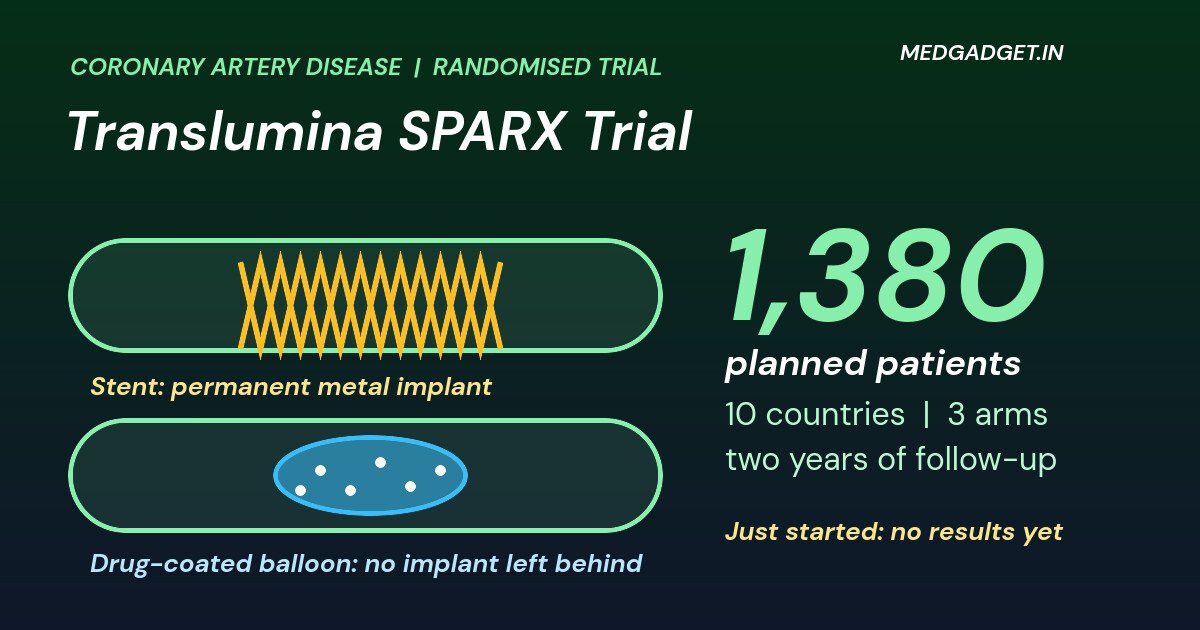
The Translumina SPARX clinical trial will test whether a balloon coated with the drug paclitaxel can be used first in complex coronary artery disease instead of a drug-eluting stent, which leaves a permanent metal implant in the artery. Translumina Therapeutics, a subsidiary of Integris Medtech, announced on 12 October 2026 that the multinational randomised trial has been initiated, with 1,380 patients planned across 10 countries and two years of follow-up.
The trial has begun, but it has produced no results. Whether a balloon-first strategy matches or beats modern stents in these patients is the question the study is designed to answer, and the answer will not be known for years. This report covers the design, the details that differ between the company’s release and the public trial record, and what to watch.
Translumina SPARX clinical trial: the design
- Question: a drug-coated balloon (DCB) strategy compared with contemporary drug-eluting stents (DES) in complex coronary disease.
- Size: 1,380 patients planned, across 10 countries according to the company.
- Arms: the trial register lists three: Translumina’s Protégé paclitaxel-coated balloon, a second paclitaxel-coated balloon called Agent, and a drug-eluting stent.
- Blinding: open label, meaning patients and doctors know which device is used.
- Primary endpoint: a device-oriented composite endpoint (DOCE), which the register defines as cardiac death, heart attack in the treated vessel and repeat treatment of the treated lesion for lack of blood flow.
- Registered as: NCT07397845 and CTRI/2026/04/109375.
Prof Adnan Kastrati of the German Heart Centre chairs the study. Prof Florim Cuculi of Luzerner Kantonsspital in Switzerland is global lead principal investigator, and Dr Praveen Chandra of Medanta, Gurgaon, is global co-principal investigator.
Where the sources differ on the Translumina SPARX clinical trial
The company’s release and the public trial record, which we read through a mirror of the ClinicalTrials.gov entry last updated on 1 June 2026, do not match on several points, and readers should know before quoting either.
- Primary endpoint timing: the release says the primary endpoint is assessed at one year; the register lists the DOCE at 24 months.
- Start date: the register gives an actual start of 22 April 2026 and marks the study as recruiting, while the release announces it as initiated in October.
- Sponsor: the release names Translumina Therapeutics Private Limited of India; the register names Translumina GmbH.
- Sites: the register lists only Lucerne, while the release cites 10 countries.
These may reflect an out-of-date registry entry, different stages of the same plan, or amendments. We have used the release for the headline numbers and flagged each difference.
Who can join the Translumina SPARX clinical trial
According to the register, adults with chronic coronary syndrome or a recent non-ST-elevation acute coronary syndrome can take part if the artery narrowing is significant and they have at least one complex feature: a small vessel (3 mm or less), a long lesion (25 mm or longer), heavy calcification, a chronic total occlusion, a bifurcation, diabetes or in-stent restenosis. Randomisation happens only after the lesion has been prepared successfully, in line with international consensus guidance on balloon use. People with a heart attack with ST elevation or shock, left main disease or a bypass graft target, severe kidney disease or very weak heart function are excluded.
Why the Translumina SPARX clinical trial tests balloons instead of stents
A stent is a small mesh tube that props the artery open after angioplasty, as described by the US National Heart, Lung, and Blood Institute. Modern drug-eluting stents release a drug to prevent re-narrowing, but the metal stays behind. Prof Kastrati said permanent metal implants may be linked to late adverse events beyond the first year. A drug-coated balloon delivers its drug to the artery wall during a short inflation and is then removed, which the company calls a “leave nothing behind” approach.
The idea is attractive for small vessels, long lesions and in-stent restenosis, where stents can be harder to use. Whether balloons give equal protection against heart attack and repeat procedures in complex lesions is not settled, which is why a large randomised comparison is needed.
A trial inside a trial
The register states a co-primary objective of comparing Translumina’s Protégé balloon with the Agent balloon, with the hypothesis that Protégé performs at least as well. This is a head-to-head test between two paclitaxel balloons as well as a comparison with stents. The register does not name the maker of Agent; we understand it to be a Boston Scientific device, which we could not confirm from the register itself. The sponsor is testing its own product, which is common in device research but means readers should look for independent oversight and reporting.
Market context
Devices for opening blocked arteries are a large and growing business. Acumen Research and Consulting values the global interventional cardiology devices market at USD 16.7 billion in 2022 and forecasts USD 36.1 billion by 2032, a compound annual growth rate of 8.2%. It says angioplasty stents held more than 29% of revenue in 2022 and that Asia-Pacific accounted for more than 52% of the market. The category also includes balloons, catheters and many other devices, so the figures are not a measure of the drug-coated balloon segment alone, and forecasts are projections, not measurements.
Why the Translumina SPARX clinical trial matters for India
Cardiovascular disease is the leading cause of death worldwide, according to the World Health Organization, and the trial’s Indian co-investigator, Dr Chandra, said India has one of the world’s highest-risk coronary populations. For an Indian manufacturer, running a randomised trial with European investigators is a bid for credibility with doctors abroad. The company says it manufactures in India, Germany and the Netherlands, and its parent has proposed a stock market listing in India, according to the release, so readers should treat promotional language with care.
Our assessment of the Translumina SPARX clinical trial
In our assessment, the Translumina SPARX clinical trial is a well-designed question, addressed by respected investigators, in patients where stents are often a poor fit. That does not mean the answer will favour balloons. The open-label design is a limitation, because endpoints such as repeat revascularisation can be influenced by what clinicians and patients know. If we equally split patients across the three arms, which the register does not state, each would have about 460 people. The first results are likely to be a few years away: the register gives an estimated primary completion of April 2028. For other cardiac technology, see our reports on the Fortis AI-powered hybrid cath lab, the Hēlo thrombectomy clearance and the at-home heart failure treatment study, or browse our medical device coverage.
What to watch next in the Translumina SPARX clinical trial
- Updates to the trial register, including sites and endpoint timing.
- Enrolment progress and any independent safety monitoring.
- The first results, likely not before 2028.
- Publication of the trial protocol.
Frequently asked questions
What is the Translumina SPARX clinical trial?
A randomised trial of 1,380 planned patients comparing paclitaxel-coated balloons with drug-eluting stents in complex coronary artery disease.
What is the primary endpoint of the Translumina SPARX clinical trial?
A device-oriented composite of cardiac death, target-vessel heart attack and repeat lesion treatment; the company says one year, while the trial register says 24 months.
Has the trial shown that balloons work as well as stents?
No. It has just begun and has no results.
Who sponsors the trial?
Translumina, which also makes one of the balloons being tested.
When will results be available?
The register estimates primary completion in April 2028.
How we reported this: we relied on the company’s 12 October 2026 release and a mirror of the public trial register entry, which we could not load directly. Figures labelled as ours are our own calculations. Last updated: 13 October 2026. This article is news reporting and not medical advice.
[…] by 2030, a rate of 7.5% a year. For other India cardiology device stories, see our report on Translumina’s SPARX drug-coated balloon trial and our report on Fortis’s AI-powered hybrid cath […]