

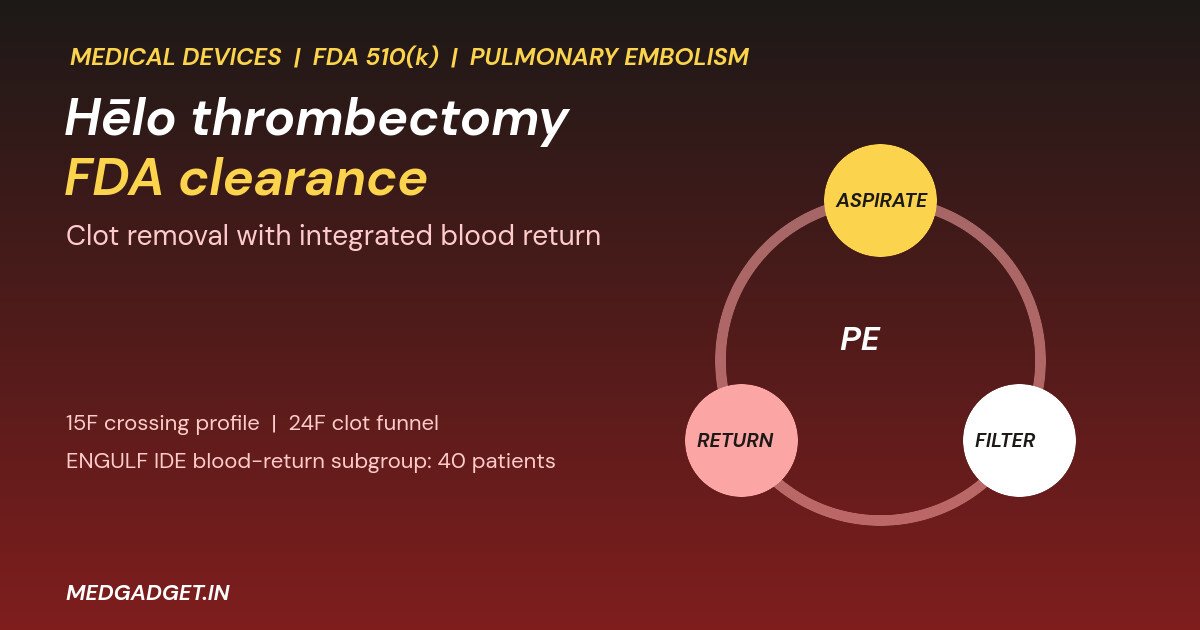
The Hēlo thrombectomy FDA clearance adds a feature that clot-removal devices for pulmonary embolism have lacked: a system that gives the patient’s own blood back. On 12 October 2026, Endovascular Engineering (E2), based in Menlo Park, California, announced 510(k) clearances for its Hēlo Thrombectomy System, a catheter for removing clots from the lungs’ arteries, and for Hēlo Return, a blood return system that collects, filters and returns blood drawn out during the procedure.
The company calls Hēlo Return the first blood-return system cleared for use with continuous vacuum aspiration. This report explains what was cleared, why blood loss matters in this procedure, what evidence the company has shown and what it has not, and where the dates and descriptions do not fully line up.
Hēlo thrombectomy FDA clearance: what was cleared
- Hēlo Thrombectomy System: non-surgical removal of emboli and thrombi from pulmonary arteries and veins, intended for peripheral veins and pulmonary embolism (PE). It can also be used to inject, infuse or aspirate contrast and other fluids.
- Hēlo Return: a blood return system used with the thrombectomy system to collect and filter aspirated whole blood before it goes back to the patient.
- Pathway: FDA 510(k), which clears a device as substantially equivalent to an earlier one, and is not the same as a full approval.
- Announced: 12 October 2026. The release gives no 510(k) numbers, clearance dates, price or launch timetable.
Why blood return matters in PE thrombectomy
Pulmonary embolism is a blockage in the arteries of the lungs, usually caused by a blood clot that travelled from the legs. It can strain the right side of the heart, and the National Heart, Lung, and Blood Institute and the Centers for Disease Control and Prevention explain the condition in general terms. Mechanical thrombectomy removes the clot with a catheter rather than dissolving it with drugs.
Large-bore aspiration works by suction, and suction pulls blood out along with the clot. In a patient who is already ill, losing a lot of blood is a concern. A system that filters that blood and returns it is intended to reduce the loss, and the company says its design brings blood loss close to zero. That claim is based on observations in its study, and the release does not give the numbers behind it.
How the Hēlo thrombectomy FDA clearance system works
The company describes continuous aspiration combined with mechanical clot disruption, delivered through a steerable catheter. It lists a 15F crossing profile and a 24F distal funnel that takes in the clot. By our conversion, at three French units to the millimetre, 15F is about 5 mm and 24F is 8 mm, which matches the 8 mm distal diameter in the FDA summary we found.
That FDA 510(k) summary K252956 describes a single-use, sterilised aspiration system that expands from a 16 Fr introducer. Its components include an aspiration catheter, an agitator, a rotating hemostatic valve, a 9F dilator and an optional audible flow indicator, and it connects to a vacuum pump. It names Penumbra’s Indigo Aspiration System with Lightning Flash as its main predicate, and E2’s earlier Hēlo G1 system as a reference device.
What the evidence for the Hēlo thrombectomy FDA clearance shows
The company says the ENGULF investigational device exemption study supported FDA review, and that supporting blood-quality testing was presented at the Society of Interventional Radiology (SIR) annual meeting in April 2026. The blood-return group cited in the release has 40 patients, and the release says ENGULF data are on file, with no published citation.
- Claims made: efficient single-pass procedures, the “highest reported clot reduction” and “lowest estimated blood loss” among PE thrombectomy device studies, and near-zero blood loss with blood return.
- What is missing: the full efficacy and safety numbers from ENGULF, event rates, and any head-to-head comparison.
- Company’s own caveat: a footnote says the cross-study comparisons are descriptive only, not head-to-head, and limited by differences in design and patients.
None of this establishes that the system produces better outcomes than other thrombectomy devices. The clearance shows the FDA found it substantially equivalent to a predicate, which is a lower bar than showing it is superior.
Dates behind the Hēlo thrombectomy FDA clearance that do not line up
The company’s release is dated 12 October 2026 and describes two new clearances, but gives no clearance dates. The FDA summary we found, for the Hēlo Thrombectomy System under K252956, carries a decision date of 18 December 2025 and already lists pulmonary embolism in its indications. A financing report from April 2026 also says the platform was cleared in late 2025 for use in peripheral veins. We therefore cannot say when each clearance was granted, or whether the PE indication was new in October. The company’s 15F crossing profile and the FDA’s 16 Fr introducer also describe different measurements, which may explain the small difference.
The company behind the Hēlo thrombectomy FDA clearance
E2 describes itself as a commercial-stage company focused on venous thromboembolism. In April 2026, it announced an $80 million Series C co-led by Gilde Healthcare and Norwest, following a $42 million Series B about a year earlier. By our sum, that is at least $122 million raised in two rounds, and the company said the money would build its commercial organisation. Chief executive Dan Rose said the clearances complete a platform that meets physician needs, and an interventional cardiologist from Beth Israel Deaconess Medical Center said it could expand access to mechanical thrombectomy. Both are opinions and not trial results.
Our assessment of the Hēlo thrombectomy FDA clearance
In our assessment, the Hēlo thrombectomy FDA clearance is meaningful because blood loss is a real practical limit on aspiration thrombectomy, and an integrated way to return blood addresses it directly. But the case is built on one study, a 40-patient subgroup and company-chosen comparisons, so the claim of better results remains unproven until the data are published. Hospitals will also want to know the cost and whether the extra system lengthens or simplifies procedures. For other recent device news, see our reports on the FDA clearance of a cuffless blood pressure ring and on Siemens Healthineers’ Accela radiotherapy system, or browse more medical device coverage.
What to watch after the Hēlo thrombectomy FDA clearance
- Publication of the full ENGULF results, including safety.
- The launch timetable, pricing and hospital adoption.
- Any comparative or registry data against other aspiration systems.
- Clarification of the clearance dates and 510(k) numbers.
Frequently asked questions
What did the Hēlo thrombectomy FDA clearance cover?
Two devices: the Hēlo Thrombectomy System for removing clots in pulmonary arteries and veins, and Hēlo Return, which filters and returns blood drawn out during the procedure.
What does the Hēlo thrombectomy FDA clearance mean by blood return?
A system that collects blood removed by suction during clot removal, filters it and gives it back to the patient to limit blood loss.
Is Hēlo Return proven to reduce blood loss?
The company reports near-zero blood loss in its study, but the underlying numbers have not been published.
Is the Hēlo thrombectomy FDA clearance an approval?
No. It is a 510(k) clearance, which means the device was found substantially equivalent to an existing one.
Who makes the system?
Endovascular Engineering, also known as E2, based in Menlo Park, California.
How we reported this: we relied on the company’s release of 12 October 2026, the FDA 510(k) summary K252956 and a financing report of April 2026. Performance claims are the company’s and have not been independently verified. Figures labelled as ours are our own calculations. Last updated: 13 October 2026. This article is news reporting and not medical advice.
[…] April 2028. For other cardiac technology, see our reports on the Fortis AI-powered hybrid cath lab, the Hēlo thrombectomy clearance and the at-home heart failure treatment study, or browse our medical device […]
[…] will be judged when full BOLT-DVT results are published and compared with existing care. See also Hēlo Thrombectomy FDA Clearance: Blood Return for PE. More in our medical device coverage, and company background is on the Penumbra […]