

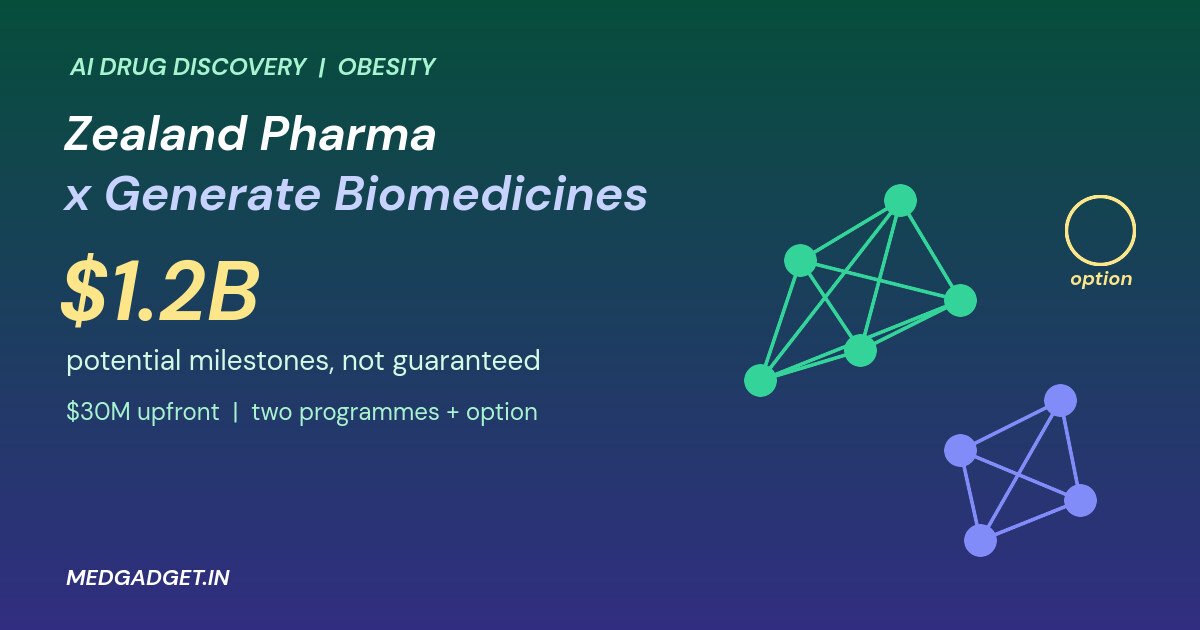
The Zealand Pharma Generate Biomedicines deal pairs a Danish obesity specialist with a Massachusetts company that designs proteins using generative artificial intelligence (AI). On 13 October 2026 (the morning of 14 October in India), the two companies announced a collaboration and license agreement to develop AI-engineered protein therapeutics for obesity and other metabolic diseases. The agreement includes a 30 million dollar upfront payment and carries potential milestone payments of nearly 1.2 billion dollars plus tiered royalties.
Those are maximum values, not revenue. Milestones are paid only if drug candidates clear research, clinical, regulatory and commercial hurdles, and no candidate from this collaboration has yet been named, let alone tested in people. Below we set out the terms, who does what and what the numbers imply.
Key takeaways
- Zealand Pharma and Generate Biomedicines will start with two programmes and have an option to add a third.
- Terms: 30 million dollars upfront, up to 35 million dollars in early preclinical milestones and nearly 1.2 billion dollars in total potential milestones, plus tiered royalties.
- Generate leads research through lead-candidate selection; Zealand takes over clinical development, regulatory filings and worldwide commercialisation.
- The programmes target multispecific protein therapeutics for obesity and other metabolic diseases.
- No clinical results exist, and the release does not name targets or candidates.
Terms of the Zealand Pharma Generate Biomedicines deal
According to the companies, the financial package has four parts: a 30 million dollar upfront payment; up to 35 million dollars in early preclinical milestones; total milestones, covering development, regulatory and commercial events, of nearly 1.2 billion dollars; and tiered royalties on future worldwide net sales of any products that reach the market. The release calls the milestones and royalties potential.
Our own arithmetic puts the upfront payment at about 2.5 percent of the 1.2 billion dollar headline, and the upfront plus early milestones at roughly 5 percent. The release does not say whether the 1.2 billion dollars includes those early amounts, so the percentages are approximate. The point stands: most of the stated value depends on success that is years away, and much of it may never be paid.
Closing conditions, such as antitrust review, are not mentioned in the release, and we have not seen the full agreement.
Who does what in the Zealand Pharma Generate Biomedicines deal
Generate will use its generative AI platform, which it says combines computational design with large-scale laboratory testing, to lead research through lead-candidate selection. Before designing, the teams will first define a target product profile for each programme, the set of properties a successful medicine should meet, and then generate candidates to meet or exceed it.
Zealand then takes on clinical development, regulatory submissions and worldwide commercialisation. The companies describe the work as multispecific protein therapeutics, meaning proteins designed to act on more than one biological target at once. Zealand says the deal broadens its toolkit beyond small molecules and peptides and opens approaches that act on several pathways.
Utpal Singh, Zealand’s chief scientific officer, called Generate a leader in AI and structure-enabled drug generation. Mike Nally, Generate’s chief executive, said the teams will first define what a great medicine looks like for each of the two initial programmes. Both are company statements.
Why the Zealand Pharma Generate Biomedicines deal matters
Obesity is one of the most competitive areas in drug development. The US National Institute of Diabetes and Digestive and Kidney Diseases lists approved options that mimic gut hormones such as GLP-1, and says adults on medication plus lifestyle programmes lose about 3 to 12 percent more of their starting weight after a year than those using lifestyle changes alone. It also notes that most people regain some weight after stopping and that side effects can be serious for some users. Companies are therefore looking for new mechanisms and better-tolerated options.
Zealand’s own pipeline shows the range. Zealand’s website describes petrelintide as a long-acting amylin analogue positioned as an alternative to GLP-1 receptor agonists, and survodutide as a glucagon and GLP-1 dual agonist licensed to Boehringer Ingelheim. For the latest petrelintide data, see our report on petrelintide’s Phase 2 ZUPREME-2 results, and for survodutide see survodutide weight loss in Phase III. The new collaboration is earlier and different in kind: it relies on AI to design a new class of molecules.
The AI angle
Generate describes itself as a clinical-stage generative biology company founded in 2018 and based in Somerville, Massachusetts. Generate Biomedicines says its platform integrates computational design with large-scale biological experimentation. Generative design can propose many protein candidates quickly, but each must still be made, tested for activity and safety and then taken through human trials. AI can shorten parts of discovery; it has not shortened the clinical stages. For another large pharma-AI tie-up, see our report on Novo Nordisk’s partnership with Anthropic for drug discovery.
Our assessment of the Zealand Pharma Generate Biomedicines deal
In our assessment, the Zealand Pharma Generate Biomedicines deal is a reasonable, modest-upfront way for Zealand to buy access to a new design approach while keeping control of the costly late stages. For Generate, it is validation and cash. For readers, the risk is reading the 1.2 billion dollar figure as value created. The honest test is whether the first candidates show better properties than existing obesity drugs, such as longer action, fewer side effects or effects beyond weight loss, and whether they do so in people. That will take years.
Risks and caveats of the Zealand Pharma Generate Biomedicines deal
- Milestones and royalties are contingent and may never be paid.
- No targets, candidates or data have been disclosed.
- The release lists risks including trial results, regulatory approval, competition and the need for capital.
- Closing conditions and the full contract terms are not public in the release.
What to watch after the Zealand Pharma Generate Biomedicines deal
- Announcement of the first candidates and target product profiles.
- Whether the third programme option is exercised.
- Preclinical data presented at scientific meetings.
- Any milestone payments disclosed in company reports.
Frequently asked questions about the Zealand Pharma Generate Biomedicines deal
How much is the Zealand Pharma Generate Biomedicines deal worth?
Up to nearly 1.2 billion dollars in potential milestones, plus 30 million dollars upfront and royalties. Those are maximums, not guaranteed payments.
Who does what?
Generate leads research through lead-candidate selection; Zealand handles clinical development, regulatory submissions and worldwide commercialisation.
What will they develop?
AI-engineered multispecific protein therapeutics for obesity and other metabolic diseases, starting with two programmes and an option for a third.
Is there an approved drug yet?
No. No candidate has been named and no human results exist.
How we reported this: we relied on the 13 October 2026 announcement by Generate Biomedicines and Zealand Pharma, Zealand’s website and US government health information. Company statements are labelled as such. Last updated: 14 October 2026. This article is news reporting and not investment or medical advice.