

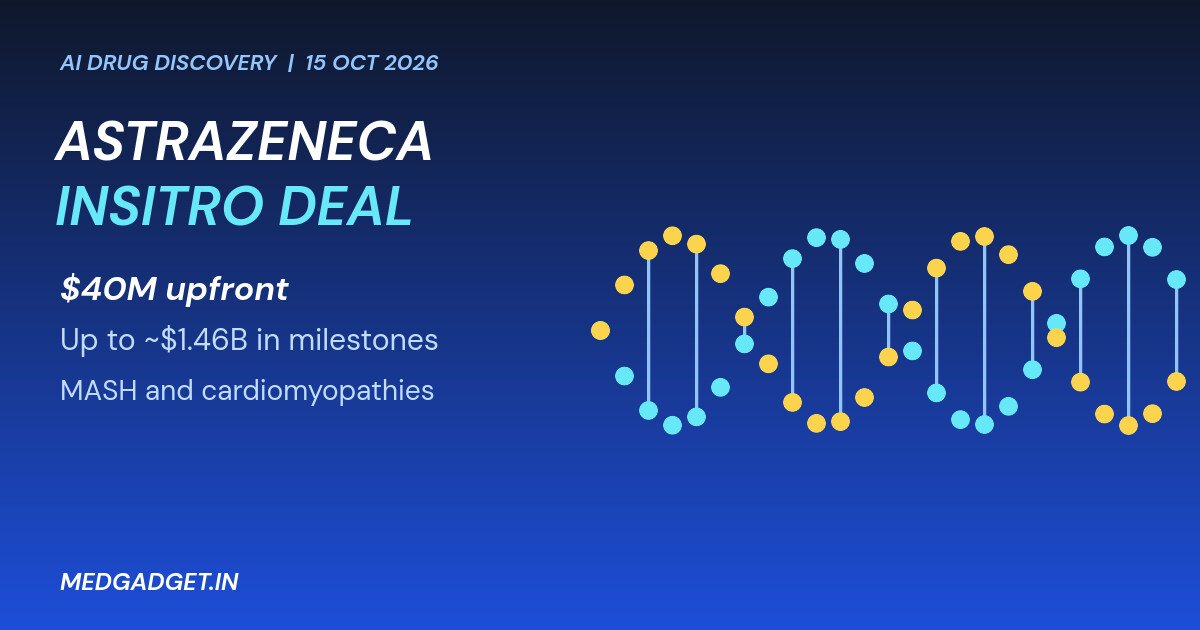
The AstraZeneca insitro AI drug discovery deal pairs a large drugmaker with an AI-focused biotech to look for new treatments for two hard-to-treat conditions: metabolic dysfunction-associated steatohepatitis (MASH), a serious liver disease, and cardiomyopathies. In a release dated 15 October 2026, AstraZeneca announced that insitro will receive $40 million upfront and is eligible for up to approximately $1.46 billion in development and commercial milestones, plus potential royalties. At the ceiling that adds up to about $1.5 billion, but only the upfront is certain.
Below we set out the money, the science each side brings, why these two diseases, what it could mean for patients and investors, and the questions the announcement leaves open.
AstraZeneca insitro AI drug discovery deal: key takeaways
- Upfront: $40 million paid to insitro.
- Milestones: up to approximately $1.46 billion tied to development and commercial events, plus potential single-digit royalties on global sales.
- Rights: AstraZeneca gets exclusive worldwide rights to advance selected programmes arising from the collaboration.
- Science: insitro will apply its Virtual Human platform, which combines large-scale human and cellular data with AI, to MASH and cardiomyopathies.
- Stage: early. The release names no drug candidates, and it does not state how long the collaboration will run.
What the money looks like in the AstraZeneca insitro AI drug discovery deal
The headline number is a ceiling, not a payment. By our arithmetic, $40 million plus $1.46 billion comes to $1.5 billion, and the upfront is about 2.7% of that total. In other words, roughly 97% of the potential value depends on programmes reaching later development and commercial stages. The release also mentions potential royalties in the single digits on global commercial sales, which would only apply if a medicine reaches the market.
That structure is common when a large company works with a platform company at an early stage. The partner gets cash now and a stake in any success, and the big company limits what it pays before there is clinical evidence.
What insitro brings to the AstraZeneca insitro AI drug discovery deal
insitro describes itself as an AI therapeutics company. Under the agreement it will apply its Virtual Human platform, which AstraZeneca describes as combining large-scale human and cellular data with AI-enabled target identification and medicine design, to find the causal biology behind both diseases. It will then advance AstraZeneca-nominated targets from discovery through to a development candidate, the stage at which a molecule is chosen to go into formal development. Daphne Koller, insitro’s founder and chief executive, said “MASH and cardiomyopathies are prevalent, underdiagnosed diseases.”
What AstraZeneca gets from the AstraZeneca insitro AI drug discovery deal
AstraZeneca takes exclusive worldwide rights to advance selected programmes and contributes its clinical development and regulatory expertise to progress the resulting medicines. Sharon Barr, executive vice president and head of BioPharmaceuticals R&D, said “one of the most critical decisions in R&D is selecting the right target.” That is the problem the collaboration is meant to address: choosing better targets before the expensive work starts.
AstraZeneca describes itself as a global, science-led biopharmaceutical company with medicines sold in more than 125 countries and a headquarters in Cambridge, UK. The release places this work within its cardiovascular, renal and metabolism area, which it says is focused on the links between the heart, kidneys, liver and pancreas.
Why MASH and cardiomyopathies
MASH is a liver disease in which fat build-up comes with inflammation and can progress to scarring; the NIDDK has background on liver disease. Cardiomyopathies are diseases of the heart muscle, and the NHLBI explains the main types. The release calls both complex and heterogeneous, with significant unmet need, which is why a data-driven approach to separating subtypes is attractive. It does not say which cardiomyopathies are in scope.
What the AstraZeneca insitro AI drug discovery deal could mean for patients
For patients, nothing changes soon. The programmes are at the discovery stage, and a medicine that comes out of them would still need to pass through candidate selection, safety studies, human trials and regulatory review. Those steps usually take many years, and many programmes do not complete them. The practical value of the announcement today is therefore as a signal: a large company has judged that AI-guided target discovery is worth paying for in two diseases that affect many people and often go undiagnosed. Whether it produces a treatment will only be known when candidates reach trials.
What it means for biotechnology investment
For the sector, the deal is another sign that large companies will pay for AI platforms, but on terms that limit their risk. The upfront payment is small next to the ceiling, which means insitro’s outcome depends on programme success rather than on the announced total. Readers comparing deals should look at the upfront and the milestone triggers, not the headline sum. This is not investment advice, and we have not seen financial forecasts from either company.
Risks and caveats of the AstraZeneca insitro AI drug discovery deal
- Early stage: there are no named candidates, no human data, and no trial dates.
- Milestones are contingent. Most of the headline value may never be paid.
- The release does not state the duration of the collaboration or the number of programmes, so descriptions of it as multiyear cannot be confirmed from the official text.
- AI-assisted target selection is promising, but it has to be proven by clinical results in these diseases.
In our assessment, the sensible reading of the AstraZeneca insitro AI drug discovery deal is a measured bet: modest cash up front, large optional upside, and a test of whether AI can improve target choice in two hard areas. For a related story on AI in drug discovery, see our report on Peptris and more in biotechnology.
What to watch next in the AstraZeneca insitro AI drug discovery deal
- Disclosure of how many programmes are under the collaboration.
- The first development-candidate nominations.
- Any first-in-human trial announcements.
- Further milestone or royalty details in AstraZeneca’s reporting.
Frequently asked questions
How much is the AstraZeneca insitro AI drug discovery deal worth?
$40 million upfront plus up to approximately $1.46 billion in milestones, so about $1.5 billion at most, with potential royalties.
What will insitro do?
Use its Virtual Human platform to find disease mechanisms and take AstraZeneca-nominated targets to a development candidate.
Which diseases are covered?
MASH and cardiomyopathies.
Are any drugs in trials?
No candidates have been named, and the programmes are at the discovery stage.
How we reported this: we relied on AstraZeneca’s announcement of 15 October 2026 and the company websites named. Figures labelled as ours are our own arithmetic. Last updated: 16 October 2026. This article is news reporting and not investment or medical advice.
[…] other health systems join. See also AstraZeneca India Clinical Trial Partnership: Bold Push and AstraZeneca insitro AI Drug Discovery Deal: Bold $1.5B Bet. More in our healthcare IT coverage. Company background is at […]
[…] not evidence of impact, so the real test will be named customers and measured outcomes. See also AstraZeneca insitro AI Drug Discovery Deal: Bold $1.5B Bet. More in our healthcare IT […]