

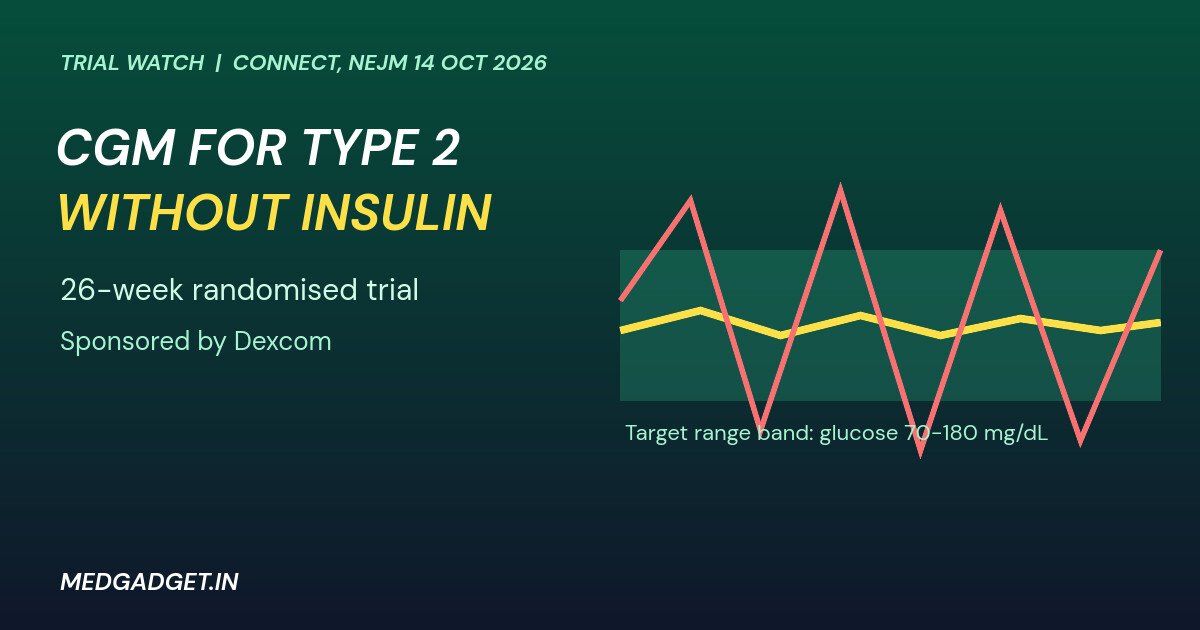
Continuous glucose monitoring for Type 2 diabetes improved blood sugar control in adults who do not use insulin, according to the Dexcom-sponsored CONNECT randomised trial. Over 26 weeks, adults using the Dexcom G7 monitor cut their HbA1c by 1.6 percentage points, from 8.8%, and the adjusted gap against routine care was 0.9 points. They also spent about five more hours a day in the target glucose range. Per Dexcom’s announcement of 14 October 2026, the results were published in The New England Journal of Medicine on that date. The trial was sponsored by the device maker and ran for six months.
Continuous glucose monitoring for Type 2 diabetes: key takeaways
- Design: randomised controlled trial at 22 US primary care practices, 26 weeks.
- Participants: 283 adults with Type 2 diabetes not using insulin were randomised; 265 completed.
- HbA1c: 8.8% to 7.2% with the Dexcom G7 and 8.7% to 8.0% with routine care, as reported; adjusted difference 0.9 points.
- Time in range: 62% versus 41%, about five hours a day.
- Caveats: sponsored by Dexcom, six months long, and key statistics and safety data were not in the sources we could access.
How continuous glucose monitoring for Type 2 diabetes was tested
CONNECT compared the Dexcom G7 with routine care, in which participants checked their glucose with a standard meter. Per the American Diabetes Association’s press release and Dexcom’s June release, 440 people were screened and 283 randomised across 22 primary care practices. Their mean age was 60, 32% were from racial or ethnic minority groups, and their mean HbA1c at the start was 8.8%, with 31% at 9% or higher. About 40% took an incretin-based medicine and 37% an SGLT2 inhibitor. Both groups received diet and exercise education and kept their existing glucose-lowering medicines. Summaries differ on the lowest HbA1c allowed at entry, so we do not state one.
What the trial of continuous glucose monitoring for Type 2 diabetes found
On the main outcome, the Dexcom G7 group reduced HbA1c by 1.6 points from a baseline of 8.8%. Coverage of the published paper reports 8.8% to 7.2% for the monitor group and 8.7% to 8.0% for routine care, which implies a raw difference of about 0.9 points; that subtraction is ours. Dexcom reports the adjusted difference as 0.9 points in favour of the G7 but gives no confidence interval in the materials we reviewed. According to the sponsor, 82% of G7 users lowered HbA1c by at least 0.5 points, 68% reached below 7.5%, and 46% reached below 7.0%.
What HbA1c measures
HbA1c reflects the share of haemoglobin in red blood cells that has glucose attached, and it gives an average of blood glucose over roughly the past three months, as the NCBI clinical reference explains. A reading of 6.5% or higher is diagnostic of diabetes. Because it is an average, it can hide swings, which is why trials also report time in range from the monitor itself. A fall of 0.9 points is large by diabetes-trial standards, but the clinical meaning for an individual depends on starting level, other treatments and complication risk.
Time in range and who benefited from continuous glucose monitoring for Type 2 diabetes
Time in range, defined here as glucose between 70 and 180 mg/dL, was 62% with the G7 and 41% with routine care at 26 weeks, a gap of 21 percentage points. By our arithmetic that is about five hours a day, matching the sponsor’s statement. The sponsor says the improvement appeared within the first one to four weeks. In people with a starting HbA1c above 10%, the G7 group fell by 3.1 points, 2.1 more than routine care, and the sponsor reports benefit across the medicine subgroups it examined. These subgroup results come from the company and ADA materials rather than the full paper.
Sponsorship and what is missing from the continuous glucose monitoring for Type 2 diabetes data
Dexcom sponsored the trial and tested its own device, and Dr Roy Beck of the Jaeb Center for Health Research is the senior author. That does not invalidate the findings, but readers should weigh them accordingly. The sources we reviewed give no safety or adverse-event data, no confidence intervals and no per-arm sample sizes. A six-month extension is under way to see whether benefits last to 12 months. We could not open the full paper, so we have not assessed its methods in detail.
Does continuous glucose monitoring for Type 2 diabetes set a new standard of care?
Dexcom’s chief executive, Jake Leach, said the company anticipates the results will help establish a new standard of care in the United States and around the world. That is a company expectation. Dr Beck said the consistency of benefit supports consideration of CGM earlier in Type 2 diabetes management, a more measured statement. Guidelines, insurance coverage, cost and availability differ between countries and health systems, and none of those is addressed in the trial materials. The results alone do not establish a standard of care everywhere.
What continuous glucose monitoring for Type 2 diabetes means for patients
People with Type 2 diabetes who do not use insulin should not change their treatment or buy a device on the strength of one sponsored trial. A doctor or diabetes educator can say whether monitoring suits their regimen, goals and budget. This article is news reporting, not medical advice.
Risks and caveats on continuous glucose monitoring for Type 2 diabetes
- The trial was sponsored by the device maker.
- The study lasted six months; longer-term benefit is not yet known.
- Safety data and confidence intervals were not available to us.
- Participants were enrolled at US primary care practices, so results may not apply everywhere.
In our assessment, continuous glucose monitoring for Type 2 diabetes looks promising for people on non-insulin regimens with high HbA1c, but the strongest claims will rest on independent replication and the 12-month extension. See also Petrelintide Hits Phase 2 Primary Endpoint in Obesity + Type 2 Diabetes: Up to 9.2% Weight Loss (ZUPREME-2) for another type 2 diabetes trial. More in our medical device coverage.
What to watch next for continuous glucose monitoring for Type 2 diabetes
- The 12-month extension results.
- Full safety and statistical detail from the paper.
- Independent trials and cost-effectiveness analyses.
- Guideline and coverage decisions outside the US.
Frequently asked questions
What did the CONNECT trial find?
Adults with Type 2 diabetes not using insulin lowered HbA1c more with the Dexcom G7 than with routine care.
How big was the effect?
The adjusted difference was 0.9 percentage points, with about five more hours a day in range.
Who funded it?
The trial was sponsored by Dexcom.
Is this now the standard of care?
Not automatically. The trial does not establish that everywhere.
How we reported this: we relied on Dexcom’s announcements, the American Diabetes Association’s press release and an NCBI clinical reference; we could not open the published paper. Last updated: 16 October 2026. This article is news reporting and not medical advice.
[…] trial reproduces a gap of about three points with the same clean tolerability profile. See also Continuous Glucose Monitoring for Type 2 Diabetes: Promising. More in our pharmaceutical […]
[…] validation settings, are what hospitals can apply while waiting for the November update. See also Continuous Glucose Monitoring for Type 2 Diabetes: Promising. More in our medical device coverage, and general regulator information is on the FDA medical […]