

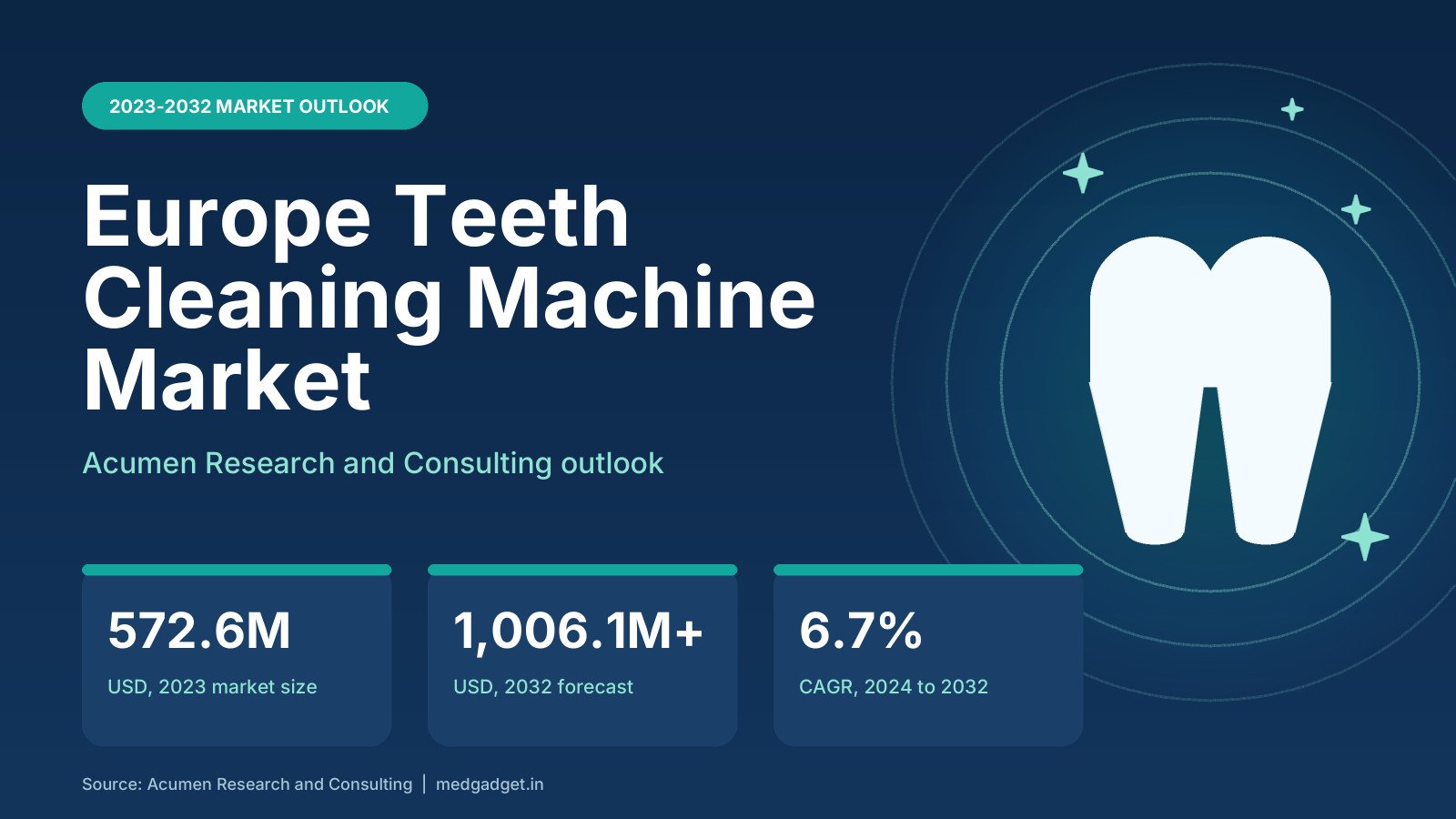
Europe’s teeth cleaning machine market is on course to cross the USD 1 billion mark by 2032, according to the Europe Teeth Cleaning Machine Market report by Acumen Research and Consulting. The report values the Europe Teeth Cleaning Machine Market at USD 572.6 million in 2023 and expects it to surpass USD 1,006.1 million by 2032, a compound annual growth rate (CAGR) of 6.7% between 2024 and 2032.
Behind that headline sits a market built on a few clear pillars. Ultrasonic cavitron machines account for more than 80% of sales, according to Acumen. Treatment procedures such as scaling and root planing make up roughly three-quarters of demand. Germany alone represents about 30% of regional spending. Ageing populations, rising dental care budgets and a shift toward compact, home-use and portable devices are pushing the market forward, while device costs and strict EU medical device rules act as brakes. This report unpacks the numbers, the trends and what they mean for dental clinics, manufacturers and investors.
Key Takeaways
- The Europe Teeth Cleaning Machine Market was valued at USD 572.6 million in 2023 and is forecast to surpass USD 1,006.1 million by 2032, a 6.7% CAGR for 2024 to 2032.
- Ultrasonic cavitron machines lead the type segment with more than 80% of sales, while treatment accounts for about 75% of application demand.
- Germany is the largest national market at USD 171.8 million in 2023 (about 30%), and the UK is expected to grow faster, at around 7.5% a year.
- Ageing populations, higher dental spending, oral-hygiene awareness and technology upgrades drive demand; high device costs, uneven access and EU Medical Device Regulation requirements restrain it.
- Home-use devices, portable and wireless models, eco-friendly water-based systems, dental tourism and cosmetic dentistry are the trends to watch.

How Big Is the Europe Teeth Cleaning Machine Market?
Short answer: Acumen Research and Consulting values the Europe Teeth Cleaning Machine Market at USD 572.6 million in 2023 and projects it to surpass USD 1,006.1 million by 2032, growing at a CAGR of 6.7% from 2024 to 2032.
| Metric | Figure | Basis |
|---|---|---|
| Market size, 2023 | USD 572.6 million | Acumen report |
| Forecast, 2032 | More than USD 1,006.1 million | Acumen report |
| CAGR, 2024 to 2032 | 6.7% | Acumen report |
| Growth multiple | About 1.76x | Derived |
| Added annual market value | About USD 433.5 million | Derived |
The last two rows are simple arithmetic on the published figures (1,006.1 divided by 572.6, and the difference between the two values), not separate estimates. They show the scale of the expansion: within nine years the market is expected to add the equivalent of three-quarters of its 2023 size.
One caution applies to any long-range forecast. The report uses 2023 as its base year, so real-world conditions in 2026, from pricing to new product launches, may already be moving faster or slower than the model assumes. The figures are best read as a directional guide to where demand is heading rather than a precise year-by-year track.
Why Ultrasonic Cavitron Machines Dominate
Acumen segments the market by type into ultrasonic cavitron machines and sandblasting teeth cleaning machines. Ultrasonic cavitron units lead decisively, accounting for more than 80% of sales according to the report. Applied to the 2023 market, that share implies more than USD 458 million of annual sales (a derived figure, not a published one).
The reasons are practical. In clinical practice, ultrasonic scalers typically combine high-frequency vibration with a water spray to loosen plaque and calculus, the hardened deposits that brushing cannot remove. That makes them a workhorse for routine hygiene visits and for deeper periodontal care. Acumen also lists advances in ultrasonic and electric appliances among the technology forces supporting growth. Sandblasting systems, the report’s other type, are generally associated with polishing and surface-stain removal and sit in a much smaller slice of sales.
The takeaway for manufacturers is that competition is concentrated in one technology family. Differentiation is likely to come from ergonomics, tip design, water management, connectivity and price rather than from a change in core technology.
Treatment Drives Demand, Medical Beauty Follows
By application, Acumen splits demand into treatment, which covers scaling, root planing and other procedures, and medical beauty. Treatment is the dominant application at about 75% of the market, which would equal roughly USD 429 million of 2023 sales (derived). Medical beauty ranks second.
Scaling removes calculus from the tooth surface and below the gum line, while root planing smooths root surfaces so gums can reattach more easily. Because these procedures are tied to disease management and routine preventive care, they tend to be less discretionary than cosmetic work. At the same time, the report highlights growing interest in cosmetic dentistry, which suggests that medical beauty could gradually claim a larger share of the pie. That is analysis, not a published forecast, but it is a trend worth tracking.
Germany, the UK and the Rest of Europe
Short answer: Germany is the largest national market at USD 171.8 million in 2023, while the UK is expected to expand faster, at a CAGR of about 7.5% from 2024 to 2032.
| Country | Key figure from the Acumen report |
|---|---|
| Germany | USD 171.8 million in 2023, about 30% of the market; CAGR over 6% (2024 to 2032) |
| United Kingdom | CAGR of about 7.5% (2024 to 2032) |
| France, Spain, Rest of Europe | Covered in the report’s country analysis |
Germany’s USD 171.8 million is almost exactly 30% of the USD 572.6 million regional total, so a single country carries nearly a third of European spending. That concentration reflects the scale of its dental sector and its role as a base for equipment makers. The UK’s projected 7.5% growth is 0.8 percentage points ahead of the 6.7% regional average (a derived comparison), which would make it one of the faster-growing national markets over the forecast period.
What Is Driving the Europe Teeth Cleaning Machine Market?
Short answer: the main drivers are an ageing population that needs more dental care, rising disposable incomes and better access to dentistry, stronger oral-hygiene awareness, and technology upgrades in ultrasonic and electric devices.
An ageing population and a heavy disease burden
Acumen lists a growing elderly population needing more dental care as a core driver. Independent evidence points the same way. A report commissioned by the European Federation of Periodontology (EFP) and published by the Economist Intelligence Unit found that periodontitis prevalence in six European countries (France, Germany, Italy, the Netherlands, Spain and the UK) had remained stable over 20 years and was generally highest among people aged 65 to 74. It concluded that population ageing increases demand for detection and treatment of the disease.
The wider picture is just as striking. According to the World Health Organization’s European office, as reported in April 2023, 50.1% of European residents have a significant oral disease such as caries or periodontitis, the highest rate of any WHO region. A condition that common creates steady, recurring demand for professional cleaning equipment.
Higher spending and better access
Acumen points to rising disposable income and improved access to dental care, supported in Western Europe by incomes and insurance coverage. More patients attending regular check-ups means more scaling procedures per clinic, which in turn supports equipment upgrades and replacement cycles.
Awareness campaigns and prevention
Public awareness is a quieter but persistent force. Acumen cites campaigns such as European Oral Health Day. Separately, the EFP marks Gum Health Day every 12 May and used the 2026 edition to launch a three-year campaign called Empowering Lives, linking healthy gums to confidence, quality of life and overall health. The EFP also says severe gum disease affects more than one billion people worldwide. Campaigns like these encourage earlier visits, which feeds directly into hygiene and treatment volumes.
Technology that clinics want to buy
Finally, product innovation. The report names advances in ultrasonic and air polishing technologies as a driver. Better handpieces, quieter units and more efficient water delivery make newer machines easier to justify for clinics that already own older equipment.
Trends Reshaping the Market
Home-use and compact devices
Acumen flags growing popularity of ultrasonic and electric devices for home use and the growth of compact, at-home designs. If that trend holds, the market’s centre of gravity could widen beyond clinics into consumer channels, bringing new retailers, pricing expectations and safety messaging with it.
Portable, wireless and battery-operated models
Portable and wireless units suit mobile dentistry, care homes and smaller practices. For an ageing Europe, where some patients cannot easily travel, equipment that can move to the patient has obvious appeal.
Eco-friendly, water-based systems
The report also notes demand for eco-friendly systems, including water-based cleaning. Sustainability is increasingly part of procurement criteria across European healthcare, and manufacturers that can show lower consumable use may gain an edge.
Dental tourism in Hungary and Poland
Acumen highlights the expansion of dental tourism in Hungary and Poland. Clinics serving international patients tend to invest in modern equipment to compete on quality as well as price, which creates a pocket of demand outside the traditional Western European core.
Cosmetic dentistry
Rising interest in cosmetic dentistry supports the medical beauty application, which is already the second-largest segment. Polishing and cleaning are common first steps before whitening or aesthetic work, linking cosmetic growth to machine demand.
Barriers: Cost, Access and Regulation
Growth is not frictionless. Acumen identifies three restraints. First, the high cost of advanced devices, such as laser-based systems, which can limit adoption in price-sensitive practices. Second, limited dental access in rural Eastern Europe, which holds back equipment demand where clinics are scarce. Third, strict EU Medical Device Regulation requirements that can slow product approvals.
The access problem has a policy dimension too. The same WHO European office report noted that more than 20% of European countries have no oral health professional in their health ministries, a sign that oral health is not yet prioritised everywhere. Closing those gaps would widen the addressable market, but progress is likely to be gradual.
Who Competes in the Europe Teeth Cleaning Machine Market?
The Acumen report names ten key players: W&H Dentalwerk International, Dentsply Sirona, LM-Instruments Oy, Straumann, Denticator Inc., Ningbo Runyes Medical Instrument Co. Ltd., GC Europe NV, Ivoclar Vivadent, Dürr Dental and 3M Company. Several have deep European roots, including W&H (Austria), LM-Instruments (Finland), Straumann (Switzerland), Ivoclar Vivadent (Liechtenstein), Dürr Dental (Germany) and GC Europe (Belgium).
The report summary reviewed for this article does not publish individual market shares, so no ranking is implied by the order of the list. What the roster does show is a mix of dental-equipment specialists, broad dental-solutions groups and a diversified manufacturer, all competing in the same ultrasonic-led segment.
What It Means for Clinics, Manufacturers, Investors and Patients
Dental clinics face a steady upgrade cycle. With ultrasonic units dominant, purchasing decisions are likely to hinge on reliability, handpiece ergonomics, service networks and total cost of ownership rather than on the technology itself.
Manufacturers should note the dual track: premium clinical systems on one side, compact and home-use models on the other. Meeting EU Medical Device Regulation requirements efficiently is a competitive skill in its own right, given the approval delays the report flags.
Investors will see a mid-single-digit growth market rather than a hyper-growth one. A 6.7% CAGR is steady and fairly defensive, supported by demographics, with upside from the UK, home-use devices and dental tourism hubs (this is analysis, not investment advice).
Patients are likely to benefit from broader availability of professional cleaning, quieter and more comfortable equipment, and more options for use at home. Professional scaling remains the standard for removing calculus; home devices complement but do not replace it.
What to Watch Through 2032
- Home-use adoption. Whether consumer ultrasonic and electric devices become a meaningful new revenue stream.
- UK momentum. Whether the UK’s projected 7.5% growth materialises and how it compares with Germany’s steadier pace.
- Regulatory timing. How EU Medical Device Regulation requirements affect launch schedules for new models.
- Access in Eastern Europe. Whether investment and policy narrow the gap in rural dental provision.
Frequently Asked Questions About the Europe Teeth Cleaning Machine Market
How big is the Europe Teeth Cleaning Machine Market?
Acumen Research and Consulting values it at USD 572.6 million in 2023 and expects it to surpass USD 1,006.1 million by 2032.
What is the CAGR of the Europe Teeth Cleaning Machine Market?
The report projects a CAGR of 6.7% from 2024 to 2032. The UK is expected to grow faster, at about 7.5%, and Germany at over 6%.
Which country has the largest teeth cleaning machine market in Europe?
Germany, with USD 171.8 million in 2023, about 30% of the regional market.
What is the most common type of teeth cleaning machine?
Ultrasonic cavitron machines, which account for more than 80% of sales according to the Acumen report. Sandblasting machines are the other type covered.
What is driving growth in the Europe Teeth Cleaning Machine Market?
An ageing population, rising disposable income and dental access, greater oral-hygiene awareness and advances in ultrasonic and electric technology, with home-use devices, dental tourism and cosmetic dentistry as emerging trends.
Sources
- Acumen Research and Consulting: Europe Teeth Cleaning Machine Market (report page)
- Acumen Research and Consulting: Europe Teeth Cleaning Machine Market press release, 10 October 2025
- European Federation of Periodontology: Economist Intelligence Unit report on periodontitis
- European Federation of Periodontology: Gum Health Day 2026
- Dimensions of Dental Hygiene: WHO finds Europe has the highest rates of oral disease
Market figures are estimates from the cited Acumen report and may be revised. Values labeled as derived are calculated from the published figures and are illustrative.
[…] ICMR Medical Device Development Initiative: Bold Plan Fortis Hospital Kitchen Licence Suspended: Hygiene Alarm Ebola Outbreak October 2026: DRC Spread Alarms, Kenya Cases Cancer Medicine Price Reduction in India: Bold Cap Nov 9 Europe Teeth Cleaning Machine Market to Top USD 1 Billion by 2032 […]