

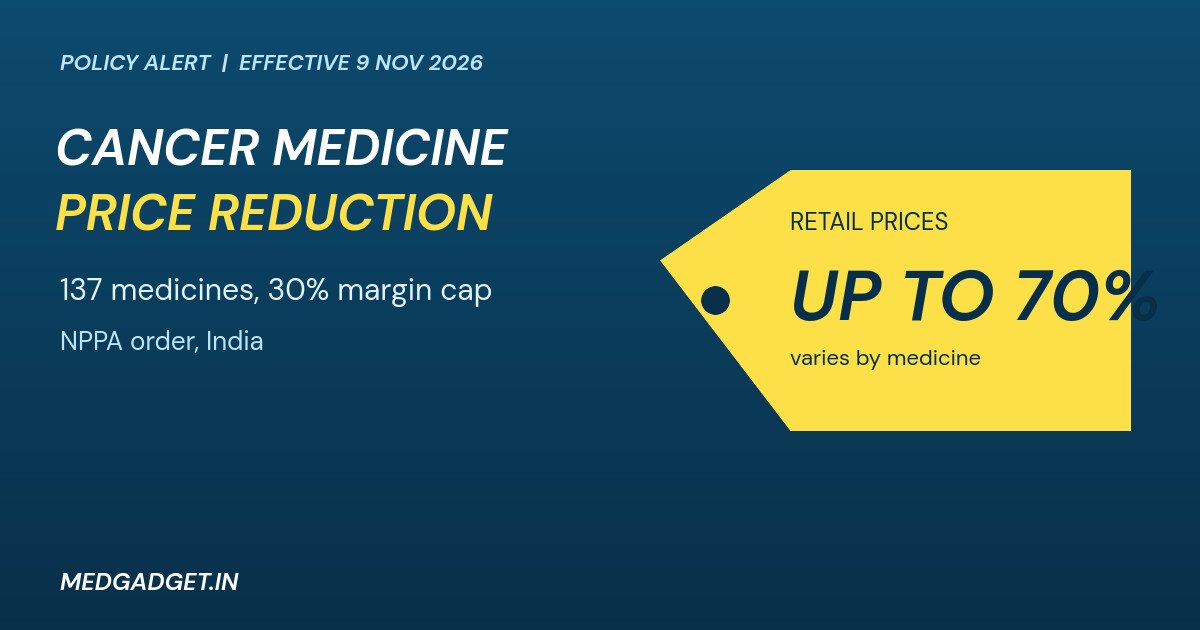
The cancer medicine price reduction in India announced on 17 October 2026 covers 137 non-scheduled anti-cancer medicines, with revised prices due to take effect on 9 November 2026. India’s drug-price regulator, the National Pharmaceutical Pricing Authority (NPPA), has capped trade margins on these medicines at 30%, and the Ministry of Chemicals and Fertilisers says retail prices are expected to fall by up to 70%, depending on each product’s current price structure. That is a ceiling on the possible fall, not a promise that every medicine will become 70% cheaper.
This report explains what the order does, how the cap works in practice, and what patients, pharmacies and hospitals can expect from the cancer medicine price reduction in India on the effective date.
Cancer medicine price reduction in India: key takeaways
- What: a 30% cap on trade margins for 137 non-scheduled anti-cancer medicines, ordered by the NPPA.
- When: revised maximum retail prices take effect on 9 November 2026 and stay until further orders.
- How much: retail prices are expected to fall by up to 70%, depending on each medicine; some may see little or no change.
- Basis: Paragraph 19 of the Drugs (Prices Control) Order, 2013, the same exceptional power used in 2019.
- Not yet confirmed here: the official list of medicines and the revised price of any individual product.
What the cancer medicine price reduction in India covers
According to the Ministry’s statement as carried in agency reports, the NPPA acted through a mechanism called Trade Margin Rationalisation after a gazette notification issued on Saturday, 17 October. The 137 medicines are non-scheduled, which means they are not on the national list of essential medicines whose ceiling prices are fixed directly. The list was drawn up on the recommendation of an expert committee that included oncologists and hospital specialists, and the statement says it will be updated periodically. Reports describe the aim as curbing excessive margins in distribution and retail without denting legitimate manufacturing revenues or causing artificial shortages.
How the 30% cap behind the cancer medicine price reduction in India works
The cap limits the margin between what a manufacturer sells a medicine for and the maximum retail price printed on the pack. Summaries of the order give the formula as maximum MRP equal to the price to stockist multiplied by 100/70, plus GST. In the worked example reported from the order, a product sold to stockists at ₹70 may carry a maximum MRP of ₹100 before GST; if its current MRP is ₹300, that is a cut of ₹200 before GST. By our arithmetic, ₹30 is 30% of ₹100, which equals a markup of about 43% on ₹70. The reference price is each manufacturer’s March 2026 price to stockists, according to those summaries.
Why up to 70% does not mean every medicine falls 70%
The size of a fall depends on the gap between the price to stockists and the current MRP. A medicine with a large gap could fall steeply; one with a modest gap could barely move. Reports say manufacturers must cut prices only where the existing MRP exceeds the amount the formula allows, and that a lower existing MRP stays as it is. Because many patients already pay below MRP through discounts or hospital contracts, the change in what an individual actually pays may differ from the change in the printed price.
What patients should expect from the cancer medicine price reduction in India on 9 November
From the effective date, retail outlets and hospitals are expected to charge the revised prices and display them. According to the Ministry’s statement, consumers can check rates on the NPPA website and through the Pharma Sahi Daam app, and state drug controllers are directed to enforce compliance. Patients should compare the price on a new pack or bill against the revised price list, and raise any difference with the pharmacy or the state drug controller. We cannot say what any individual medicine will cost, and this article is not medical advice.
What manufacturers and hospitals must do
Summaries of the order say manufacturers must report revised prices to the NPPA and state drug controllers within seven days of publication, publish price lists, and keep production at existing levels, with prior permission needed to reduce it. A six-month notice period is reported for discontinuing a listed product. Hospitals must display the revised rates and are responsible for implementation. Free supplies under a company’s patient assistance programme are reported to be excluded from the calculation, subject to conditions.
What happened in 2019
India has used this tool before. In its government notice of February 2019, the NPPA capped trade margins at 30% on 42 non-scheduled anti-cancer drugs under the same paragraph of the pricing order, calling it a proof of concept. A follow-up release of March 2019 said 390 brands had cut prices by up to 87%, and a later government release put the figure at up to 90% across 526 brands. Those results show the scale of change possible, but they relate to a different list and market.
What we have not verified about the cancer medicine price reduction in India
We have not reviewed the gazette text itself, so the figures above come from the Ministry’s statement as reported and from summaries of the order. Reports describe the list as including targeted therapies and immunotherapies, but we have not seen the official list, so we do not name individual medicines, cancer types or revised prices.
Risks and caveats on the cancer medicine price reduction in India
- The up-to-70% figure is a ceiling, and the actual fall varies by product.
- Real-world savings depend on current discounts and hospital contracts.
- Supply continuity is a stated concern, which is why production levels must be maintained.
- The list can be updated, so the scope may change.
In our assessment, the cancer medicine price reduction in India is a margin-cutting measure aimed at the distribution chain, and its test will be whether the printed price falls on 9 November and whether supply holds. See also Medicine Price Control India 2026: SC Eyes Wider Cap. More in our pharmaceutical coverage.
What to watch next on the cancer medicine price reduction in India
- Publication of the official list and revised price lists.
- Manufacturers’ filings within the seven-day window.
- Any additions to the list of 137 medicines.
- Reports of shortages or disputes after 9 November.
Frequently asked questions
When does the cancer medicine price reduction in India start?
Revised prices take effect on 9 November 2026.
How many medicines are covered?
137 non-scheduled anti-cancer medicines, with the list open to periodic updates.
Will every medicine become 70% cheaper?
No. Retail prices are expected to fall by up to 70%, depending on each medicine.
Who ordered the cap?
The National Pharmaceutical Pricing Authority, under the Department of Pharmaceuticals.
How we reported this: we relied on the Ministry’s statement as reported, summaries of the NPPA order and government releases on the 2019 precedent; we could not open the gazette text. Last updated: 19 October 2026. This article is news reporting and not medical advice.
[…] are priced separately through ceiling prices. Our earlier reports on the cap are available in Cancer Medicine Price Reduction in India and India Caps Cancer Drug Trade Margins at 30% of […]