

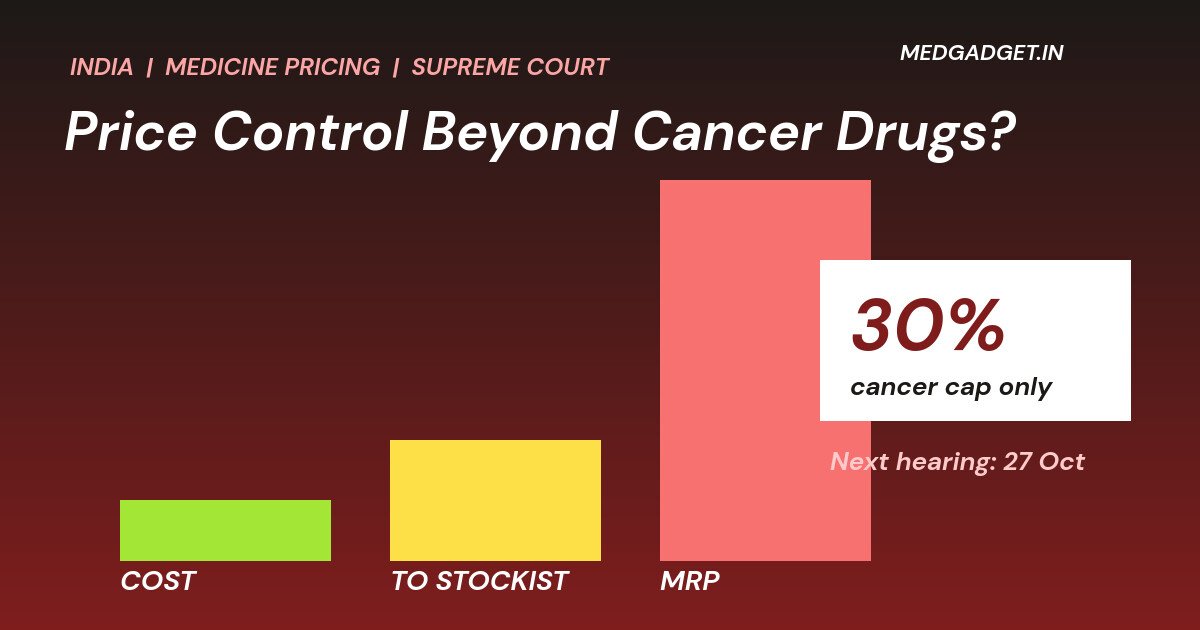
The medicine price control India 2026 debate reached a sharper point on 12 October, when the Supreme Court of India asked why the government’s newest trade-margin cap covers only certain cancer drugs. Hearing petitions on medicine pricing, Justices Vikram Nath and Sandeep Mehta were told that the Centre has decided to limit trade margins on anti-cancer medicines to 30% of the maximum retail price (MRP). The bench called the response “hardly anything to be happy about” and asked why other medicines, and medical devices, should be left out.
In medicine price control India 2026 terms, nothing universal has been decided. There is no cap on all medicines, the court has not issued a pricing order, and the case returns on 27 October. This report separates what the judges said from what the government has done, sets out the markups the bench cited, explains the legal framework behind them, and lists what remains unknown.
Medicine price control India 2026: what happened on 12 October
- The bench: Justices Vikram Nath and Sandeep Mehta.
- For the Centre: Solicitor General Tushar Mehta and Additional Solicitor General Aishwarya Bhati.
- The government’s step: a cap on trade margins for anti-cancer medicines at 30% of MRP, which the Centre estimated would save patients about ₹2,500 crore a year.
- The court’s question: if cancer drug margins can be capped, why not those of other medicines?
- The deadline: the Solicitor General was given time to come back with ways of capping medicine prices, and the bench said the government should act by 27 October.
Medicine price control India 2026: the markups the judges cited
The bench relied on concrete examples to argue that high margins are not confined to cancer drugs. These figures are as stated in court and reported afterwards; we have not independently verified them, and the government did not necessarily accept each one.
- A saline drip with an MRP of ₹270 against an actual cost of ₹11.
- An India-made cardiac stent costing about ₹5,000 that hospitals sell for more than ₹25,000. The Solicitor General replied that stents already carry price caps.
- The antibiotic azithromycin sold for over ₹70 against a cost of about ₹28.
- A drug with an MRP of ₹2,850 and a price to stockist of ₹78.29.
The arithmetic matters. By our calculation, the saline example is a markup of roughly 25 times (270 divided by 11), the stent about five times, azithromycin about two and a half times, and the last drug about 36 times between stockist price and MRP. One report of the hearing quotes the bench as saying the saline drip was sold at 400 times its cost, which does not match the ₹270 and ₹11 figures reported alongside it, so readers should treat the multiple with care. The underlying point, a wide gap between cost and shelf price, holds either way.
What the government told the court
The Centre’s lawyers defended a narrower approach. The Solicitor General argued that medicines cannot be capped beyond a limit because higher margins help drugs reach remote areas. His colleague argued that medicine prices in India are among the lowest in the world and that pricing is only one part of policy, which must balance affordability, availability and market conditions. One report quotes the Centre as saying, “We don’t want to control the entire ecosystem of drugs.”
The same report says the cap would apply to a list of cancer drugs to be notified, which could be updated periodically and would leave out inexpensive medicines. Another account of the hearing links the decision to a meeting of the National Pharmaceutical Pricing Authority (NPPA) on 8 October and to Paragraph 19 of the Drugs (Prices Control) Order, 2013 (DPCO). Each detail appears in only one account we reviewed, so we flag them as reported, not confirmed.
How medicine price control India 2026 rules work today
The Centre filed a 551-page affidavit, as reported, describing the current system. It rests on two tiers, and the difference explains why the court is probing the second.
- Scheduled drugs are those on the National List of Essential Medicines (NLEM). The 2022 list has 388 drugs and more than 900 formulations. The ceiling price is the simple average of the retail prices of brands and generics with at least a 1% market share, plus a 16% margin. Ceiling prices have been fixed for 935 formulations.
- Non-scheduled drugs are everything else. Here the pricing authority monitors MRPs so that none rises by more than 10% over the previous twelve months.
The 30% margin cap for anti-cancer drugs sits on top of this structure and, according to the reporting, concerns non-scheduled cancer medicines. Our earlier report on the India cancer drug trade margin cap explains the 8 October announcement in more detail.
What the 30% cap means for medicine price control India 2026
A trade-margin cap limits what distributors and retailers can add, so it can lower the MRP of a medicine, but it does not set a price for it. The government has said it expects some cancer drug MRPs to fall; the size of any fall depends on how high the margins are today. Importantly, the notification list, effective date and enforcement method were not clear in the accounts we reviewed.
In our assessment of medicine price control India 2026, the court is signalling that a drug-by-drug approach leaves too much room for gaps. Judges have pushed in earlier hearings too: on 22 September the bench described a tenfold gap between the retailer price of an essential cancer medicine and its MRP in sharp terms, and on 29 September it asked why a uniform margin could not apply to all pharmaceutical products and raised concerns about hospitals that require patients to buy from in-house pharmacies. Those remarks were not orders.
Who is affected if medicine price control India 2026 widens
- Manufacturers: MRPs are set by companies, so any margin cap would shift attention to how they price products and share margins down the chain.
- Distributors and chemists: their earnings depend on trade margins, so a cap beyond cancer drugs would hit them first.
- Hospitals: in-house pharmacies and device billing are under scrutiny, as the stent example shows.
- Patients: potentially lower prices, though supply in remote areas is the government’s stated concern.
This is our reading of the structure, not a prediction of the outcome. The court could also decide to leave the policy choice to the executive. For a related regulatory thread, see our report on the Supreme Court order on pharma freebies to doctors and our wider pharmaceutical coverage.
Medicine price control India 2026: what to watch before 27 October
- Whether the Centre notifies the list of cancer drugs and the date the 30% cap takes effect.
- Any proposal to extend margin limits to other medicines or to medical devices.
- The Solicitor General’s “modalities” for capping prices, which the court asked for.
- Any direction on hospital pharmacies.
- The hearing itself on 27 October, 2026. Check the court’s listing and the Department of Pharmaceuticals for updates.
Frequently asked questions
Has medicine price control India 2026 capped all medicines?
No. The court questioned the narrow approach, but no universal cap has resulted from the 12 October hearing.
What is the 30% cap on cancer drugs?
A limit on trade margins for anti-cancer medicines at 30% of MRP, as described by the government.
What does medicine price control India 2026 mean for patients?
Possibly lower prices on some cancer drugs once the cap is notified. For other medicines, nothing has changed yet.
When is the next hearing?
27 October 2026.
Who regulates medicine prices in India?
The NPPA, working under the Drugs (Prices Control) Order, 2013. Drug quality and approvals are handled separately by the CDSCO.
How we reported this: we relied on reports of the Supreme Court hearing of 12 October 2026 and on earlier reporting of the cancer drug margin announcement. We did not read the court record itself. Figures labelled as ours are our own calculations. Last updated: 13 October 2026. This article is news reporting and not legal or medical advice.
[…] pricing moves have come from other directions too. Our report on the Supreme Court looking at wider medicine price control and our report on the cap on cancer drug trade margins show regulators attacking costs at the […]
[…] its test will be whether the printed price falls on 9 November and whether supply holds. See also Medicine Price Control India 2026: SC Eyes Wider Cap. More in our pharmaceutical […]
[…] point and not a result. See also India Caps Cancer Drug Trade Margins at 30% of MRP. See also Medicine Price Control India 2026: SC Eyes Wider Cap. More in our healthcare services […]