

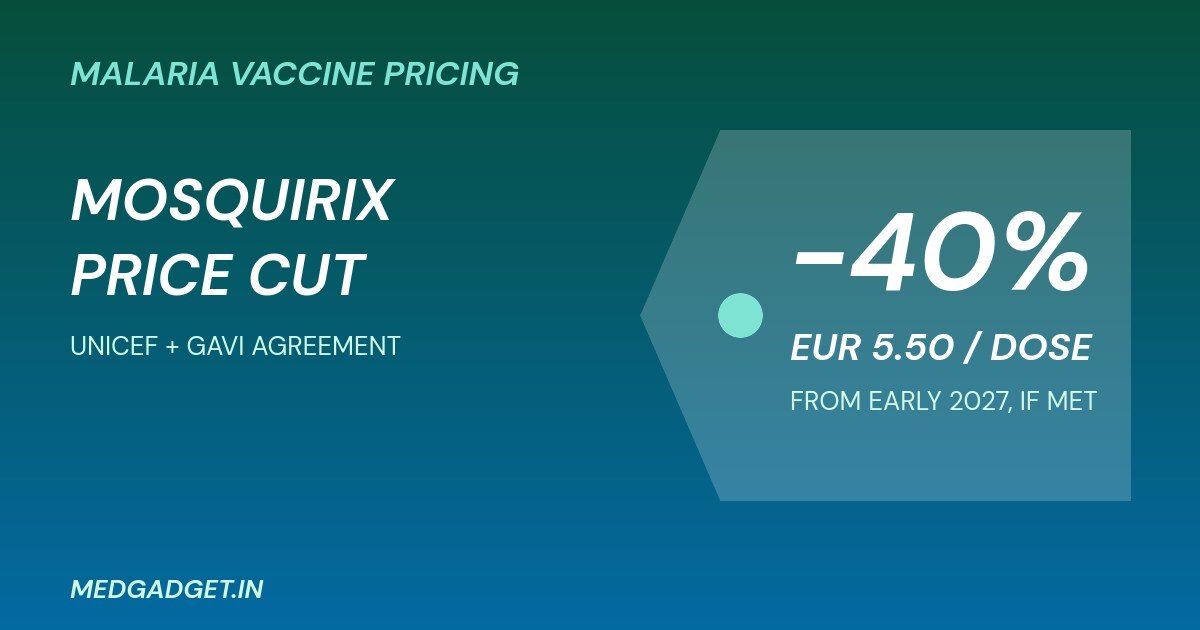
The Mosquirix malaria vaccine price cut agreed by UNICEF and Gavi lowers the price of the vaccine by about 40% to €5.50 per dose, which is roughly US$6 at recent exchange rates by our own conversion. The agreement, reported on 22 October 2026, is expected to save about US$50 million between 2027 and 2029, and it ties the new price to regulatory and manufacturing milestones that have not yet been met.
Key takeaways from the Mosquirix malaria vaccine price cut
- The price falls by about 40% to €5.50 per dose, according to the wire-service report on the agreement.
- Expected savings are about US$50 million over 2027 to 2029.
- The lower price should take effect by early 2027, subject to milestones including WHO prequalification of a new manufacturing facility.
- Production is being transferred from GSK to India’s Bharat Biotech, with GSK continuing to supply the adjuvant; full takeover is targeted for 2028.
- The Mosquirix malaria vaccine price cut is an agreement and not yet a delivered price, because the conditions must be met first.
What the Mosquirix malaria vaccine price cut changes
Mosquirix, also known as RTS,S/AS01, was developed by GSK and the nonprofit PATH. UNICEF buys vaccines for many countries, and Gavi, the vaccine alliance, provides financing. According to the report, they agreed to cut the price by about 40% to €5.50 per dose. By our own arithmetic, a 40% cut to €5.50 implies a previous price of roughly €9 per dose, though the report as we read it does not state the earlier price, so treat that figure as an estimate.
The savings estimate is about US$50 million between 2027 and 2029. That figure depends on how many doses countries order and on the new price taking effect when expected. The report says the lower price should apply by early 2027, once regulatory and manufacturing milestones are met before UNICEF begins buying at the new price.
Bharat Biotech and the Mosquirix malaria vaccine price cut
Production is moving from GSK to Bharat Biotech under a technology transfer. GSK is expected to keep supplying the vaccine’s adjuvant, a component that boosts the immune response, after Bharat takes over production, which is targeted for 2028. The report notes that last year GSK and Bharat said they planned to bring the price below US$5 per dose by 2028. The new price is therefore a step on that path, not the end of it.
One named condition is WHO prequalification of a new manufacturing facility. Prequalification is the WHO process that assesses whether a vaccine meets quality standards so that UN agencies can buy it. The company’s own site is bharatbiotech.com. We have not seen the facility’s prequalification status, and the report does not give a date.
How to read the savings and timeline of the Mosquirix malaria vaccine price cut
Taken at face value, US$50 million over three years is about US$17 million a year on average, by our own arithmetic. That average hides the fact that the price only applies once the conditions are met, so the savings are likely to be weighted towards the later years if the start slips. The report does not give a year-by-year profile, and we have not tried to construct one.
The timeline has three dates worth separating. Early 2027 is when the lower price should begin. 2028 is when Bharat Biotech is targeted to take over production fully. And 2028 is also the year of the earlier ambition to go below US$5 per dose. Each depends on the next stage of the technology transfer, so a delay in one could affect the others. This is our reading of the report, not a statement by the companies.
General background: why price matters for malaria vaccines
Malaria remains a leading cause of death in young children in Africa, as the World Health Organization describes in its malaria fact sheet. Vaccines are given in multiple doses, so the price per dose, multiplied by the number of children, determines how many can be reached within a fixed budget. A lower price can stretch the same budget further, which is the logic behind the Gavi and UNICEF negotiation.
The report adds that last year Gavi and UNICEF agreed a 25% price cut for a malaria vaccine made by the Serum Institute of India. Two suppliers, both in India for production, give buyers more room to negotiate, but we have not seen analysis of how the two prices compare. For related coverage see our pharmaceutical news.
Our analysis: the Mosquirix malaria vaccine price cut is a real step, with conditions
In our assessment, the Mosquirix malaria vaccine price cut is meaningful because it is concrete: a stated price, a stated saving and a stated timetable. It also shows how technology transfer can lower costs, since moving production to a manufacturer with lower unit costs is the main mechanism behind the cut. But the benefit does not arrive until the milestones are met, and a delay in prequalification would delay the saving.
We also note that savings of US$50 million over three years are small compared with the overall cost of malaria control, and the number of extra children reached will depend on funding as much as on price. We have no figures from Gavi or UNICEF on that, so we do not estimate it.
What is not disclosed about the Mosquirix malaria vaccine price cut
- The earlier price per dose and the exact exchange rate used.
- Expected dose volumes behind the US$50 million estimate.
- The timetable for the new facility’s WHO prequalification.
- Details of the technology-transfer terms between GSK and Bharat Biotech.
- How many additional children could be vaccinated at the new price.
Risks and caveats for the Mosquirix malaria vaccine price cut
The price takes effect only if regulatory and manufacturing milestones are met, and technology transfers can slip. The report is a single wire account, and the exchange-rate conversion is approximate. Vaccine supply also depends on funding, delivery systems and country demand, none of which this agreement settles. This article reports a pricing agreement and is not medical advice.
What to watch next on the Mosquirix malaria vaccine price cut
- Announcements on WHO prequalification of the new facility, via the Gavi website and WHO.
- Confirmation from UNICEF that the new price is in effect, through its Supply Division.
- Progress on Bharat Biotech taking over production in 2028.
- Further movement towards the sub-US$5 price target.
FAQ
How much is the Mosquirix malaria vaccine price cut?
About 40%, to €5.50 per dose, according to the report on the UNICEF and Gavi agreement.
When does the new price start?
It should apply by early 2027, once regulatory and manufacturing milestones, including WHO prequalification of a new facility, are met.
Who will make the vaccine?
Production is moving from GSK to Bharat Biotech, with GSK still supplying the adjuvant, and full takeover is targeted for 2028.
How we reported this: we relied on a wire-service report of the agreement and attributed all figures to it. Conversions and estimates are labelled as ours. Last updated 23 October 2026. This is news reporting and not advice.