

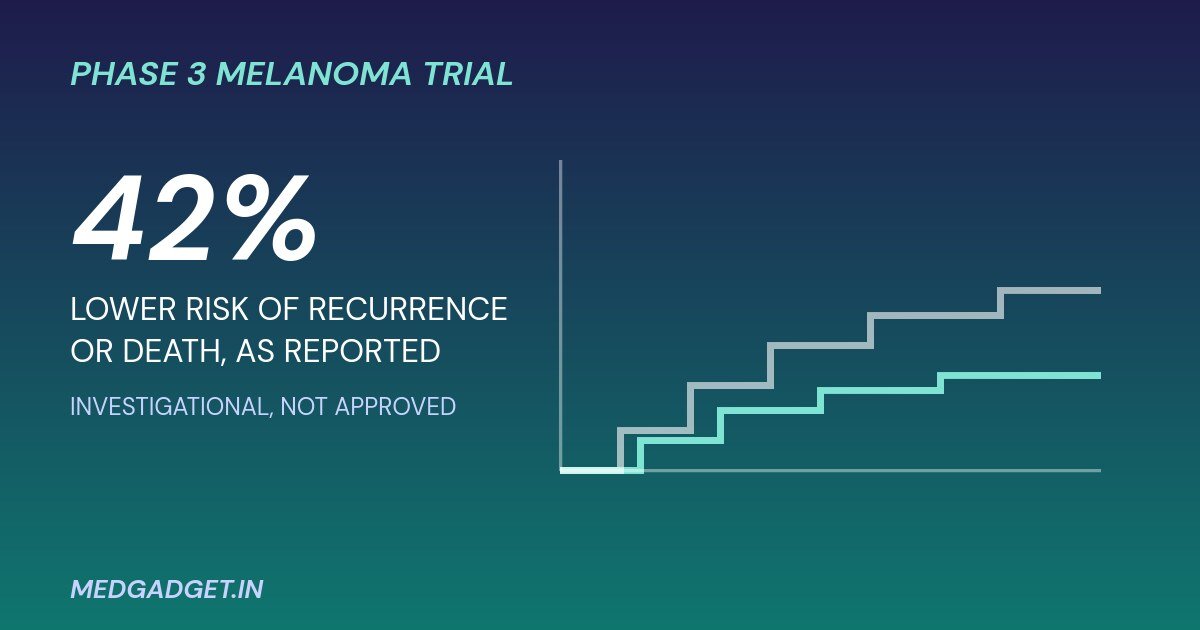
The Moderna Merck melanoma vaccine, an individualised mRNA therapy called intismeran autogene given with Keytruda (pembrolizumab), cut the risk of recurrence or death by 42% compared with Keytruda alone in a Phase 3 trial of 1,137 patients, according to results published by the companies in October 2026. The therapy is investigational and not approved for use, and the companies say they are engaging with regulatory authorities.
Key takeaways from the Moderna Merck melanoma vaccine Phase 3 results
- Recurrence-free survival (RFS) hazard ratio 0.58, a 42% lower risk of recurrence or death (95% CI 0.45 to 0.75; p less than 0.001), at a median follow-up of 24.6 months.
- Distant metastasis-free survival (DMFS) hazard ratio 0.62, a 38% lower risk of distant spread or death (95% CI 0.45 to 0.85; p=0.002).
- At two years, 82.2% of patients on the combination had no recurrence, versus 70.0% on Keytruda alone.
- Overall survival data are not yet mature, though the companies report a favourable trend.
- The Moderna Merck melanoma vaccine is not an approved treatment, and the results come from company-reported data.
How the Moderna Merck melanoma vaccine trial was designed
The trial, INTerpath-001 (NCT05933577), is a global, randomised, double-blind Phase 3 study. It enrolled 1,137 patients with completely resected stage IIB to IV cutaneous melanoma, meaning the visible tumour had been surgically removed and the aim was to prevent recurrence. Patients were randomised 2:1 to intismeran plus Keytruda or to placebo plus Keytruda.
Intismeran was given at 1 mg every three weeks for up to nine doses, alongside Keytruda at 400 mg every six weeks for up to nine cycles, about one year. The primary endpoint was RFS and the key secondary endpoint was DMFS. The companies announced in August 2026 that both endpoints were met, and the detailed figures appeared in the Merck release on the ESMO presentation.
What the numbers mean
A hazard ratio of 0.58 means that, at any given time during follow-up, patients on the combination had about 58% of the risk of a recurrence or death compared with patients on Keytruda alone, a 42% reduction. The two-year figures translate this into absolute terms. By our own arithmetic, 82.2% versus 70.0% is a 12.2 percentage-point difference in two-year RFS, and 88.5% versus 80.2% is an 8.3-point difference in two-year DMFS.
The companies also report pre-specified sensitivity analyses. After the first six months, the RFS hazard ratio was 0.42, and in the first six months it was about 1.0, which suggests the benefit emerges after the initial period. In the modified intention-to-treat population the RFS hazard ratio was 0.51. These analyses are company-reported, and the full methods are expected in the peer-reviewed paper that the release says has been accepted by the New England Journal of Medicine.
Safety findings
Treatment-related adverse events occurred in 95.8% of patients on the combination and 90.0% on Keytruda alone. Grade 3 to 5 treatment-related events were similar, at 14.2% versus 13.4%. The most common events with the combination were fever (52.2%), injection-site pain (51.0%) and fatigue (38.5%). The companies report no new safety signals. We note that the difference in any-grade events, 5.8 percentage points by our arithmetic, is modest but real.
General background: how an individualised neoantigen therapy works
Intismeran autogene is made for each patient. The tumour is sequenced, and the companies say each dose encodes up to 34 neoantigens, which are tumour-specific protein changes. After injection, cells make those proteins, and the immune system learns to recognise them. Keytruda, an anti-PD-1 antibody, helps T cells remain active against cancer. Merck says about 330,000 new melanoma cases were diagnosed worldwide in 2022, and most recurrences occur within two years of surgery.
Earlier Phase 2b data, presented at the ASCO meeting in 2026, showed a 49% reduction in recurrence or death at five years (hazard ratio 0.51). The new trial is the first Phase 3 test of the approach. See our pharmaceutical coverage for related reporting.
Our analysis: significant, with open questions
In our assessment, the Moderna Merck melanoma vaccine result is significant because it is Phase 3 evidence for a personalised cancer therapy, which has been a long-standing goal. A Merck executive describes it as the first Phase 3 study to demonstrate a clinically meaningful improvement in RFS and DMFS for this approach. That is the company’s characterisation.
The open questions are practical. Overall survival, which regulators and clinicians weigh heavily, is immature. The population is limited to resected stage IIB to IV disease. And a therapy made for each patient raises questions about manufacturing time, cost and access that the data do not answer. A potential 2027 launch has been mentioned in press coverage, but we could not find a timeline in the companies’ release, so we treat it as unconfirmed.
There is also a reading point on the comparison group. Because both arms received Keytruda, the trial isolates the contribution of the added therapy. That is a stricter test than comparing with no treatment, and it is one reason the Moderna Merck melanoma vaccine data will attract close attention from regulators and oncologists.
What is not disclosed about the Moderna Merck melanoma vaccine
- Overall survival results and event counts.
- Manufacturing turnaround time, cost and price.
- Regulatory submission dates and any launch timeline.
- Subgroup results by stage and other characteristics.
- Longer-term safety data and discontinuation rates.
Risks and caveats
The efficacy and safety numbers come from the sponsors’ release and have not yet been seen in the peer-reviewed paper. Hazard ratios describe relative risk and do not predict the benefit for an individual patient. Results in resected melanoma do not apply to advanced disease. The Moderna Merck melanoma vaccine remains investigational, and nothing here is medical advice or a recommendation to seek or avoid treatment.
What to watch next
- The full presentation at the European Society for Medical Oncology Congress and the New England Journal of Medicine paper.
- Overall survival updates as the trial matures.
- Regulatory filings and decisions for the Moderna Merck melanoma vaccine.
- Results from the other trials in the INTerpath programme.
FAQ
Is the Moderna Merck melanoma vaccine approved?
No. It is investigational, and the companies say they are engaging with regulators.
What is the difference from a standard vaccine?
It is a therapy made for each patient from their tumour’s mutations, used with Keytruda to help prevent recurrence, rather than to prevent infection.
How much did it reduce the risk?
The companies report a 42% lower risk of recurrence or death and a 38% lower risk of distant spread or death versus Keytruda alone.
How we reported this: we relied on the sponsors’ release and attributed all figures to Merck and Moderna. Calculations are labelled as ours. Last updated 23 October 2026. This is news reporting and not advice.