

The Hovilpri FDA approval gives people with weakened immune systems a first oral option for herpes sores that no longer respond to standard antivirals. The FDA announced on 9 October 2026 that it has approved Hovilpri (pritelivir) 100 mg tablets for adults who are immunocompromised and have mucocutaneous herpes simplex virus (HSV) lesions that did not respond to acyclovir, valacyclovir or famciclovir.
The sponsor, Asahi Kasei Therapeutics, says it expects Hovilpri to reach the US market before the end of 2026. This report on the Hovilpri FDA approval covers who the drug is for, how it works, the trial numbers, the safety information, and the questions that remain.
Hovilpri FDA approval in brief
- Drug: pritelivir, sold as Hovilpri, a 100 mg oral tablet.
- Who it is for: immunocompromised adults with mucocutaneous HSV lesions that are refractory to acyclovir, valacyclovir or famciclovir, with or without documented resistance.
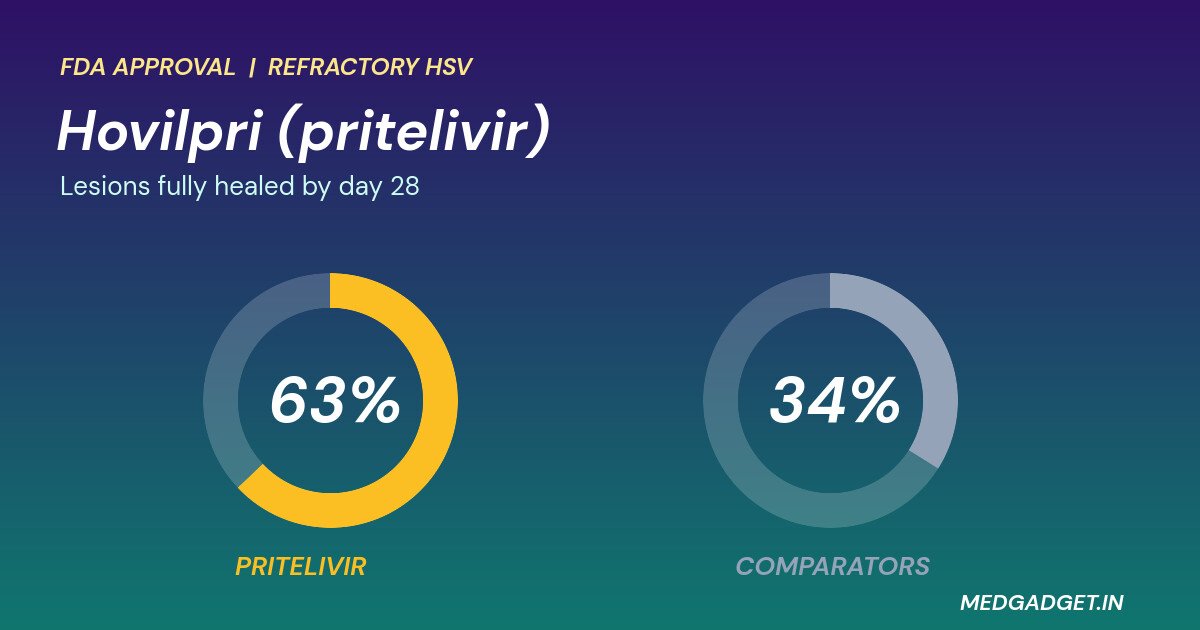
- Key result in the Hovilpri FDA approval: all lesions healed by day 28 in 63% of people on pritelivir versus 34% on investigator-chosen treatment.
- Review status: the FDA says the application received priority review.
- Launch: the company expects US availability before the end of 2026.
Who needs the Hovilpri FDA approval: refractory HSV infection
HSV-1 and HSV-2 cause painful blisters and cannot be cured, although several approved antivirals control outbreaks in most people. In immunocompromised patients, outbreaks can be more frequent and more serious, and they can respond poorly to available treatment because of drug resistance or intolerance. The US Centers for Disease Control and Prevention provides general information on herpes for readers who want background.
The trial population shows who is affected: people with blood cancers or other haematological disorders, stem-cell and solid-organ transplant recipients, people with HIV, and people with autoimmune or inflammatory disease or other cancers. One report cites a company estimate of about 15,000 such patients in the United States. We have not seen that estimate in the FDA announcement, so treat it as a company figure.
How pritelivir works against refractory HSV infection
Pritelivir is described as a first-in-class helicase-primase inhibitor. It blocks proteins the virus needs to copy its genetic material, which stops it multiplying. The older first-line drugs must first be activated by a viral enzyme called thymidine kinase. Mutations in that enzyme are a common route to resistance. Pritelivir does not depend on that activation step, which is why it can work in some infections that resist the older drugs.
The company calls Hovilpri the first FDA-approved treatment for refractory mucocutaneous HSV lesions with a novel mechanism in nearly 30 years. That is the company’s description, and we have not verified the 30-year comparison independently.
Hovilpri FDA approval: dosing and treatment length
According to a published summary of the prescribing information, treatment starts with a 400 mg oral loading dose on day 1, followed by 100 mg once daily. In the trial, people were treated until their lesions healed, for up to 28 days, with an extension to 42 days if lesions were improving but not fully healed. Prescribers should rely on the final label for dosing.
The PRIOH-1 trial behind the Hovilpri FDA approval
Approval rests on Part C of the Phase 3 PRIOH-1 study (NCT03073967 on ClinicalTrials.gov), a randomised, open-label, comparator-controlled superiority trial in 101 immunocompromised adults with treatment-refractory HSV.
- Comparators: investigator’s choice of intravenous foscarnet, intravenous or topical cidofovir, or topical 5% imiquimod.
- Primary endpoint: all lesions healed by day 28.
- Day 28 result: 63% with pritelivir versus 34% with the comparators. The adjusted difference was 28.4 percentage points (95% confidence interval 9.6 to 47.3; p value 0.0047).
- Day 42 result: about 82% versus 42% among those who continued treatment, per manufacturer data. Day 42 was not the primary endpoint.
- Virus clearance: median time to undetectable HSV in lesions was 9 days versus 21 days, but that difference was not statistically significant (p value 0.0581).
By our calculation, the day-28 results are a 29-point raw gap, and healing was about 1.9 times as common on pritelivir. With 101 people randomised 1:1, each group had roughly 50 people. These are our own calculations from the reported figures.
Reading the Hovilpri FDA approval data with care
Three points matter when weighing the data. The trial was open-label, so patients and doctors knew which treatment was given. The comparison was against a mix of treatments chosen by the investigator, not a single standard. And the confidence interval around the day-28 difference is wide, from about 10 to about 47 percentage points, which is normal for a trial of 101 people but means the true benefit could be smaller or larger than the headline.
The comparators also differ sharply in how hard they are to take. Intravenous foscarnet needs infusion access and frequent monitoring of kidney function and electrolytes, which is part of the case for an oral tablet. The study reports consistent effects across the main immunocompromised subgroups, according to the manufacturer.
Safety information in the Hovilpri FDA approval
The FDA lists headache as the most common adverse reaction. Manufacturer data report treatment-related adverse reactions in 22% of people on pritelivir versus 54% on comparators, and discontinuations because of adverse reactions in 2% versus 20%. Commonly reported events included headache, diarrhoea, nausea, reduced appetite, vomiting and dizziness.
One summary cautions that these figures do not establish an overall safety advantage, because the comparators are different drugs with different risks and the trial was open-label. The FDA also points readers to the prescribing information for drug interactions. Summaries note that some acid-reducing medicines can lower pritelivir levels, and that pritelivir can raise levels of medicines that are BCRP substrates. We did not see the full warnings, contraindications or any boxed warning, so check the label.
Asahi Kasei Therapeutics and AiCuris
Pritelivir was developed by AiCuris, which is now part of Asahi Kasei Therapeutics. One report describes the approval as the first commercial milestone from Asahi Kasei’s acquisition of the company. One summary lists Fast Track and Breakthrough Therapy designations alongside priority review, but the FDA announcement only mentions priority review, so we report priority review only.
Our assessment
In our assessment, the Hovilpri FDA approval fills a real gap. People whose herpes sores resist standard drugs have had to rely on infused or topical treatments with notable burdens. A tablet with a different mechanism and a clearly higher healing rate in a randomised trial is a meaningful step. The caveats are the open-label design, the small trial and the mixed comparator group, so real-world data will matter. Price and access for a small patient group will also decide how many people benefit.
For related coverage, see our reports on the once-monthly olanzapine injection approved for schizophrenia and Viatris’s $1.65 billion Pacira deal, or browse more pharmaceutical news.
What to watch next for the Hovilpri FDA approval
- The US launch date and list price before the end of 2026.
- The final label, including warnings, interactions and any monitoring advice.
- Real-world healing rates and resistance data from early users.
- Whether other regulators accept the application.
Frequently asked questions
What does the Hovilpri FDA approval cover?
Pritelivir 100 mg tablets for immunocompromised adults with mucocutaneous HSV lesions that did not respond to acyclovir, valacyclovir or famciclovir.
How strong is the evidence behind the Hovilpri FDA approval?
All lesions had healed by day 28 in 63% of people on pritelivir versus 34% on investigator-chosen treatment.
How is Hovilpri taken?
By mouth, with a 400 mg loading dose on day 1 and then 100 mg once daily, for up to 28 days and up to 42 days if lesions are still improving, per a summary of the label.
What are the main side effects?
Headache was the most common adverse reaction. Diarrhoea, nausea, reduced appetite, vomiting and dizziness were also reported.
When will Hovilpri be available?
The company expects US availability before the end of 2026.
How we reported this: we relied on the FDA announcement and the Asahi Kasei Therapeutics announcement of 9 October 2026, along with published summaries of the prescribing information and the PRIOH-1 trial. We did not read the full label. Some figures come from manufacturer data and secondary summaries, and figures labelled as ours are our own calculations. Last updated: 10 October 2026. This article is news reporting and not medical advice.