

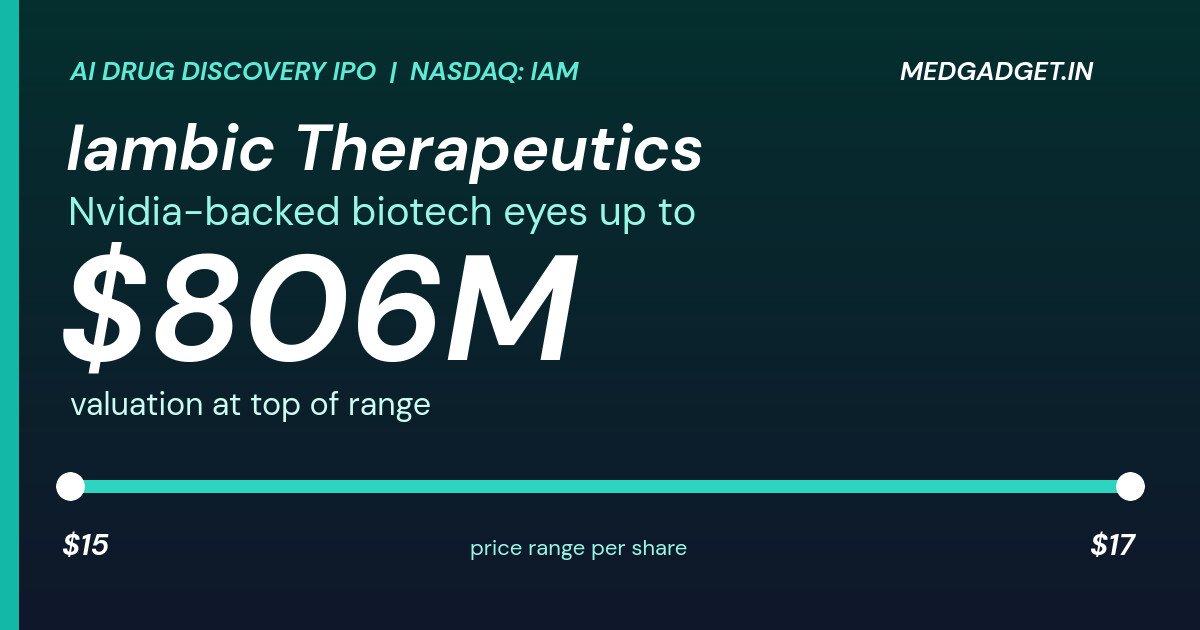
The Iambic Therapeutics IPO has moved from a quiet filing to a priced-out plan: the Nvidia-backed AI drug discovery company is targeting a valuation of up to about $806 million in a US listing. According to its latest regulatory filing, disclosed on 8 October 2026, Iambic Therapeutics plans to offer about 9.38 million shares at $15 to $17 each, raising up to roughly $159.4 million, and to list on the Nasdaq under the ticker IAM once the deal closes.
The company first filed for an IPO in September, so the listing itself is not new. What is new is the price range, and with it the first concrete valuation. That makes this one of the more closely watched biotech offerings of the autumn, in a market where many other deals have been delayed.
Iambic Therapeutics IPO at a glance
- Shares offered: about 9.38 million.
- Price range: $15 to $17 per share.
- Maximum raise: up to about $159.4 million.
- Valuation: up to about $805.8 million at the top of the range, on shares outstanding per the filing.
- Listing: Nasdaq, ticker IAM, after the deal closes.
- Lead underwriters: J.P. Morgan, Jefferies, BofA Securities and Citigroup.
- Status: the offering has not yet priced or closed.
The numbers behind the $806 million valuation
The headline figures are consistent with one another. Nine point three eight million shares at the $17 top of the range comes to about $159.4 million. By our calculation, a valuation of $805.8 million at $17 implies roughly 47.4 million shares outstanding, and the same share count would put the company at about $711 million at the bottom of the range. Those are our own estimates from the reported figures, not numbers disclosed by the company.
The filing also shows that some large investors have signalled interest. ARK Investment Management and Duquesne Family Office have indicated an interest in buying shares worth up to $60 million in the offering. By our calculation, that would be roughly 38% of the maximum raise. Such indications are not binding, and final allocations are decided at pricing.
What Iambic actually develops
Iambic describes itself as an AI-driven drug discovery company. It was founded in 2019 and was originally known as Entos. Its approach combines AI models, which the company calls Enchant and NeuralPLexer, with an automated laboratory platform that generates experimental data on a weekly basis. The models are used to design and predict how drug candidates interact with their protein targets, and the lab data are fed back to refine them.
On its website, the company lists a cancer-focused pipeline at different stages:
- IAM1363: a selective, brain-penetrant inhibitor for HER2-driven cancers, in a Phase 1/1b trial. The company says it has shown anti-tumour activity and tolerability.
- IAM217: a brain-penetrant KIF18A inhibitor for ovarian cancer, triple-negative breast cancer and other solid tumours, with an investigational new drug (IND) application submitted.
- IAM-C1: a selective CDK2/4 inhibitor for HR-positive, HER2-negative breast cancer and CCNE1-amplified cancers, at the IND-enabling stage.
These are the company’s own descriptions. None of the programmes has been approved, and early-stage results do not predict final trial outcomes.
Where Nvidia fits in
Nvidia is described as a backer of Iambic, which is a large part of why the offering is framed as an AI story. The reports we reviewed did not state the size of Nvidia’s holding, and we have not assumed one. A well-known technology investor does not change the underlying clinical risk: the value of an AI drug discovery company ultimately rests on whether its medicines work in patients.
Why the IPO matters for biotech investors
The wider IPO market has had a difficult autumn, with deals delayed by rising Treasury yields and market volatility. Biotech is one of the few areas still attracting investor interest, and AI-enabled drug discovery is the theme drawing the most attention. A successful pricing could encourage other private AI biotechs to test the market. A weak debut could do the opposite.
In our assessment, the key question for investors is not the AI label but the pipeline. Iambic’s lead programme is only in Phase 1/1b, so the shares would be priced largely on expectations. Buyers should expect volatility and should read the risk factors in the prospectus, which is available through the SEC’s EDGAR database. For context on how funding is flowing into this field, see our report on the Biohub virtual biology initiative, or browse more biotechnology news.
Risks to keep in mind
Any early-stage biotech listing carries a familiar set of risks. Clinical trials can fail or be delayed, regulators can ask for more data, and a company without approved products may need to raise more capital after the IPO, diluting existing shareholders. Newly listed shares can also swing sharply in the first weeks of trading, and share prices of AI-linked companies can move with sentiment as much as with science. The filing’s risk-factor section is the authoritative place to see how Iambic itself describes these issues.
What to watch next
- Pricing: whether the shares price within, above or below $15 to $17.
- First-day trading: how the stock behaves after listing under IAM.
- Use of proceeds: the reports we reviewed did not state how the money would be spent; the prospectus is the place to check.
- Clinical updates: further data on IAM1363 and the start of trials for IAM217.
Frequently asked questions
What is the Iambic Therapeutics IPO valuation?
Up to about $806 million at the top of the $15 to $17 range, based on shares outstanding in the filing.
How much will Iambic raise?
Up to about $159.4 million, by selling about 9.38 million shares.
When will Iambic list and under what ticker?
It plans to list on the Nasdaq as IAM once the offering closes. No pricing date had been confirmed in the reports we reviewed.
Is Nvidia investing in the IPO?
Nvidia is described as a backer of the company. The reports we reviewed did not say whether it is buying shares in the offering.
Is this the first time Iambic filed for an IPO?
No. The company filed in September. The new development is the price range and valuation disclosed on 8 October 2026.
How we reported this: we relied on a regulatory filing as reported on 8 October 2026 and on the company’s website. Valuation and share-count estimates labelled as ours are our own calculations. Last updated: 9 October 2026. This article is news reporting and not investment advice.