

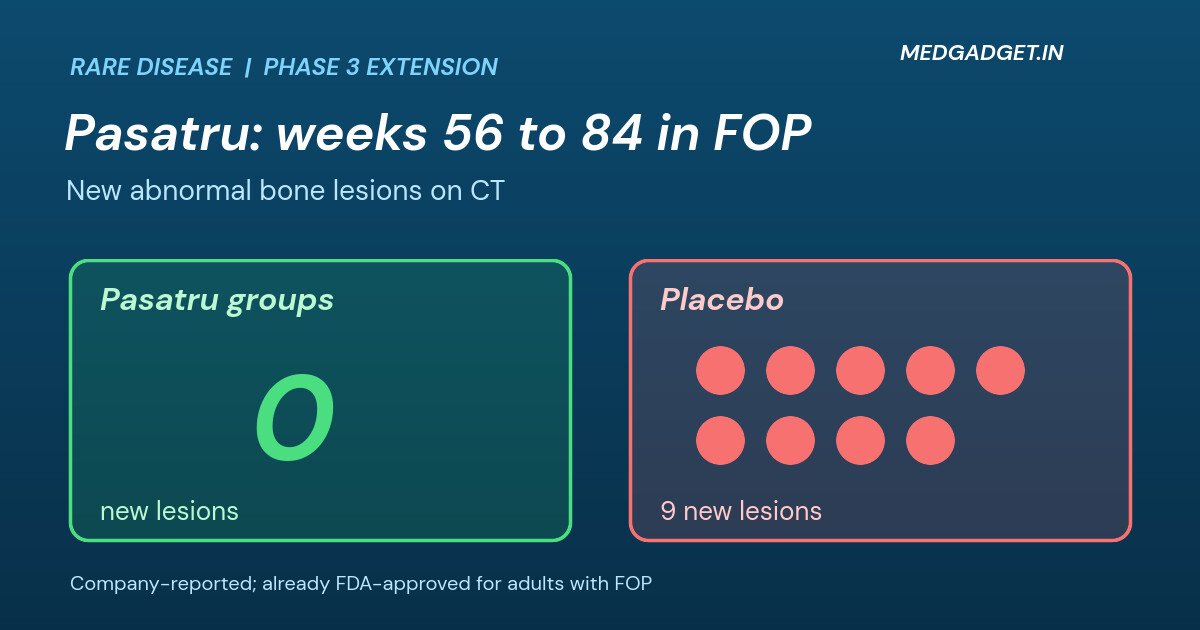
The Regeneron Pasatru Phase 3 results published on 12 October 2026 add longer-term evidence for a drug that is already on the market. Regeneron Pharmaceuticals reported that, in the extension of the OPTIMA trial, adults with the ultra-rare disease fibrodysplasia ossificans progressiva (FOP) who took Pasatru (garetosmab-grts) developed no new abnormal bone lesions between weeks 56 and 84, while nine new lesions appeared in the placebo group.
This is not a new approval. The FDA approved Pasatru for adults with FOP in August 2026, and these data extend the evidence behind that decision. The safety findings, including a clear rise in skin and soft-tissue infections with dose, matter as much as the headline.
Key takeaways
- From weeks 56 to 84, the Pasatru groups had no new heterotopic ossification (HO) lesions on CT; the placebo group had nine, according to Regeneron.
- OPTIMA enrolled 63 adults; 58 completed the extension to at least 84 weeks.
- Skin and soft-tissue infections rose with dose: 33% on placebo, 53% on 3 mg/kg and 78% on 10 mg/kg. All resolved.
- No deaths were reported, and no one stopped treatment because of infection.
- The findings come from the company and were presented as a late-breaking oral talk; we have not seen the full data.
What is FOP in the Regeneron Pasatru Phase 3 results?
FOP is a genetic disorder in which soft tissues such as muscle, tendon and ligament turn into bone, forming a second skeleton outside the normal one. The extra bone, called heterotopic ossification, builds up in painful flare-ups and can lock joints. MedlinePlus notes that the condition is caused by changes in the ACVR1 gene. Surgery to remove the bone often triggers more bone growth.
Regeneron Pasatru Phase 3 results: what was reported
OPTIMA is a global, randomised, double-blind, placebo-controlled trial. Participants received Pasatru at 10 mg/kg or 3 mg/kg, or placebo, by infusion every four weeks for 56 weeks. Those who stayed in the double-blind extension were followed to at least 84 weeks. Whole-body CT scans counted new lesions, and doctors and patients assessed flare-ups.
- Week 56: the primary endpoint was met, with a reduction of 90% or more in new HO lesions, according to the company.
- Weeks 56 to 84: no new lesions in Pasatru groups versus nine on placebo. One lesion seen at week 56 in the 3 mg/kg group was no longer detectable at week 84.
- Flare-ups: clinician-assessed flare-ups at week 84 were 1 in the 10 mg/kg group, 14 in the 3 mg/kg group and 17 on placebo.
The lesion comparison is small in absolute terms, because the disease is rare and the groups are small. A count of nine against zero is striking, but it comes from a few dozen people, which limits how precisely the benefit can be estimated.
Safety findings in the Regeneron Pasatru Phase 3 results
Regeneron describes the drug as generally well tolerated and consistent with week 56. The most common events were acne in the 10 mg/kg group and non-severe nosebleeds in the 3 mg/kg group. Bleeding events were lower on 10 mg/kg than on 3 mg/kg or placebo.
The infection signal is the main caution. Skin and soft-tissue infections occurred in 33% of placebo patients, 53% on the lower dose and 78% on the higher dose. Regeneron says all resolved and none led to discontinuation. The prescribing information also warns of possible serious infections needing treatment or hospital care and says the drug can cause serious birth defects, so pregnancy must be excluded before treatment and contraception used during and for six months after.
Approval status after the Regeneron Pasatru Phase 3 results
Pasatru is approved in the United States to reduce new HO lesions and clinician-assessed flare-ups in adults with FOP. According to the International FOP Association, it is the second FOP treatment approved in the US and is given as a monthly infusion of about an hour. Regeneron says it is under review by the European Medicines Agency, that other submissions including Japan are planned, and that a trial in adolescents and children, OPTIMA 2, is planned to begin later this year. Safety and efficacy in children have not been established.
The findings were given as a late-breaking oral presentation at the annual meeting of the American Society for Bone and Mineral Research. Our own earlier report on the FDA approval of Mirum’s Atebrioz for FOP shows how quickly the treatment field for this disease is changing.
Our assessment of the Regeneron Pasatru Phase 3 results
In our assessment, the Regeneron Pasatru Phase 3 results strengthen the case for the drug, because they show that the lesion control seen at week 56 did not fade over the next 28 weeks. For a disease in which bone growth is permanent, durability is the point. Yet some limits matter. The numbers are small, the data come from the sponsor, and the infection rate on the higher dose is substantial. Patients and doctors will weigh that against the benefit, and head-to-head comparisons with other approved drugs do not exist. For more rare-disease and drug coverage, browse our pharmaceutical reports.
What to watch next after the Regeneron Pasatru Phase 3 results
- A decision from the European Medicines Agency.
- Start and design of the OPTIMA 2 paediatric trial.
- Longer follow-up on infections and joint function.
- Real-world use after the US launch.
Frequently asked questions
What are the Regeneron Pasatru Phase 3 results?
In the OPTIMA extension, adults taking Pasatru had no new abnormal bone lesions between weeks 56 and 84, compared with nine on placebo.
Are the Regeneron Pasatru Phase 3 results a new approval?
Yes. The FDA approved it for adults with FOP in August 2026. This announcement adds longer-term data and is not a new approval.
How was Pasatru given in the trial?
By infusion every four weeks, at 10 mg/kg or 3 mg/kg, compared with placebo.
What side effects feature in the Regeneron Pasatru Phase 3 results?
Skin and soft-tissue infections, acne and nosebleeds. The prescribing information also warns of birth defects.
Can children use Pasatru?
Not yet. Safety and efficacy in children have not been established, and a paediatric trial is planned.
How we reported this: we relied on Regeneron’s 12 October 2026 announcement and patient-organisation information about the approval. We did not see the full presentation. Last updated: 14 October 2026. This article is news reporting and not medical advice.