

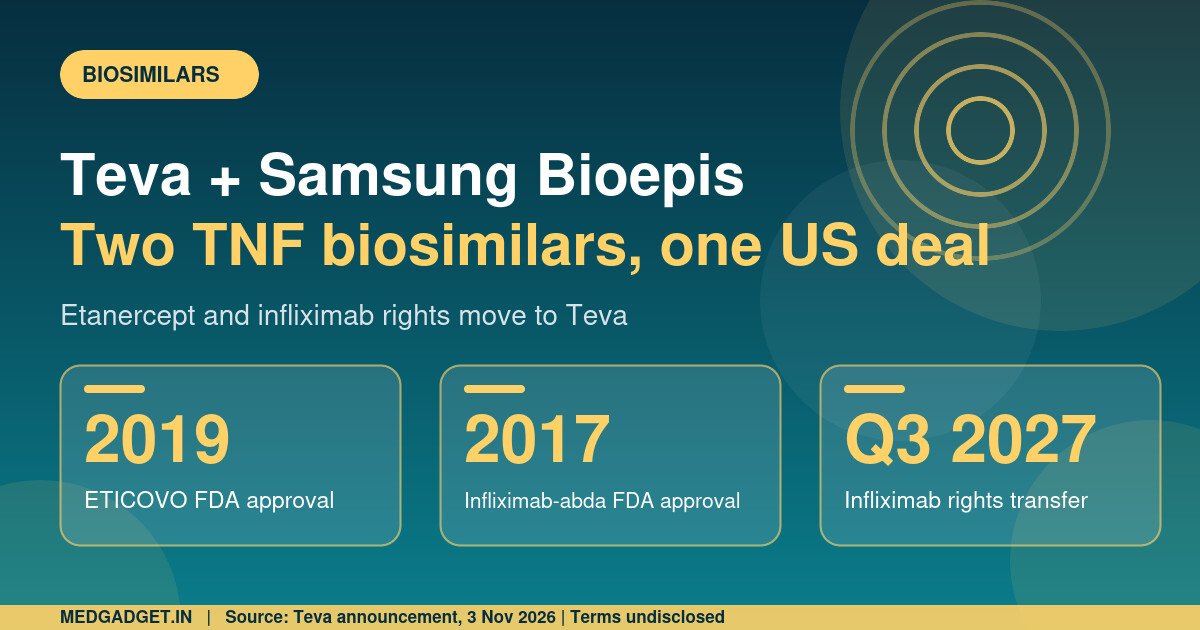
The Teva Samsung Bioepis biosimilar agreement, announced on 3 November 2026, gives Teva the right to commercialise two biosimilars in the United States: ETICOVO (etanercept-ykro), a biosimilar to Enbrel, and infliximab-abda, a biosimilar to Remicade. Both products were approved by the FDA years ago, in 2019 and 2017 respectively, so the news is about who will sell them, not about a new approval. Samsung Bioepis will keep responsibility for regulatory work and manufacturing.
Key takeaways from the Teva Samsung Bioepis biosimilar agreement
- Teva will commercialise ETICOVO (etanercept-ykro) and infliximab-abda in the US; both are biosimilars of long-established TNF inhibitor medicines.
- Neither product is newly approved: the FDA approved infliximab-abda in 2017 and ETICOVO in 2019.
- ETICOVO is not currently sold in the US. Teva gains its US rights at closing, expected by the end of 2026, and will announce launch timing later.
- US rights to infliximab-abda transfer to Teva in the third quarter of 2027.
- Samsung Bioepis will handle regulatory matters and manufacturing; Teva will handle commercialisation.
- The upfront payment, paid over three years, has not been disclosed. The deal also includes possible milestones and a profit share.
What is a biosimilar, in plain language?
A biosimilar is a biological medicine that is highly similar to an already approved biological medicine, known as the reference product, with no clinically meaningful differences in safety, purity or potency. Because biologics are made in living cells, a biosimilar cannot be an exact copy the way a generic tablet can. Regulators therefore require extensive analytical and clinical comparison. The FDA biosimilars information pages explain how the agency reviews them.
Enbrel (etanercept) and Remicade (infliximab) are both TNF inhibitors, drugs that block tumour necrosis factor, a protein involved in inflammation. They are used in several immune-mediated inflammatory conditions. The announcement does not discuss clinical use, so we describe the products only at this general level.
The two products at the centre of the deal
| Product | Reference medicine | FDA approval | US rights to Teva |
|---|---|---|---|
| ETICOVO (etanercept-ykro) | Enbrel | 2019 | At closing, expected by end-2026 |
| Infliximab-abda | Remicade | 2017 | Third quarter of 2027 |
ETICOVO is not currently marketed in the US, so the agreement gives it a route to patients that it has not had so far. The release did not give a separate brand name for infliximab-abda, and we do not assume one. Launch timing for ETICOVO is to be announced by Teva at a later date.
Who does what
- Teva: commercialises both products in the US, which includes sales, marketing and distribution.
- Samsung Bioepis: remains responsible for regulatory matters and manufacturing of both products.
- Closing: subject to customary conditions, including regulatory approvals.
This split keeps the manufacturing and regulatory expertise with the developer and puts the selling effort with a company that has an established US commercial infrastructure. The financial structure reflects a shared interest in sales: Samsung Bioepis receives an upfront payment spread over three years, potential launch and sales milestones, and a share of profit. None of those figures has been published.
Timeline
- 2017: the FDA approves infliximab-abda.
- 2019: the FDA approves ETICOVO.
- 2025: Teva and Samsung Bioepis launch EPYSQLI (eculizumab-aagh) in the US, an earlier collaboration.
- 2026: a Canadian agreement for OPUVIZ (aflibercept) and a global agreement for up to six early-stage candidates, per the companies.
- 3 November 2026: the new US agreement is announced.
- By end-2026: ETICOVO rights expected to transfer at closing.
- Q3 2027: infliximab-abda rights transfer.
A widening partnership
The agreement builds on earlier cooperation. Teva has said it works with Samsung Bioepis on EPYSQLI, an eculizumab biosimilar commercialised in the US from 2025, and on OPUVIZ, an aflibercept biosimilar in Canada, and a 2026 global deal covers up to six early-stage candidates. For readers following Teva’s wider strategy, see our coverage of Teva’s third-quarter 2026 results and of its Weltruza announcement.
Market context: biosimilars in the US
According to Acumen Research And Consulting, the global biosimilars market was valued at USD 26.7 billion in 2023 and is projected to reach USD 113.2 billion by 2032, a compound annual growth rate of 17.5% from 2024 to 2032. North America accounted for about USD 10.7 billion, Asia-Pacific is expected to grow at over 18.4%, and recombinant non-glycosylated proteins were the largest product group at over USD 14.4 billion.
The report page carries a last-updated date of August 2017, which does not fit a 2023 base year, and it contains a stray heading about a different market, so we treat the figures as indicative and not as a precise measure. The report covers all biosimilars worldwide and does not isolate Teva, Samsung Bioepis or these two products.
Our analysis
In our assessment, the agreement is best read as a portfolio move. For Teva, it adds two established, FDA-approved TNF inhibitor biosimilars to its US range without development risk. For Samsung Bioepis, it hands selling to a partner and keeps its manufacturing role. The open questions are commercial: price, contracting and uptake in a market where reference products and several other biosimilars are already established. We are not in a position to forecast those outcomes, and the companies have not provided sales estimates.
What is not disclosed
- The amount of the upfront payment and the size of milestones.
- The profit-share percentage.
- The launch date and price of ETICOVO in the US.
- Any brand name or launch plan for infliximab-abda.
- The status of the regulatory approvals needed to close.
Risks and caveats
- Closing depends on customary conditions, including regulatory approvals.
- Launch timing is not fixed and could change.
- Market figures are third-party projections.
- Nothing here is medical or investment advice.
What to watch next
- Confirmation that the deal has closed.
- Teva’s announcement of an ETICOVO launch date.
- Any update on infliximab-abda ahead of the third quarter of 2027.
- Competitive pricing and contracting in the TNF inhibitor class.
General background
Company information is available from Teva and Samsung Bioepis. For other recent biosimilar stories, read our reports on a US biosimilar launch, a Keytruda biosimilar candidate and a biosimilar manufacturing deal. Browse more in our Pharmaceutical section.
Questions readers are asking about the Teva Samsung Bioepis biosimilar agreement
Has the FDA just approved these products?
No. Infliximab-abda was approved in 2017 and ETICOVO in 2019. The agreement changes who commercialises them in the US.
When will ETICOVO be available?
Teva expects to take over US rights at closing, expected by the end of 2026, and will announce launch timing later.
What happens to Samsung Bioepis’ role?
It continues to be responsible for regulatory matters and manufacturing.
FAQ
What is etanercept-ykro?
It is the nonproprietary name of ETICOVO, a biosimilar to Enbrel.
What is infliximab-abda?
A biosimilar to Remicade, approved by the FDA in 2017.
Were deal values shared?
No. The upfront payment, milestones and profit share were not quantified.
How we reported this: details come from Teva’s announcement of 3 November 2026; market figures are attributed to Acumen Research And Consulting. Last updated 4 November 2026. This is news reporting and not medical or investment advice.