

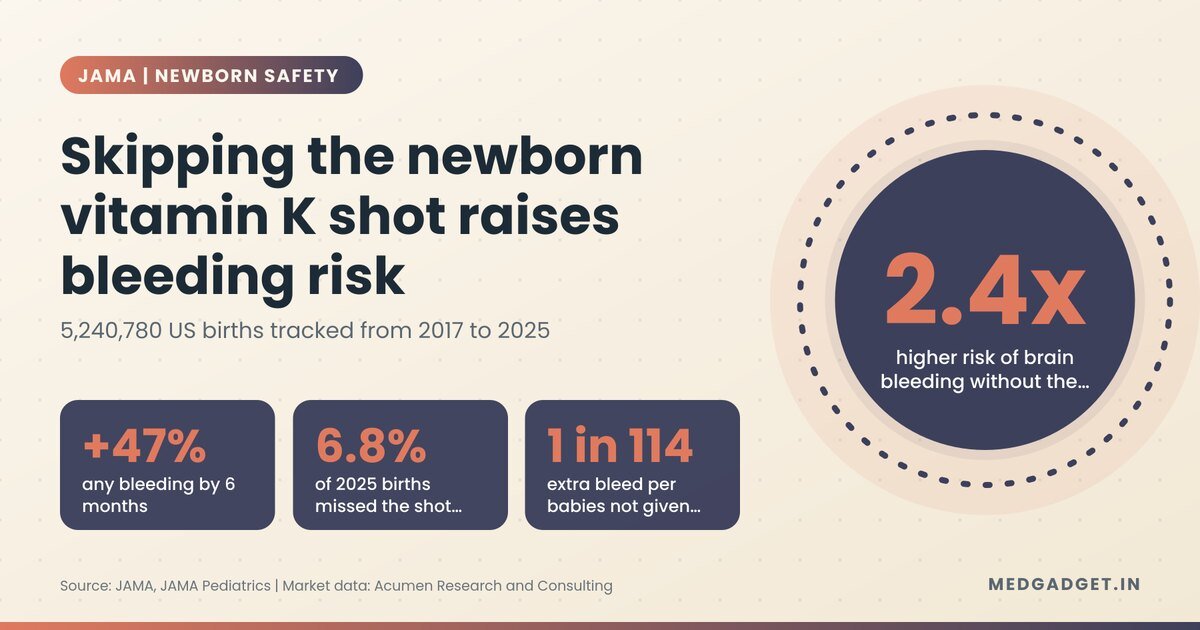
Skipping the vitamin K shot for newborns raised the risk of any bleeding in the first six months of life by 47% and more than doubled the risk of bleeding inside the skull, according to a study of more than 5.2 million US births published in JAMA on November 5, 2026. A companion JAMA Pediatrics research letter covering over 11 million infants found that diagnoses of vitamin K deficiency bleeding rose about four-fold between 2017 and 2025, as the share of babies receiving the injection slipped from 97.7% to 95.0%.
The findings put hard numbers on a trend paediatricians have warned about for years: a small but growing number of parents declining a routine, low-cost injection that prevents a rare but devastating condition. This explainer covers what the studies found, why newborns need vitamin K, and what parents should watch for.
Key takeaways on the vitamin K shot for newborns
- Infants who did not get the intramuscular shot had an adjusted 1.47 times higher risk of any bleeding by six months.
- Intracranial (brain) bleeding occurred in 33.0 per 10,000 non-recipients versus 13.2 per 10,000 recipients.
- For every 114 newborns who miss the shot, one additional baby has a bleed.
- US non-receipt more than doubled, from 3.1% of births in 2017 to 6.8% in 2025, in the main study.
- Only 19.2% of babies diagnosed with vitamin K deficiency bleeding had received the injection.
Why babies are born short of vitamin K
Vitamin K is needed to make several clotting factors. Newborns start life with very low stores because little of the vitamin crosses the placenta, breast milk contains small amounts, and the gut bacteria that help produce it have not yet developed. Without a top-up, some babies develop vitamin K deficiency bleeding (VKDB). The late form, which typically appears between two and eight weeks of age and is most common in exclusively breastfed infants, is the most dangerous because it often strikes the brain with little warning.
A single intramuscular injection at birth has been standard practice in the US since the 1960s. The CDC advises giving it within six hours of birth and says babies who do not receive it are 81 times more likely to develop VKDB.
Inside the 5.2 million-birth study
Researchers led by Kristan Scott of the Children’s Hospital of Philadelphia used Epic Cosmos, a large pool of electronic health records, to follow 5,240,780 infants born at 35 to 43 weeks of gestation between January 2017 and December 2025. Of those, 234,825 (4.5%) did not receive intramuscular vitamin K. The team tracked a combined outcome of brain, newborn and vitamin K deficiency bleeding up to six months of age.
| Outcome (per 10,000 infants) | No vitamin K shot | Received shot | Adjusted risk ratio |
|---|---|---|---|
| Any bleeding to 6 months | 288.0 | 185.9 | 1.47 |
| Intracranial bleeding | 33.0 | 13.2 | 2.43 |
| Late bleeding (after discharge) | 10.3 | 4.8 | 2.11 |
| Death with bleeding during birth stay | 2.9 | 1.1 | 2.69 |
By our calculation, the gap in any bleeding works out to about 102 extra cases per 10,000 babies who skip the shot, consistent with the authors’ number needed to harm of 114. Bleeding rose over the study period in both groups, partly reflecting better coding, but it rose faster among non-recipients: their rate climbed from 225.3 to 394.0 per 10,000, against 136.6 to 221.8 for recipients.
The results line up closely with a Swedish cohort of more than 2 million infants, also published in JAMA Pediatrics this year, which reported adjusted odds ratios of 1.52 for any bleeding and 2.91 for intracranial bleeding in babies without prophylaxis. Agreement across two health systems strengthens the case that the link is real rather than an artefact of US data.
The second study: a four-fold rise in VKDB
The JAMA Pediatrics research letter from Elizabeth Wolf and Steven Woolf of Virginia Commonwealth University looked specifically at VKDB diagnoses in more than 11 million infants. Rates climbed from 24.0 to 107.4 per 100,000 between 2017 and 2025, which by our calculation is roughly a 4.5-fold increase. “We’ve gone generations without seeing this kind of increase in complications,” Woolf told reporters.
Limits of the evidence
Both studies are observational, so families who decline the shot may differ in other ways that affect bleeding risk. The main study could not tell whether infants without an injection were given oral vitamin K instead, or received a shot later. Oral vitamin K exists but needs several doses and is considered less reliable; an accompanying JAMA editorial from Laura Kair of UC Davis and colleagues called for an FDA-regulated oral formulation for families who firmly refuse the injection.
What parents in India and elsewhere should know
Although the new data are from the US and Sweden, the biology is universal and vitamin K at birth is part of standard newborn care in India too. Parents delivering in any hospital can ask the team to confirm the injection was given and recorded on the discharge card, especially for babies who will be exclusively breastfed. Warning signs of bleeding can include unexplained bruising, bleeding from the nose or umbilical stump, a bulging soft spot on the head, pale or yellow skin, unusual sleepiness, poor feeding or persistent fussiness. Any of these in a young infant warrants urgent medical care. Related reading: WHO prequalifies a multi-dose RSV vaccine vial for infants and the halted hepatitis B newborn vaccine trial. More stories are in our healthcare services section.
Market context
Newborn care is a growing area of health spending. Acumen Research and Consulting valued the global neonatal medicine market at USD 3,861 million in 2021 and projects USD 7,171 million by 2030, a 7.2% compound annual growth rate, with Asia-Pacific forecast to grow fastest. Vitamin K prophylaxis itself is inexpensive; the larger costs come from treating the brain injuries it prevents.
Frequently asked questions
Is the vitamin K shot necessary for newborns?
Major health agencies recommend it for all newborns. The new JAMA study found babies who skipped it had a 47% higher risk of any bleeding and more than double the risk of brain bleeding in the first six months.
What happens if a baby does not get vitamin K?
Most babies will be fine, but some develop vitamin K deficiency bleeding, which can cause bleeding in the brain. The CDC reports that about one in five babies with such brain bleeding dies, and many survivors have lasting brain damage.
Is oral vitamin K as good as the injection?
Oral vitamin K is available but requires multiple doses and is considered less effective than the single injection. Parents considering it should discuss it with their paediatrician.
Why are more parents refusing the vitamin K shot?
Researchers point to falling trust in routine public health advice; the US Department of Health and Human Services has attributed it to pandemic-era mandates and mixed messaging. Vitamin K is a vitamin, not a vaccine.
Sources: Scott K et al., JAMA, November 5, 2026, and Wolf ER et al., JAMA Pediatrics, as reported by Contemporary Pediatrics and MedicineNet. Market data: Acumen Research and Consulting. This article is for information only and is not medical advice. Last updated November 13, 2026.