

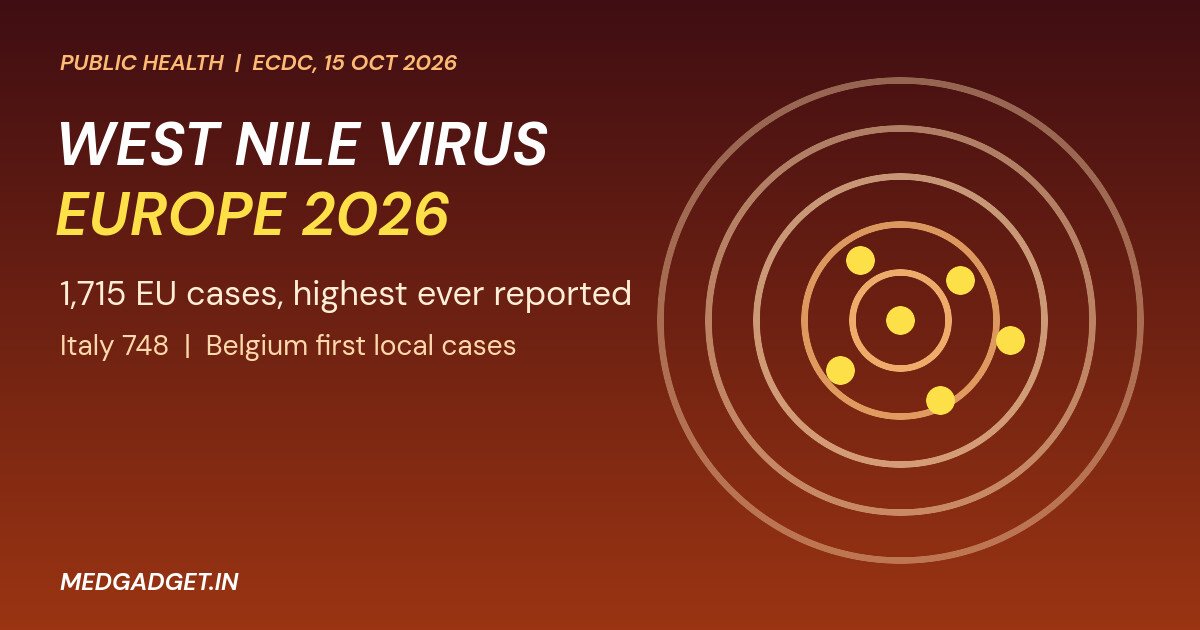
The West Nile virus Europe 2026 season is the largest on record in the European Union. On 15 October 2026 the European Centre for Disease Prevention and Control (ECDC) said that EU countries had reported 1,715 locally acquired human cases as of 7 October, the highest number ever recorded, along with 130 deaths so far this season. These are reported surveillance totals, not a forecast. They do not mean the virus is spreading evenly across the continent, and they do not mean every infection is severe.
Here is what the data show, which countries are most affected, how this compares with earlier figures this season, and what ordinary people can do to lower their risk.
West Nile virus Europe 2026: key takeaways
- Record: 1,715 locally acquired human cases in EU countries as of 7 October, the highest ever reported, according to ECDC.
- Deaths: 130 reported so far this season in the same release.
- Where: Italy reported 748 cases, the most of any country. Greece and France each had their highest-ever number of human cases. The Netherlands reported 59 and Belgium 15.
- New area: Belgium’s 15 cases are its first locally acquired human infections.
- Severity: ECDC sees no sign of increased severity. The shares of cases hospitalised, with neurological symptoms or dying remain below the previous decade’s levels.
- Outlook: conditions are becoming less favourable for the virus as summer ends, but more cases are expected.
What the ECDC data show for West Nile virus Europe 2026
The ECDC release counts locally acquired infections, meaning people who caught the virus in the country where they were diagnosed rather than while travelling. The figure of 1,715 cases is the highest ever reported for EU countries. Italy accounts for 748 of them, which by our arithmetic is about 44 percent of the EU total, so the season has been heavily concentrated in one country even though the record is EU-wide.
The release does not give a historical average or animal outbreak counts, so we do not quote either from it. It also states plainly that the occurrence of the virus varies considerably from year to year and is difficult to predict, a point made by Ole Heuer, head of unit at ECDC.
Why West Nile virus Europe 2026 totals look different
You may see other numbers in circulation. The October release gives the figure for EU countries. An earlier EFSA–ECDC monthly report, with data submitted up to 3 September, covered a wider Europe that includes EU candidate countries such as Serbia and North Macedonia, and counted 1,086 locally acquired cases and 61 deaths. Those totals cover different dates and different groups of countries, so they cannot be compared directly, and readers should check which geography a figure refers to before quoting it.
Which countries are most affected by West Nile virus Europe 2026
Italy leads, followed by Greece and France, both of which set their own records this year. In the September report, Italy had 516 cases and 25 deaths, and Greece had 284 cases and 24 deaths, with the Attica region accounting for 162 of Greece’s cases. France had 36 cases at that point. The Netherlands and Belgium are the northernmost entries in the October picture. Belgium had reported no human cases before this year, although animal outbreaks there (14 in horses and 26 in birds by early September) showed the virus was already circulating after first being detected in 2025 through bird surveillance.
Is the West Nile virus Europe 2026 season more severe?
More cases do not automatically mean more severe illness. ECDC says there is no sign of increased severity and that the shares of cases hospitalised, with neurological symptoms, or dying remain below the previous decade’s levels. The September report gives preliminary numbers: 78 percent of cases hospitalised against a ten-year average of 87 percent, 60 percent with neurological symptoms against 65 percent, and a case fatality rate of about 6 percent against 10 percent. Most cases were men aged 65 and over. Those percentages are for the wider European dataset and are preliminary.
How West Nile virus spreads and who is at risk
According to the World Health Organization’s fact sheet, the virus is mainly spread by the bite of infected mosquitoes, which pick it up from birds. About 80 percent of people infected have no symptoms, about one in five develops fever and other symptoms, and fewer than 1 percent develop severe neurological illness. There is no vaccine for people. ECDC says older adults and people with weakened immune systems face higher risk and should take extra care.
What you can do about West Nile virus Europe 2026
- Use mosquito repellent on exposed skin, as ECDC advises.
- Wear loose, long clothing in the evening and at night.
- Use window screens, mosquito nets or air conditioning where appropriate.
- Older adults and people with weakened immune systems should take extra care and speak to a doctor if they develop severe symptoms.
Risks and caveats for West Nile virus Europe 2026 figures
- Surveillance totals are provisional. Cases are reported with delays and counts can change.
- The EU figure and wider European figures are different measures. Do not mix them.
- Reported counts depend on testing and reporting, and many infections cause no symptoms and go unrecorded.
- The numbers describe what has happened so far, not what will happen. They do not show uniform spread across Europe.
In our assessment, the headline record is real but should be read alongside the severity data: more infections have been found, yet there is no evidence from ECDC that the illness itself has become worse. For other public health coverage, see Congo Ebola Outbreak October 2026: Alarming Rise Past 9,000 and our healthcare services section. ECDC publishes a weekly West Nile virus report updated during the transmission season.
What to watch next for West Nile virus Europe 2026
- Weekly ECDC updates, which the agency says run every Friday during the transmission season.
- Whether late cases push the totals higher, as ECDC expects.
- Final season figures and comparisons with earlier years.
- Whether new areas such as Belgium and the Netherlands report more infections next year.
Frequently asked questions
How many West Nile virus cases are there in Europe in 2026?
ECDC reported 1,715 locally acquired human cases in EU countries as of 7 October 2026, the highest ever recorded.
How many deaths in West Nile virus Europe 2026?
ECDC reported 130 deaths so far this season in its 15 October release.
Is West Nile virus Europe 2026 spreading everywhere?
No. Italy accounts for the largest share, and Greece and France also set records. Spread is uneven.
Is the virus more dangerous this year?
ECDC says there is no sign of increased severity.
How we reported this: we relied on the ECDC release of 15 October 2026, the EFSA–ECDC monthly report and WHO background. Percentages and shares labelled as ours are our own arithmetic. Last updated: 16 October 2026. This article is news reporting and not medical advice.