

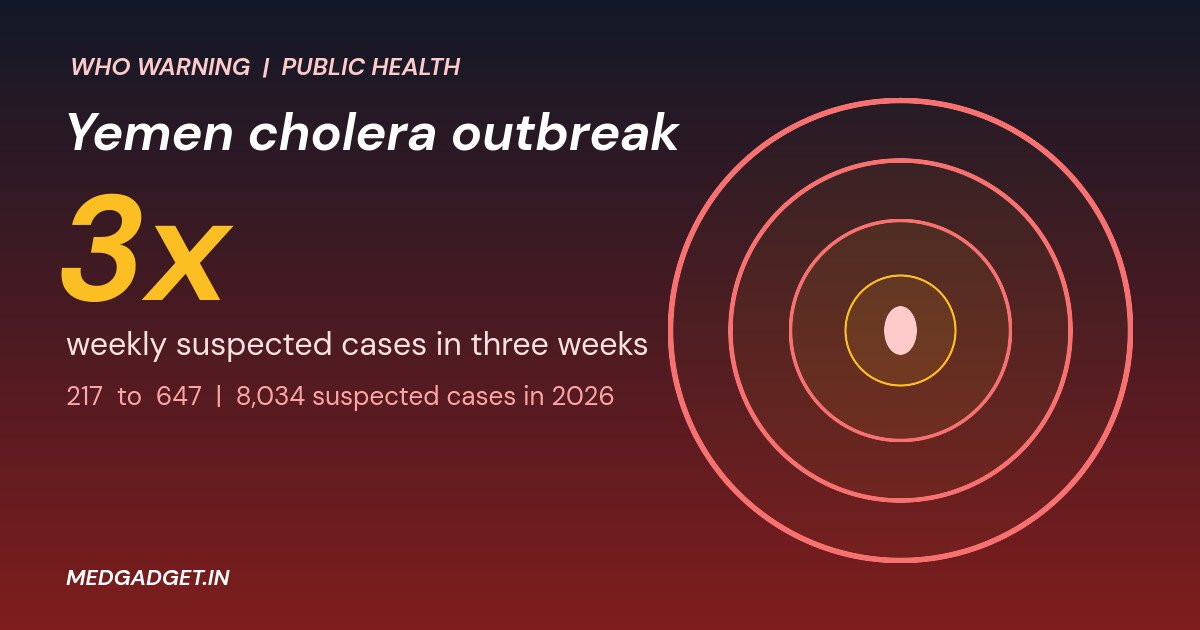
The Yemen cholera outbreak October 2026 is accelerating. On 13 October, the World Health Organization (WHO) warned that suspected cholera cases in Yemen have roughly tripled in about three weeks, from 217 in the week of 6–12 September to 647 in the week of 27 September to 3 October. For the year so far, Yemen has reported 8,034 suspected cases and 27 deaths, and renewed fighting has displaced more than 200,000 people.
Every one of these numbers describes suspected cases, not laboratory-confirmed infections. That matters for how far the totals can be pushed, and we explain why below, along with what is driving the rise and what responders say they need.
Key takeaways
- Weekly suspected cholera cases in Yemen rose from 217 to 647 in three weeks, according to WHO.
- Yemen has recorded 8,034 suspected cases and 27 deaths in 2026, about a quarter of the cases in the latest four weeks.
- More than 200,000 people have been displaced by renewed fighting, and unsafe water and crowded camps raise the risk.
- WHO says it has secured only a small share of the money needed for a 90-day emergency response.
- The figures are suspected cases and may change as testing and reporting catch up.
What WHO says about the Yemen cholera outbreak October 2026
WHO’s count rises from 217 suspected cases in the week of 6–12 September to 647 in the week of 27 September to 3 October. By our own arithmetic, that is a rise of about 198 percent, or close to three times the earlier level. WHO has not published the weeks in between in the material we reviewed, so the exact path of the increase is not clear.
Of the 8,034 suspected cases reported since January, WHO says about a quarter fell in the most recent four-week period. That is roughly 2,000 cases, our estimate from the stated share, in a month. WHO’s statement does not give the cut-off date for the yearly totals.
The agency says five south-western governorates that host many displaced people, Abyan, Lahij, al-Dhalea, Taiz and Aden, account for 92 percent of reported cases. The disease has also reached remote displacement camps in Hadramout in the east, where medical teams struggle to get access. Annette Heinzelmann, WHO’s emergency director for the region, said families who have fled conflict now face another threat from diseases that can be prevented and treated.
Why the Yemen cholera outbreak October 2026 is spreading
Cholera is an acute diarrhoeal infection caused by the bacterium Vibrio cholerae, picked up from contaminated food or water. The WHO cholera fact sheet explains that most infected people have no symptoms or only mild ones but can still shed the bacteria for 1 to 10 days, so the infection moves quietly through crowded settings. A minority develop severe watery diarrhoea that can be fatal within hours without treatment.
Conditions in displacement sites are close to ideal for spread: shared water points, limited sanitation and little room. Reports of the warning say fighting between Houthi forces and the government reignited in July, ending about four years of fragile calm, and food insecurity has worsened since. Yemen has seen cholera before. A wave in 2017 infected hundreds of thousands of people and killed at least 2,000, and WHO warned in 2024 that the country carried the highest burden in a global outbreak.
Reading the Yemen cholera outbreak October 2026 numbers: suspected cases and deaths
Suspected cases are people whose symptoms match a case definition. Many have not been tested, and some turn out to have other causes of diarrhoea. Counts can therefore overstate cholera, but weak surveillance can understate it, especially where roads are blocked. The WHO fact sheet itself notes that reported figures likely undercount the true burden worldwide.
The 27 reported deaths equal about 0.3 percent of suspected cases, by our calculation. We would not read that as reassurance. The figure mixes suspected and confirmed cases, deaths in remote camps may not be counted, and deaths tend to lag behind a surge in infections. WHO says well-run treatment centres should keep deaths below 1 percent of cases, a goal that depends on fast access to rehydration.
Funding gap in the Yemen cholera outbreak October 2026 response
WHO says it has secured $3.78 million of the $31 million it needs for a 90-day emergency response in Yemen. That is roughly 12 percent of the target, by our calculation. The money would pay to expand disease surveillance in displacement sites, deploy rapid response teams, strengthen cholera treatment and improve infection prevention in health facilities and treatment centres.
Heinzelmann warned that without urgent funding and unimpeded access to safe water, vaccination and essential health services, outbreaks could spread rapidly. The statement does not describe any vaccination campaign under way. WHO’s own pages list three pre-qualified oral cholera vaccines, and the WHO page on cholera vaccines sets out how they are used, but supply has been tight worldwide.
Our assessment of the Yemen cholera outbreak October 2026
In our assessment, the Yemen cholera outbreak October 2026 is a warning about the speed at which a preventable disease can rebuild when water and sanitation break down. The jump from 217 to 647 weekly cases over three weeks is steep enough to justify alarm even allowing for suspected-case counting. The larger risk is geographic: cases are concentrated in governorates where many people have moved, and the spread to remote camps suggests that the real numbers could be higher than reported. Funding of about 12 percent of the stated need leaves little room for the surveillance that would settle that question. For related outbreak coverage, see our reports on the Kenya Ebola outbreak in October 2026 and the Pennsylvania measles outbreak.
What readers should know
- Cholera is treatable. Most patients recover with prompt oral rehydration, and severe cases need intravenous fluids and antibiotics, per the WHO fact sheet.
- Safe water, sanitation and hygiene are the main protection, with vaccines as a complement.
- Anyone with severe watery diarrhoea should seek medical care quickly; for background, see the WHO questions and answers on cholera outbreaks.
What to watch in the Yemen cholera outbreak October 2026
- Weekly WHO case counts, and whether the rise slows or accelerates.
- Laboratory confirmation rates and any revision of the suspected-case totals.
- Progress on the $31 million response appeal.
- Access to camps in Hadramout and other hard-to-reach areas.
Frequently asked questions about the Yemen cholera outbreak October 2026
How many cholera cases has Yemen reported in 2026?
WHO reports 8,034 suspected cases and 27 deaths so far this year.
How fast are cases rising?
Weekly suspected cases rose from 217 (6–12 September) to 647 (27 September to 3 October), roughly a threefold increase.
Are these confirmed cholera cases?
No. They are suspected cases, and not all have been confirmed by laboratory testing.
Why is cholera spreading in the Yemen cholera outbreak October 2026?
Renewed fighting has displaced more than 200,000 people into camps with limited safe water and sanitation, which allows the bacteria to spread.
What does WHO need?
WHO says it has $3.78 million of the $31 million required for a 90-day emergency response and is calling for urgent funding and access.
How we reported this: we relied on WHO’s 13 October 2026 warning, the WHO cholera fact sheet and reports of the statement. Figures are WHO’s unless we label them as our own calculations. Last updated: 14 October 2026. This article is news reporting and not medical advice.