

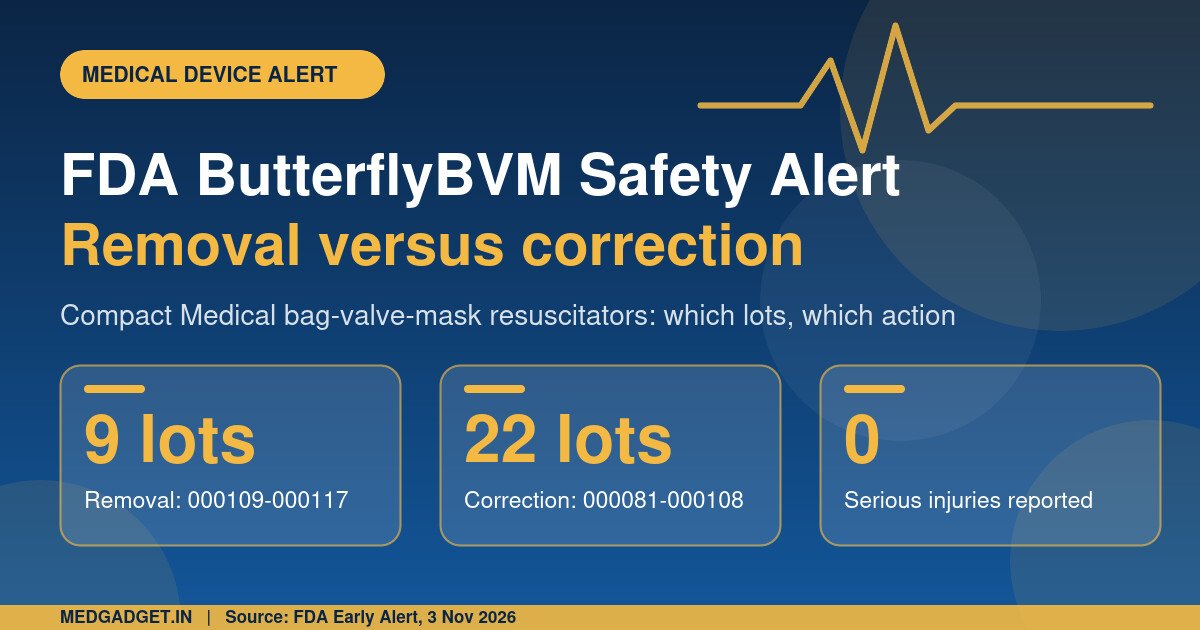
The FDA ButterflyBVM safety alert, published on 3 November 2026, tells hospitals, ambulance services and other users of Compact Medical’s ButterflyBVM bag-valve-mask resuscitators to act on specific manufacturing lots. The agency issued it as an Early Alert, which it uses to tell the public about a potentially high-risk device issue. It has not assigned a recall classification.
Key takeaways from the FDA ButterflyBVM safety alert
- The problem: a hole can develop in the resuscitator’s bellows, so air meant for the patient can leak out.
- Nine lots (000109 to 000117) are subject to removal, and 22 lots (000081 to 000108) are subject to correction, meaning the devices stay in use but must pass a pre-use check every time.
- As of 2 November 2026, Compact Medical reported no serious injuries or deaths linked to the issue.
- The FDA has not assigned a recall class; the page is an Early Alert based on the manufacturer’s notices of 26 September and 7 October 2026.
- Users should keep a backup bag-valve-mask available in every care scenario.
What is a bag-valve-mask resuscitator, and why does a hole matter?
A bag-valve-mask (BVM) is a hand-squeezed bag attached to a face mask. Paramedics, nurses and doctors use it to push air into the lungs of a patient who is not breathing or is breathing too little, for example during cardiac arrest or in an emergency room. Because the bag is the source of the breath, any leak reduces the volume reaching the patient.
According to the FDA, a hole in the ButterflyBVM bellows lets tidal volume, the amount of air delivered with each squeeze, escape instead of reaching the patient. That can cause inadequate ventilation and hypoxia, a shortage of oxygen in the body, and if not corrected it could lead to serious injury or death. The agency states that lots 000109 to 000117 have a higher rate of holes than previously observed.
Removal versus correction: what the FDA alert asks users to do
The alert separates affected devices into two groups. The distinction matters because the two groups carry different instructions.
- Removal (lots 000109 to 000117): stop using these devices and take them out of service once replacement units are in place. This group covers eight lots of the ButterflyBVM READY (SKUs R300 and R308) and lot 000114 of the standard ButterflyBVM (A100 and A108).
- Correction (lots 000081 to 000108): the devices may stay in use, but each unit must pass the Pre-Use Test or Equipment Check described in the instructions for use before every patient. Any unit that fails is not used. This group includes 14 READY lots, four standard ButterflyBVM lots and four ButterflyBVM PLUS lots (P200 and P208).
The manufacturer’s notice describes the removal as an urgent medical device recall. That is the company’s wording; the FDA states it has not classified the event. We therefore describe it as a removal and a correction, not as a classified recall. You can read the agency’s page at the FDA Early Alert.
Timeline of the ButterflyBVM issue
- 26 September 2026: Compact Medical sends its first letter to customers.
- 7 October 2026: the company sends a follow-up letter.
- 2 November 2026: date of the company’s latest report of no serious injuries or deaths.
- 3 November 2026: the FDA publishes the Early Alert.
What hospitals and emergency services should do now
For removal lots, the FDA advises users first to confirm backup BVMs are in place before pulling units from carts, vehicles or kits. Then stop using every unit from those lots, wherever it is stored, label it Do Not Use and quarantine it. If packaging or labelling is missing, assume the device is from an affected lot. A unit that failed during patient use or is linked to an injury should not be destroyed; keep it in its original packaging and contact the manufacturer. Distributors should stop distributing the removal lots.
For correction lots, check inventory at every location and run the pre-use test before each patient. If ventilation looks inadequate during use, check the device for a hole; if one is found, switch to a backup BVM at once, then quarantine and report the unit. Share the notice with everyone who uses these devices. Adverse events can be reported through the FDA MedWatch programme, and questions can go to Compact Medical at the contact details on the FDA page or at the company website.
Implications for emergency respiratory care
Manual resuscitators are a last line of support, so a defect in one is taken seriously. Two features of this alert are worth noting. First, the hazard can arise during use, which is why the instructions emphasise a pre-use check and a ready backup. Second, the affected lots include devices distributed to crash carts, vehicles and kits, places where a unit may sit for long periods. Services that stock BVMs in many locations may need a systematic inventory to find the lots.
Related device-safety coverage on this site includes our report on the Philips Respironics DOJ agreement, which concerns respiratory devices in a different context.
Market context: bag-valve-mask ventilation
According to Acumen Research And Consulting, the global bag-valve-mask ventilation market was valued at USD 563.2 million in 2023 and is projected to reach USD 887.6 million by 2032, a compound annual growth rate of 5.2% for 2024 to 2032. North America was the largest region at about USD 214.1 million in 2023, Asia-Pacific is the fastest-growing at above 5.9%, disposable BVMs held 54% of the market and hospitals and clinics 60% by end user.
The report page was last updated in February 2025, and it contains some inconsistencies: it lists a trend toward reusable healthcare textiles although disposables lead, and one statistic is cut off mid-sentence. Our check shows the stated growth rate is consistent with the forecast. The figures describe the whole category and not ButterflyBVM.
Our analysis
In our assessment, this alert is best read as a targeted, lot-level action, not a withdrawal of the whole product line. The FDA describes specific lots, specific instructions and a manufacturer-reported absence of serious injuries so far. At the same time, the possible consequence of a leaking resuscitator is severe, so the pre-use test and a backup device are not optional. Whether the event is later classified as a recall, and at what level, is for the FDA to decide.
What is not disclosed
- The distribution dates of the affected lots.
- The number of units in each lot or in use.
- The root cause of the higher hole rate in lots 000109 to 000117.
- Whether and when the FDA will assign a recall classification.
Risks and caveats
- The FDA page reflects the manufacturer’s information as of 2 and 3 November 2026 and may be updated.
- No injury count means none reported to the company so far, not that none occurred.
- Lot numbers must be checked against the FDA table; we summarise but do not replace it.
- This article is not medical or clinical advice.
What to watch next
- Any FDA update, including a recall classification.
- Compact Medical’s replacement and root-cause communications.
- Reports of adverse events through MedWatch.
- Hospital and EMS procurement responses.
General background
Early Alerts are one of the ways the FDA communicates about potentially high-risk device problems while its review continues. For more device news, see our Medical Device section.
Questions readers are asking about the FDA ButterflyBVM safety alert
Is this an FDA recall?
The FDA has published an Early Alert and has not assigned a recall class.
Which products are affected?
ButterflyBVM READY, ButterflyBVM and ButterflyBVM PLUS devices from the listed lots.
Have any patients been harmed?
As of 2 November 2026 the company reported no serious injuries or deaths linked to the issue.
Can correction-lot devices still be used?
Yes, if each unit passes the pre-use test before every patient and a backup BVM is available.
FAQ
How do I find the lot number?
Check the device or packaging; if packaging or labelling is missing, assume the device is from an affected lot, per the FDA.
Who do I contact?
Compact Medical, or the FDA at 1-888-INFO-FDA, and report problems through MedWatch.
What should I do with a failed unit?
Quarantine it in its original packaging and contact the manufacturer; do not destroy it.
How we reported this: details come from the FDA Early Alert dated 3 November 2026; market figures are attributed to Acumen Research And Consulting. Last updated 4 November 2026. This is news reporting and not medical advice.