

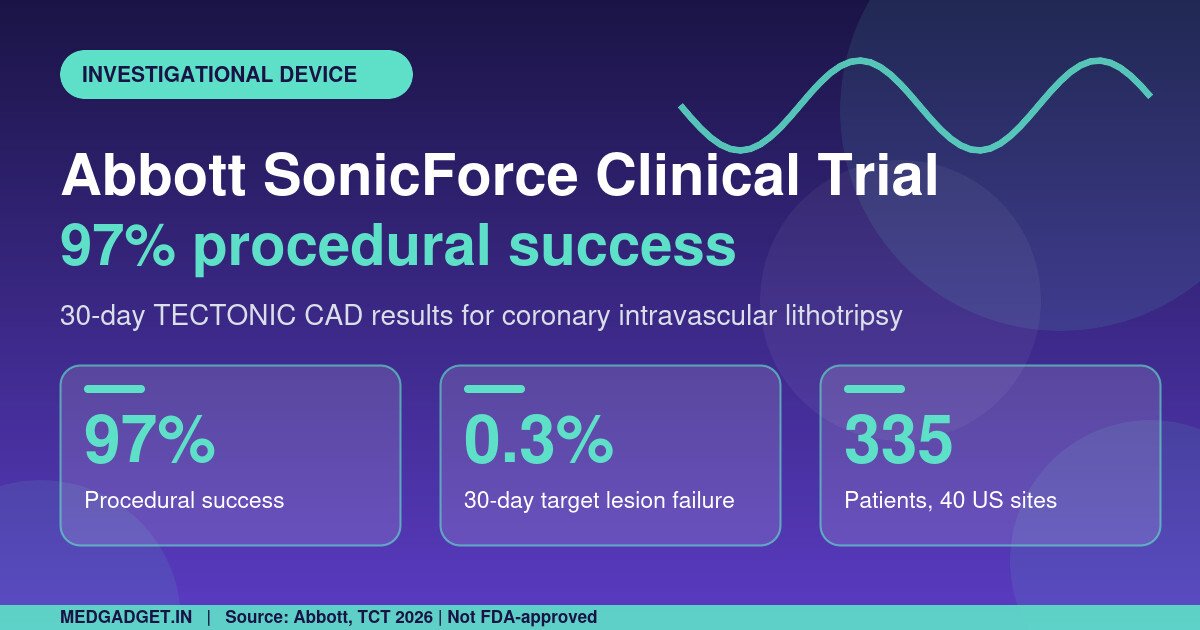
The Abbott SonicForce clinical trial has reported its first major results. In the TECTONIC CAD study, an investigational coronary intravascular lithotripsy (IVL) system met its primary safety and effectiveness endpoints, with procedural success in 97% of 335 patients and a 30-day target lesion failure rate of 0.3%. The results were presented on 1 November 2026 at the Transcatheter Cardiovascular Therapeutics (TCT) meeting in San Diego.
Key takeaways from the Abbott SonicForce clinical trial
- TECTONIC CAD enrolled 335 patients with severely calcified coronary artery disease at 40 US sites under an Investigational Device Exemption.
- Primary safety endpoint met: 30-day target lesion failure of 0.3%. Primary effectiveness endpoint met: procedural success in 97%.
- Core-laboratory imaging showed remaining vessel blockage below 50% in all patients assessed after IVL.
- An optical coherence tomography (OCT) sub-study of 106 patients found calcium fractures and improved stent expansion.
- SonicForce is investigational: it is not approved by the US FDA and is limited by federal law to investigational use.
How coronary intravascular lithotripsy works
Coronary arteries can narrow when plaque builds up inside them, and in some patients that plaque contains hard calcium. IVL borrows an idea from kidney-stone treatment: it sends acoustic pressure waves through a balloon-mounted catheter to crack the calcium. According to Abbott, SonicForce delivers up to 160 pulses at two pulses per second and is designed with longer treatment lengths, more pulses and improved catheter deliverability.
The aim is not to remove the calcium but to fracture it so that the artery wall becomes more compliant. Once the calcium is cracked, a stent can expand more fully, and that is the step that matters for blood flow.
Why calcified coronary lesions are so difficult to treat
A stent is a small mesh tube that props open a narrowed artery. In a heavily calcified lesion, the vessel wall can be rigid, so a balloon may not dilate it evenly and a stent may not open to its full size. An under-expanded stent is a recognised risk factor for later problems. Investigator Eric Secemsky of Beth Israel Deaconess Medical Center, the trial’s co-principal investigator, said coronary calcium remains one of the greatest challenges to achieving optimal percutaneous coronary intervention (PCI) outcomes. Abbott describes its coronary portfolio as spanning imaging, lesion preparation and stents.
What the 30-day results indicate
| Measure | Result | What it means |
|---|---|---|
| Procedural success (primary effectiveness) | 97% | Met the primary effectiveness endpoint; the release does not define procedural success, so check the JACC paper |
| 30-day target lesion failure (primary safety) | 0.3% | Met the primary safety endpoint; definition not given in the release |
| MACE, as-treated population | 0.3% | Cardiac death, any myocardial infarction and target vessel revascularisation combined |
| Residual blockage after IVL (core lab) | Below 50% in all patients assessed | A key secondary endpoint, met |
Taken together, these numbers say that, over 30 days in a selected trial population, the system was used successfully and few serious events occurred. The results were published at the same time in JACC: Cardiovascular Interventions.
Procedural success is not the same as long-term benefit
This distinction is central to reading the study. Procedural success describes what happened during and soon after the procedure; it does not measure whether patients live longer, avoid a heart attack or need fewer repeat procedures over years. A 30-day safety rate of 0.3% is encouraging, but 30 days is short. Longer follow-up is needed to see how stents placed after IVL perform, and the release does not describe a comparison group, so we cannot say whether SonicForce outperforms other treatment approaches.
Timeline of the TECTONIC CAD study
- 1 November 2026: 30-day results presented at TCT in San Diego by Dr Secemsky.
- Same day: results published in JACC: Cardiovascular Interventions.
- Not yet announced: regulatory submission or approval for SonicForce.
What Abbott said
Julie Tyler, senior vice president of Abbott’s vascular business, said approval would strengthen the company’s leadership in treating severely calcified coronary arteries. The company’s own cardiovascular news is at Abbott. For other Abbott news on this site, see our report on its nutrition spin-off plan.
Market context: coronary stents
IVL is used to prepare a vessel before a stent. According to Acumen Research And Consulting, the global coronary stents market was valued at USD 7.8 billion in 2022 and is projected to reach USD 16.8 billion by 2032, a compound annual growth rate of above 8.2%. North America held a 34% share in 2022, Asia-Pacific is expected to grow at about 9%, and drug-eluting stents held 66% of the type segment.
The report is about stents, not IVL, and has flaws: its endpoints imply a growth rate of about 8.0%, it gives no clear CAGR period in its headline, and it mentions agent-eluting stents where drug-eluting stents are meant. It is useful context for the stenting market that IVL serves, not a measure of the IVL market itself.
Our analysis
In our assessment, the Abbott SonicForce clinical trial achieved what a pivotal safety and effectiveness study needs to: it met both primary endpoints with low event rates at 30 days. The open questions are the ones an investigational device always faces. How will the regulator view the data, how will outcomes hold at one year and beyond, and how will the device compare in practice with systems already in clinical use? Those answers are not in this release.
What is not disclosed
- The formal definitions of procedural success and target lesion failure.
- Whether TECTONIC CAD was single-arm; the release does not say.
- Lesion details such as length, vessel size and calcium morphology.
- Follow-up beyond 30 days, and any regulatory filing timeline.
Risks and caveats
- SonicForce is investigational and not approved by the FDA.
- Results are company-reported 30-day data from a selected trial population.
- Our table describes only what the release states.
- This article is not medical advice.
What to watch next
- One-year and longer follow-up from TECTONIC CAD.
- An Abbott regulatory submission or any FDA decision.
- Real-world use if the device is eventually cleared.
- Competing IVL data from other manufacturers.
General background
IVL has become a recognised way to prepare calcified coronary lesions before stenting, and an established IVL system from another company is already in clinical use. More device news is in our Medical Device section.
Questions readers are asking about the Abbott SonicForce clinical trial
Is SonicForce approved?
No. It is investigational and not approved by the FDA.
What does 97% procedural success mean?
It is the primary effectiveness result; the release does not define it, so the published paper should be consulted.
How many patients were in the trial?
335 patients at 40 US sites.
Does the trial show long-term benefit?
No. The reported data are 30-day results.
FAQ
What is IVL?
Intravascular lithotripsy uses acoustic pressure waves to crack calcium inside an artery.
Why does calcium matter in PCI?
It can stop a stent from expanding fully.
Who presented the data?
Dr Eric Secemsky, co-principal investigator, at TCT 2026.
How we reported this: details come from Abbott’s announcement of the TECTONIC CAD results and the associated publication; market figures are attributed to Acumen Research And Consulting. Last updated 4 November 2026. This is news reporting and not medical advice.
[…] Medtronic Reports Significant Blood Pressure Reduction in SPYRAL AFFIRM Renal Denervation Study Abbott’s SonicForce Heart Device Achieves 97% Procedural Success in TECTONIC CAD Clinical Trial FDA Issues Safety Alert for Compact Medical ButterflyBVM Resuscitators Over Potential Device […]