

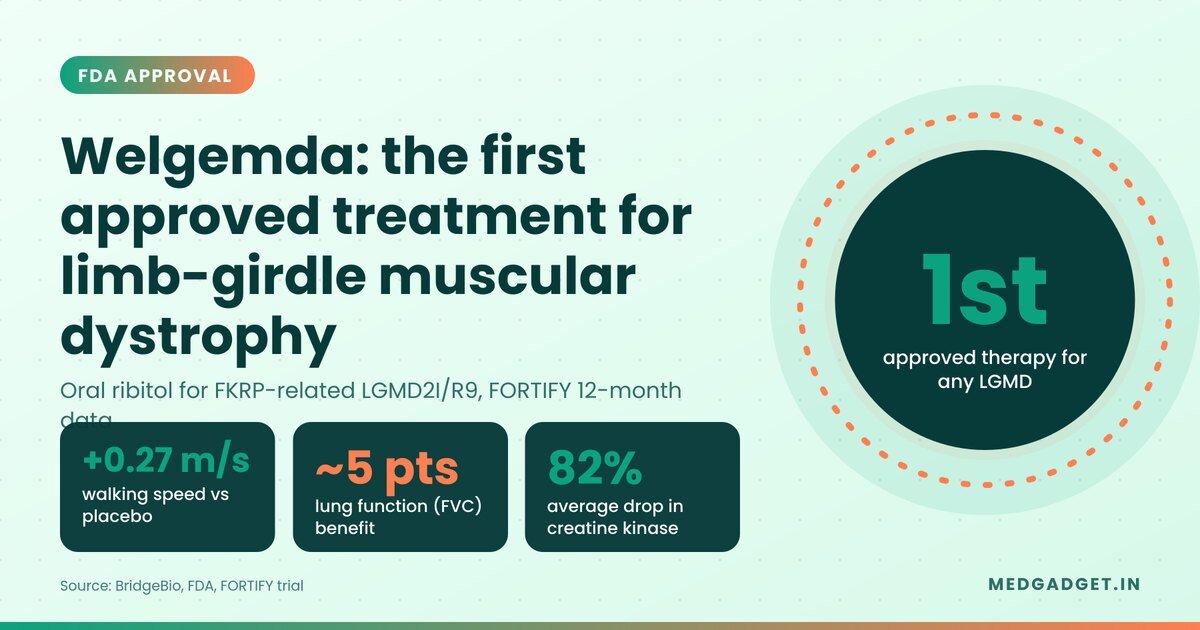
The Welgemda FDA approval on 23 November 2026 gives limb-girdle muscular dystrophy (LGMD) its first approved treatment of any kind. The US regulator granted traditional approval to BridgeBio’s Welgemda (ribitol, BBP-418), a twice-daily oral solution, for adults and children weighing at least 30 kg with LGMD2I/R9, the form caused by mutations in the FKRP gene. In the Phase 3 FORTIFY trial, patients on the drug walked faster and kept more lung function over 12 months than those on placebo.
Key takeaways on the Welgemda FDA approval
- First FDA-approved therapy for any limb-girdle muscular dystrophy; indicated for FKRP-related LGMD2I/R9 in patients weighing 30 kg or more.
- Traditional (full) approval, based on a planned 12-month interim analysis of the 112-patient FORTIFY trial.
- Walking speed on a 100-metre timed test improved by 0.27 metres per second versus placebo (p<0.0001).
- Lung function (FVC) was about 5 percentage points better than placebo (p=0.0071).
- Diarrhoea was the most common side effect; no patient stopped treatment because of adverse reactions.
- BridgeBio also received a rare pediatric disease priority review voucher; a European filing is planned for the first half of 2028.
What LGMD2I/R9 does to the body
Limb-girdle muscular dystrophies are a group of inherited diseases that waste the muscles of the hips and shoulders first. LGMD2I/R9 is one of the more common subtypes in northern Europe. A Norwegian study found 153 genetically confirmed patients, a prevalence of 2.84 per 100,000. Symptoms can start in childhood or adulthood, and over time many patients lose the ability to climb stairs or walk, and some develop breathing and heart muscle weakness. BridgeBio estimates around 7,000 people in the US and Europe live with LGMD2I/R9 and related conditions the drug could address.
How a simple sugar alcohol became a drug
Muscle cells anchor themselves to the surrounding tissue through a protein called alpha-dystroglycan, which only works when it is decorated with a specific sugar chain. The FKRP enzyme adds a ribitol-based building block to that chain. In LGMD2I/R9, mutations leave the enzyme partly working but too sluggish, so alpha-dystroglycan is poorly glycosylated and muscle fibres tear more easily during contraction.
Ribitol is a naturally occurring sugar alcohol. Giving it in large oral doses raises the supply of the enzyme’s raw material, pushing the residual FKRP activity to rebuild the sugar chain. FORTIFY confirmed that the drug hits its target: glycosylated alpha-dystroglycan rose by month three and stayed elevated at 12 months. The FDA said this showed the drug reaching its target at the approved dose.
FORTIFY results in numbers
| Endpoint (12-month interim) | Result with ribitol | Statistical significance |
|---|---|---|
| 100-metre timed walk | +0.27 m/s versus placebo | p<0.0001 |
| Forced vital capacity (% predicted) | About +3% vs about -2% on placebo (roughly 5-point gap) | p=0.0071 |
| North Star Assessment for LGMD | Improvement vs decline on placebo | Nominally significant |
| Glycosylated alpha-dystroglycan | Increased at 3 months, sustained at 12 months | p<0.0001 |
| Serum creatine kinase (muscle damage marker) | Average 82% reduction from baseline | p<0.0001 |
FORTIFY randomised 112 patients aged 12 to 60 two-to-one to ribitol or placebo across sites in the US, Europe and Australia. The study is designed to run for up to 36 months, and its formal primary measure, the North Star Assessment at 36 months, is not due until primary completion around September 2027. For a slowly progressive disease, improvement rather than slower decline on walking speed at one year is a notable signal. Dr Laura Jawidzik of the FDA’s neurology division said the data “show meaningful improvements in walking speed and lung function.”
Safety and practical use
Welgemda is taken twice a day as an oral solution mixed with water. The most common side effects were gastrointestinal, mainly diarrhoea and stomach or abdominal pain, plus joint pain. BridgeBio reported no serious diarrhoea and no discontinuations due to adverse reactions. The drug is only for the FKRP-related subtype, so genetic confirmation is essential; it is not expected to help other forms of LGMD or other muscular dystrophies.
Availability, price and what it means for India
BridgeBio expects an immediate US launch, with access supported through its ForgingBridges programme. The company has not disclosed a price. Outside the US, the only filing announced so far is a European marketing application planned for the first half of 2028. There is no announced plan for India, where patients with genetically confirmed LGMD2I/R9 would currently have no domestic route to the drug. The approval may still matter for Indian neuromuscular care: it strengthens the case for wider genetic testing of LGMD, since only patients with a confirmed FKRP diagnosis can benefit.
Rare neuromuscular drug development has been active this year, from PepGen’s myotonic dystrophy data to the Lembaz approval in Niemann-Pick type C. More in our FDA approvals section.
What remains unknown
- Whether the 12-month gains hold or grow through the full 36-month FORTIFY readout.
- Effects on heart muscle, which can be involved in LGMD2I/R9.
- US price, insurance coverage and timing of approvals outside the US.
Frequently asked questions
What is Welgemda used for?
Welgemda (ribitol) is approved to treat limb-girdle muscular dystrophy type 2I/R9, caused by FKRP gene mutations, in adults and children weighing at least 30 kg.
Is there a cure for limb-girdle muscular dystrophy?
No. Welgemda is the first approved treatment for any form of LGMD, and it treats only the FKRP-related subtype. It improved walking speed and lung function in its trial but is not a cure.
How is Welgemda taken?
It is an oral solution mixed with water and taken twice daily.
Is Welgemda available in India?
Not at present. BridgeBio has announced a US launch and a planned European filing in 2028, but no Indian regulatory submission.
Sources: BridgeBio press release, 23 Nov 2026; FDA approval announcement; Muscular Dystrophy Association; FORTIFY (NCT05775848). This article is for information only and is not medical or investment advice. Last updated 24 November 2026.