

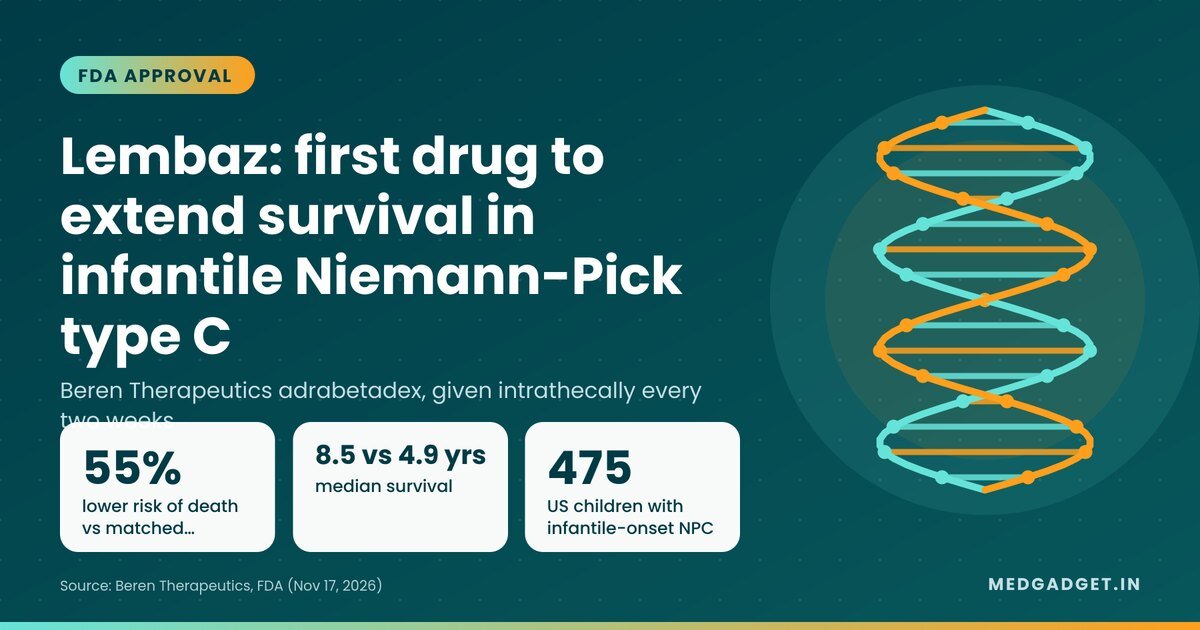
The Lembaz FDA approval on November 17, 2026 made Beren Therapeutics’ adrabetadex the first medicine shown to help children with infantile-onset Niemann-Pick disease type C (NPC) live longer. The US Food and Drug Administration cleared the intrathecal drug for patients weighing at least 7 kg whose neurological symptoms began before age 6, after an analysis of 36 treated children found a 55% lower risk of death than in matched untreated controls. Median survival was 8.5 years with treatment versus 4.9 years without.
NPC already had two approved drugs, but neither has been shown to extend life. That is what makes this decision a milestone for families, and also why the way the FDA reached it is worth understanding.
Key takeaways on Lembaz FDA approval
- Drug: Lembaz (adrabetadex), a cyclodextrin compound from Beren Therapeutics and its subsidiary Mandos.
- Patients: Children and adults of at least 7 kg with NPC whose neurological symptoms started before age 6 (infantile-onset NPC, or I-NPC).
- Benefit: 55% reduction in the risk of death; median survival 8.5 vs 4.9 years against an external control group.
- How given: Intrathecal injection into the spinal fluid, every two weeks, with careful dose escalation.
- Main safety issue: Boxed warning for hearing loss, which can be permanent, plus ataxia and fatigue.
- Availability: At US commercial treatment sites from early December 2026.
What Niemann-Pick type C does to children
NPC is an inherited disorder caused by changes in the NPC1 or NPC2 gene. Cells cannot move cholesterol and other fats out of their storage compartments, so lipids build up in the brain, liver and spleen. In children, this shows up as delayed milestones, loss of walking and speech, swallowing problems, seizures and an inability to move the eyes up and down.
The earlier symptoms start, the faster the disease moves. According to Beren, average age at death is about 5.6 years when neurological signs begin before age 2 and about 13.4 years when they begin between 2 and 6. Around 475 children in the United States, roughly half of all NPC patients, have the infantile-onset form.
How adrabetadex works and how it is given
Adrabetadex is a form of cyclodextrin, a ring-shaped sugar molecule that can help release trapped cholesterol from cells. Because it does not cross the blood-brain barrier well, it has to be delivered directly into the cerebrospinal fluid through a lumbar injection, the same route used for a spinal tap. Per NeurologyLive’s report on the approval, the approved schedule is every two weeks, more frequent than the monthly dosing used in the earlier Phase 1/2a study.
That means a lifelong commitment to regular procedures at a specialist center, often with sedation in young children. The drug does not fix the underlying gene defect.
The evidence: survival against an external control
The FDA did not base this approval on a placebo-controlled trial, which would have been difficult and arguably unethical in a rapidly fatal childhood disease. Instead, it accepted an overall survival analysis pooling children treated across three clinical studies and an expanded access program, compared with a matched external control group drawn from untreated patients. Beren’s announcement says the agency judged this comparison to be adequate and well-controlled.
| Measure | Lembaz-treated | Matched external control |
|---|---|---|
| Children analyzed | 36 | Not disclosed |
| Risk of death | 55% lower | Reference |
| Median survival | 8.5 years | 4.9 years |
| Survival gain | About 3.6 years (by our calculation) |
By our calculation, median survival was about 73% longer in treated children. External-control designs carry known weaknesses: treated families may have had better access to supportive care, and diagnosis or record-keeping can differ between groups. The FDA’s acceptance after a review extended by three months earlier this year suggests the agency scrutinized these questions closely, but the size of the control group and the hazard ratio confidence interval have not been publicly released.
Safety: hearing tests are built into treatment
Hearing damage is the defining risk. Lembaz carries a boxed warning for hearing impairment, ranging from mild to profound and sometimes permanent, including in children who had normal hearing before starting. Every patient needs baseline audiology with pure tone audiometry, speech recognition testing and tympanometry, then repeat testing one to two weeks after the first and second dose at each new dose level. Doctors are told not to raise the dose if hearing falls beyond set limits, and testing continues monthly and then yearly once the dose is stable.
Ataxia and fatigue can also be severe enough to need hospital care, usually in the first days after a dose and more often at higher doses. Other common side effects, seen in at least a quarter of trial patients, included vomiting, back pain, headache, fever, diarrhea, nausea and cough. For many families, trading some hearing for years of life will be a hard but understandable choice, one best made with a metabolic specialist and audiologist.
How Lembaz fits with other NPC drugs
| Drug | Company | Approved | Population | Survival shown? |
|---|---|---|---|---|
| Miplyffa (arimoclomol) | Zevra Therapeutics | Sept 2024 | Age 2+, with miglustat | No |
| Aqneursa (levacetylleucine) | IntraBio | 2024 | Weight 15 kg+ | No |
| Lembaz (adrabetadex) | Beren Therapeutics | Nov 2026 | 7 kg+, onset before age 6 | Yes |
The oral drugs slow neurological decline on rating scales; Lembaz is the only one with a survival claim, and its lower weight threshold reaches younger children. Doctors may combine approaches, but the label data address Lembaz on its own terms. Beren also received a priority review voucher with the approval, which it can use or sell.
What it means for families in India
Lembaz is approved only in the United States, and Beren has not announced filings with India’s CDSCO or other regulators. Indian families affected by NPC typically depend on specialist genetics centers for diagnosis and on supportive care, so near-term access would likely require named-patient import routes. Rare disease research continues to move quickly, as our coverage of PepGen’s myotonic dystrophy data and ersodetug in tumor hyperinsulinism shows.
FAQ
What is Lembaz approved for?
Lembaz (adrabetadex) is approved in the US to reduce the risk of death in patients weighing at least 7 kg with Niemann-Pick disease type C whose neurological symptoms began before age 6.
Is there a cure for Niemann-Pick disease type C?
No. Lembaz and the oral drugs Miplyffa and Aqneursa treat the disease but do not correct the gene defect.
How is adrabetadex given?
It is injected intrathecally, into the fluid around the spinal cord, every two weeks, with hearing checks before and during dose increases.
When will Lembaz be available?
Beren says it will be available at US commercial treatment sites in early December 2026.
Read more in our Drug Approvals section.
Sources: Beren Therapeutics announcement and FDA press announcement (November 17, 2026); NeurologyLive. No relevant Acumen Research and Consulting market report was available for this topic. This article is for information only and is not medical advice. Last updated November 19, 2026.