

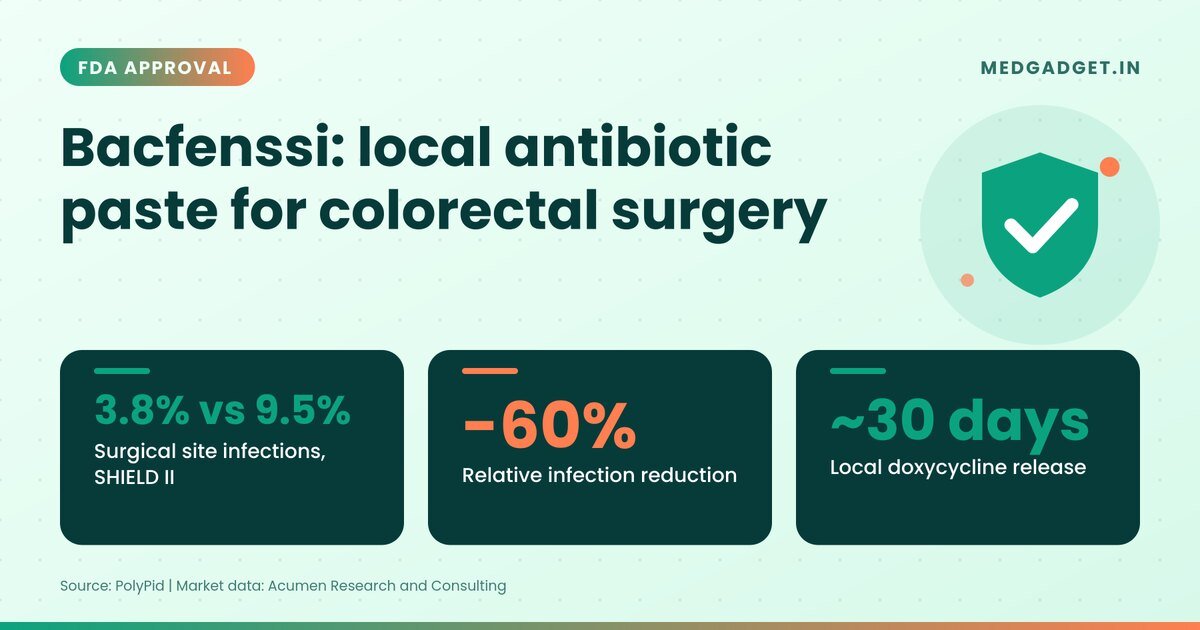
Bacfenssi FDA approval arrived on 24 November 2026, four days ahead of its 28 November target date: the US Food and Drug Administration cleared PolyPid’s Bacfenssi (doxycycline hyclate) for extended-release paste, formerly known as D-PLEX100, to reduce surgical site infections in adults and children weighing at least 45 kg who undergo colorectal surgery with incisions longer than 20 cm. In the pivotal SHIELD II trial, it cut the surgical site infection rate from 9.5% to 3.8%, a 60% relative reduction.
The paste is applied directly into the surgical site at wound closure and releases the antibiotic locally for about 30 days. Azurity Pharmaceuticals holds US and Canadian rights and plans a US launch in early 2027.
Key takeaways on Bacfenssi FDA approval
- Approved 24 November 2026 under Priority Review, ahead of the 28 November PDUFA date.
- Indication limited to colorectal surgery with incisions over 20 cm; efficacy is not established for shorter incisions.
- SHIELD II (798 patients): composite of infection, death or reintervention 10.9% vs 18.1% (p=0.004); infections alone 3.8% vs 9.5% (p=0.001).
- Holds Breakthrough Therapy, Fast Track and QIDP designations, giving eight years of US exclusivity.
- EU decision expected in the second half of 2027; not approved in India or elsewhere yet.
The SHIELD II numbers in plain terms
SHIELD II was a randomised, double-blind, multinational Phase 3 study (NCT04411199). Its primary analysis focused on 798 patients with long abdominal incisions, who received either Bacfenssi plus standard infection-prevention care or standard care alone. PolyPid says the trial met its primary endpoint and all key secondary endpoints.
| Endpoint (incisions over 20 cm) | Bacfenssi + standard care | Standard care alone | Relative reduction | p-value |
|---|---|---|---|---|
| Composite: SSI, all-cause death or reintervention (primary) | 10.9% | 18.1% | 40% | 0.004 |
| Surgical site infection (key secondary) | 3.8% | 9.5% | 60% | 0.001 |
By our calculation, the absolute drop in infections was 5.7 percentage points, which means roughly 18 patients would need to be treated to prevent one surgical site infection. For the composite endpoint, the absolute difference was 7.2 points, or about one event avoided for every 14 patients treated. Those are meaningful figures for a one-time application in an operation that already carries high infection risk.
How a local antibiotic paste works
Standard prevention relies on intravenous antibiotics given around the time of incision, skin preparation, and careful technique. Blood levels from IV doses fall within hours, while the wound remains vulnerable for days. Bacfenssi uses PolyPid’s Kynatrix technology, a polymer and lipid matrix that holds 63 mg of doxycycline per vial and releases it slowly at the incision site for about a month. The aim is a high antibiotic concentration exactly where bacteria from the bowel can seed the wound, with low exposure elsewhere in the body.
We explained the trial design and the case for local delivery in our preview, D-PLEX100 FDA decision due 28 November.
Safety and label limits surgeons should know
- Contraindication: known hypersensitivity to tetracycline-class antibiotics.
- Common side effects (at least 2% and more frequent than control): incision site reactions, procedural pain, anaemia and wound dehiscence.
- Class warnings: tooth discolouration and enamel hypoplasia, inhibition of bone growth, Clostridioides difficile infection, photosensitivity, pseudotumor cerebri and microbial overgrowth.
- Other: anticoagulant doses may need adjustment, and breastfeeding is not recommended for 38 days after administration.
The approval does not cover laparoscopic or small-incision procedures, where infection rates are already lower. PolyPid says it has begun talks with the FDA about further indications, but nothing beyond colorectal surgery is approved.
Why this matters beyond the US
Surgical site infections are a persistent problem in hospitals worldwide, including in India, where long open abdominal operations remain common in public and private centres. A product that works at the wound itself, and is applied once, could fit settings where post-operative follow-up is difficult. It is not yet available outside the US: the European Medicines Agency is reviewing a marketing application with a decision expected in the second half of 2027, and there is no filing reported with India’s CDSCO. Hospital uptake in the US will also depend on payment; a CMS New Technology Add-on Payment decision is expected in August 2027.
Supply is another watchpoint. PolyPid manufactures the paste at a single facility in Israel, so scale-up for launch will be tracked closely.
Market context
Bacfenssi enters a large but mature antibiotics field. Acumen Research and Consulting valued the global antibiotics market at $42 billion in 2021 and forecasts $63 billion by 2030, a compound annual growth rate of 4.6%, with Asia-Pacific the fastest growing region. Products that reposition old molecules such as doxycycline into targeted delivery systems are one way developers are finding value in a category dominated by generics. See more approvals in our FDA Approvals section.
FAQ
What is Bacfenssi?
Bacfenssi is a doxycycline extended-release paste from PolyPid, applied into the surgical site at wound closure to lower the risk of infection after colorectal surgery.
When was Bacfenssi approved by the FDA?
PolyPid announced the approval on 24 November 2026, ahead of the 28 November PDUFA date.
How much does Bacfenssi reduce surgical site infections?
In SHIELD II, infections fell from 9.5% with standard care to 3.8% with Bacfenssi added, a 60% relative reduction, in patients with incisions longer than 20 cm.
When will Bacfenssi be available?
Azurity plans a US launch in early 2027. An EU decision is expected in the second half of 2027.
Sources: PolyPid press release; Contagion Live; Reuters. Market data: Acumen Research and Consulting, Antibiotics Market report. Not medical or investment advice. Last updated 25 November 2026.