

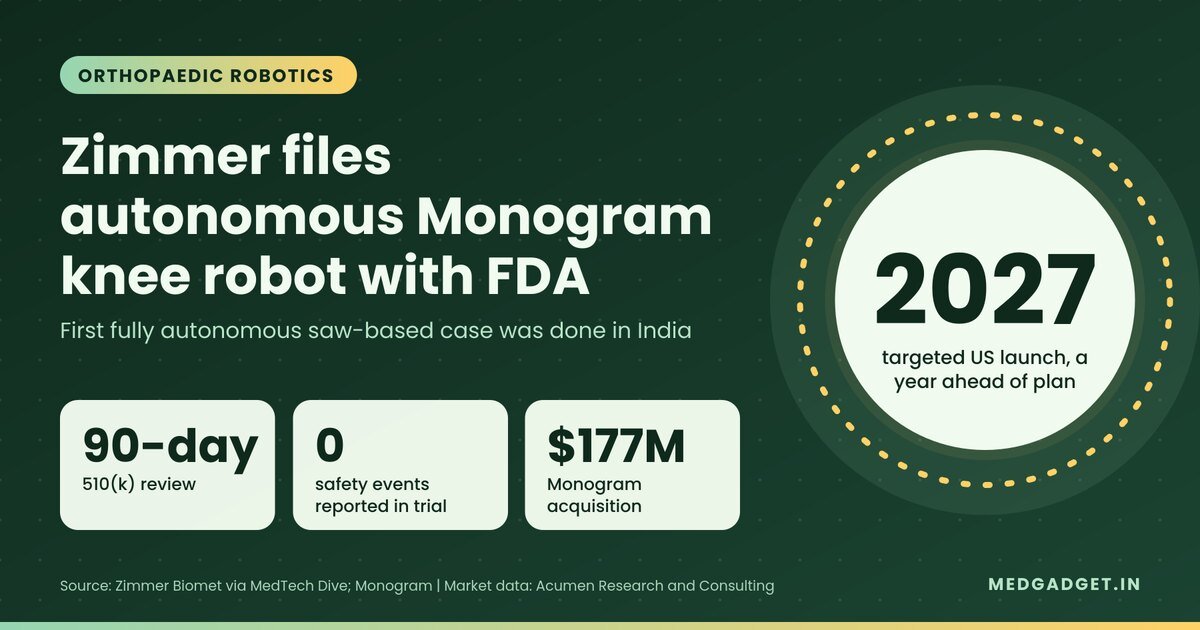
The Zimmer Monogram robot is now under FDA review in its autonomous form. Zimmer Biomet has filed a 510(k) submission for a surgeon-guided autonomous version of the Monogram knee replacement robot, chief executive Ivan Tornos told investors in mid-November 2026, and the company now hopes to launch in the US during 2027, a year earlier than it had planned. The system’s first fully autonomous saw-based knee replacement was performed in India, at Shalby Hospitals, in July 2025.
Key takeaways on the Zimmer Monogram robot
- Zimmer has filed a 510(k), which the company describes as a 90-day submission, for the autonomous Monogram system.
- Tornos said the clinical trial reported zero safety events and showed faster bone preparation and landmarking.
- Target US launch is 2027, subject to FDA clearance, ahead of an earlier 2028 plan.
- A semi-autonomous Monogram knee robot already won FDA 510(k) clearance in March 2025.
- India played a central role: the first fully autonomous saw-based robotic knee replacement was done with Shalby Hospitals.
From semi-autonomous to autonomous: what changes
Most knee robots in use today, including Zimmer’s own ROSA and rival systems, guide the surgeon’s hand or restrict where a saw can cut, but the surgeon still moves the tool. Monogram’s mBôs platform is built around CT imaging and AI-assisted planning. In its autonomous mode, the robot arm performs the planned bone cuts itself while the surgeon supervises and can stop it. Tornos called it a “game-changing platform” and acknowledged that, because it is new technology, there may be back-and-forth with the FDA during review.
| Milestone | Date | Detail |
|---|---|---|
| Semi-autonomous mBôs TKA cleared | March 2025 | FDA 510(k) for CT-based, AI-navigated knee robot |
| Zimmer agrees to buy Monogram | July 2025 | Deal valued at about $177 million |
| First fully autonomous saw-based knee surgery | July 2025 | Performed in India with Shalby Hospitals |
| Acquisition completed | October 2025 | Monogram becomes part of Zimmer Biomet |
| Autonomous version 510(k) filed | November 2026 | 90-day submission per Zimmer |
| Planned US launch | 2027 | Depends on FDA clearance; previously 2028 |
The India connection
Monogram ran its early autonomous cases in India before seeking US clearance, working with Shalby Hospitals, one of the country’s largest joint replacement chains. India has become an attractive setting for first-in-human orthopaedic robotics work because of high knee replacement volumes, experienced arthroplasty surgeons and faster trial set-up than many Western markets. That fits a wider push by the Centre to expand accredited clinical trial capacity, as covered in our report on plans for 1,000 accredited trial sites.
Zimmer has not said whether or when the autonomous system will be filed with India’s CDSCO. Indian patients will also want to know about cost, since robotic knee surgery in private hospitals already carries a premium over conventional surgery.
What the evidence does and does not show
The headline claim of zero safety events comes from the company, and Zimmer has not yet released patient numbers, alignment accuracy figures or functional outcomes in a peer-reviewed paper. Surgeons speaking at a Stifel investor conference pointed to possible time savings, fewer instrument trays and better accuracy, according to analyst commentary reported by MedTech Dive. Those are plausible advantages of automated cutting, but long-term implant survival and patient-reported function are what ultimately matter in knee replacement, and those take years to measure.
Why Zimmer is racing to launch
Knees are Zimmer’s core franchise, and they have been under pressure: US knee sales fell 2% in the third quarter of 2026 even as the company’s technology revenue rose 24%. ROSA, which Zimmer said in 2025 was nearing 2,000 installations worldwide, is imageless; Monogram gives Zimmer a CT-based option and a first-mover claim on autonomy. The semi-autonomous Monogram system is due to be sold with Zimmer implants by early 2027, and an autonomous launch in the same year would give the sales force a stronger story against competitors. Our coverage of Smith+Nephew’s weaker hip and knee outlook shows how competitive the US joint market has become.
Market context
Acumen Research and Consulting projected the global orthopedic implants market would reach around US$68.2 billion by 2026, growing at a CAGR of about 4.7% from 2019, with reconstructive joint replacements holding roughly 34% of the market in 2018 and Asia-Pacific expected to grow fastest. The report was last updated in January 2020, so these figures are dated and indicative only. They still underline why robotics, which can lock hospitals into a single implant brand, has become a key battleground.
FAQ
Is the Zimmer Monogram robot FDA approved?
The semi-autonomous Monogram knee robot was cleared in March 2025. The fully autonomous version was submitted for 510(k) clearance in November 2026 and is not yet cleared.
Can a robot do knee replacement surgery on its own?
In Monogram’s autonomous mode the robot performs planned bone cuts, but a surgeon plans the case, supervises throughout and completes the rest of the operation.
Where was the first autonomous knee replacement done?
Monogram reported the first fully autonomous saw-based robotic knee replacement in July 2025, performed in India with Shalby Hospitals.
When will the autonomous Monogram launch?
Zimmer is aiming for a US launch in 2027 if the FDA clears the device. See more medical device news.
Sources: MedTech Dive; Monogram Technologies release; ORTHOWORLD. Market data: Acumen Research and Consulting. Not medical or investment advice. Last updated 24 November 2026.