

Humanoid robot companies are moving from stage demos to factory floors, warehouses and, soon, living rooms. By late 2026, one US developer has listed on Nasdaq, a Chinese maker says it shipped thousands of units in a single half-year, and carmakers are testing two-legged robots on real production tasks. This guide ranks no one, because the field is moving too fast for a league table, but it names the 20 companies we think matter most going into 2027, explains what each is actually doing and separates company claims from proven results. It also draws on market data from Acumen Research And Consulting to show how big the opportunity could become.
Key takeaways: humanoid robot companies in 2027
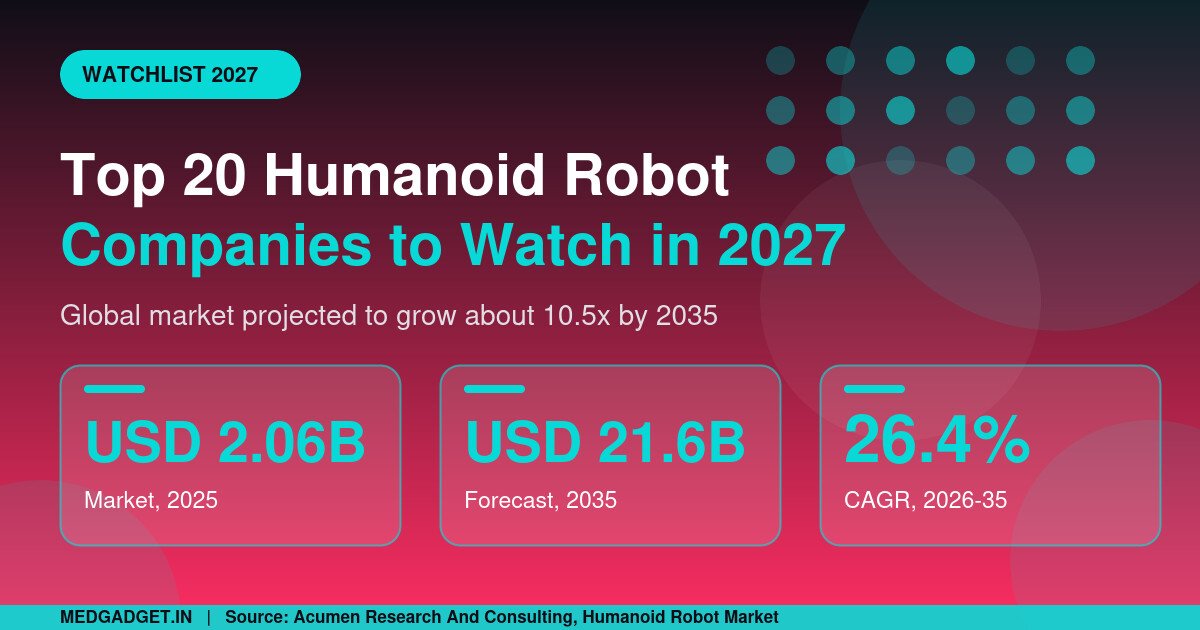
- The global humanoid robot market was valued at USD 2,060.4 million in 2025 and is projected to reach USD 21,647.3 million by 2035, a 26.4% compound annual growth rate for 2026 to 2035, according to Acumen Research And Consulting.
- North America held about 35% of the 2025 market, while Asia-Pacific is the fastest-growing region at more than 28.7% a year.
- Agility Robotics began trading on Nasdaq as AGLT on 5 November 2026, and Figure says it has delivered more than 350 third-generation robots.
- Chinese makers, led by AgiBot and Unitree, are pushing volume and price.
- Most deployments are still pilots; many headline targets are company claims and not independent results.
How big is the humanoid robot market?
According to Acumen Research And Consulting, the global humanoid robot market was USD 2,060.4 million in 2025 and is projected to reach USD 21,647.3 million by 2035, growing at a 26.4% compound annual growth rate over 2026 to 2035. By our calculation that is roughly a ten-and-a-half-fold increase in a decade.
| Acumen measure (2025 base) | Share or value |
|---|---|
| North America | 35% (about USD 725.3 million) |
| Asia-Pacific | 30%, fastest growing at more than 28.7% a year |
| Europe | 22% |
| Hardware vs software | 69% vs 31% |
| Industrial and logistics applications | 32% |
| Healthcare and personal assistance | 23% |
| Hospitality | 13% |
| Wheel drive vs biped | 65% vs 35% |
Acumen attributes demand to labour shortages, advances in AI, sensors and batteries, and falling hardware costs, and names high upfront cost, weak infrastructure and public wariness as restraints. Two cautions: the regional and application shares on the page each add up to 99%, not 100%, and the report was last updated on 30 December 2025 while its key-player list leans toward older research and service robot makers. Source for all figures in this section: Acumen Research And Consulting.
The 20 humanoid robot companies to watch
1. Figure AI (United States)
Figure says it has delivered more than 350 Figure 03 robots and raised its production rate from one robot a day to one an hour at its BotQ factory, according to its April 2026 production update. These are company-reported figures, and the firm also says an earlier model contributed to production of 30,000 cars at BMW.
2. Tesla (United States)
Tesla is developing Optimus for its own factories first. Timelines for volume production have shifted before, so treat any target as forward-looking. Its scale in manufacturing and AI is the reason it stays on every watchlist.
3. Agility Robotics (United States)
Maker of the Digit warehouse robot, Agility became what it calls the first US publicly listed pure-play humanoid company when it began trading on Nasdaq as AGLT on 5 November 2026. Its listing announcement reports more than 100,000 totes moved at GXO and says Digit 5, unveiled in September 2026, has more than $300 million of committed orders subject to contractual milestones.
4. Boston Dynamics (United States)
The electric Atlas stands 1.9 metres tall, has 56 degrees of freedom and a 50 kg instant payload, per its product page. It is in field testing at a Hyundai facility, with a staged rollout to select early adopters and no stated general availability date.
5. Apptronik (United States)
Apptronik, maker of Apollo, announced a $520 million extension in February 2026 that brought its Series A to more than $935 million, with investors including Google and Mercedes-Benz. It has partnerships with Mercedes-Benz, GXO, Jabil and Google DeepMind.
6. 1X Technologies (Norway and United States)
1X targets the home with NEO, offered at $20,000 for early access or $499 a month, with US deliveries listed as starting in 2026. Delivery dates were not specific, so check shipping before ordering.
7. Sanctuary AI (Canada)
Sanctuary builds general-purpose humanoids, led by its Phoenix robot, and focuses on hand dexterity and AI control. It is a research-heavy bet and has fewer public deployment details than rivals.
8. NEURA Robotics (Germany)
Based in Metzingen, NEURA is pitching its 4NE1 cognitive humanoid for work and home and has opened reservations. European industrial credentials are its edge.
9. Unitree Robotics (China)
Unitree made humanoids affordable: its G1 lists at US $13,500 and weighs about 35 kg, according to the company’s G1 page. It has also been reported to be preparing a Shanghai stock market listing.
10. AgiBot (China)
AgiBot says IDC ranked it first for humanoid shipments in the first half of 2026, with more than 8,600 units and about 35% of a global total approaching 25,000. This is a company statement quoting IDC.
11. UBTECH (China)
Listed in Hong Kong, UBTECH sells the Walker S2, which it says is the first humanoid able to swap its own battery, in about three minutes, to support round-the-clock work.
12. Fourier (China)
Shanghai-based Fourier grew out of rehabilitation robotics, which gives it a head start in robots that work safely around people. Its GR series targets care and research.
13. Galbot (China)
Galbot builds wheeled, embodied-AI humanoids for retail and logistics, a design choice that echoes Acumen’s finding that wheel drive makes up 65% of the market.
14. XPeng (China)
The electric-vehicle maker unveiled its IRON humanoid, using its car AI and manufacturing know-how. Carmakers entering the field is one of the clearest trends of 2026.
15. Honda (Japan)
Honda, listed among Acumen’s key players, spent decades on humanoid research, including ASIMO. Its engineering depth keeps it relevant even though it is quieter than start-ups.
16. Engineered Arts (United Kingdom)
Maker of Ameca, one of the most expressive humanoid faces, Engineered Arts focuses on entertainment, research and human-robot interaction.
17. Hanson Robotics (Hong Kong)
Famous for Sophia, Hanson Robotics works on lifelike social robots for education, service and companionship.
18. SoftBank Robotics (Japan)
The company behind Pepper and NAO has a long record in service and education robots and shows how social humanoids reached classrooms and shops first.
19. Humanoid (United Kingdom)
A London-based start-up that has raised significant venture funding in a short time, signalling that capital is spreading beyond the United States and China.
20. Kawada Robotics (Japan)
Kawada, another Acumen key player, has built humanoid and dual-arm industrial robots for years and represents the established Japanese robotics tradition.
Timeline
- December 2025: Acumen’s humanoid robot market page last updated.
- February 2026: Apptronik extends its Series A to more than $935 million.
- April 2026: Figure reports more than 350 Figure 03 robots delivered.
- September 2026: Agility unveils Digit 5; AgiBot reports first-half shipment ranking.
- 5 November 2026: Agility begins trading on Nasdaq as AGLT.
- 2027: planned early customer access for Digit 5; Atlas rollout to early adopters continues.
Our analysis
In our assessment, 2027 will be decided by three things: whether pilots become repeat orders, whether prices fall fast enough to widen the market beyond early adopters, and whether safety and reliability stand up in busy workplaces. The Acumen figures suggest a market that is still small in dollars, about USD 2.06 billion in 2025, which means a handful of large orders can move the leaderboard. Hardware at 69% of the market also suggests that component makers and manufacturing capacity matter as much as software.
What is not disclosed
- Independent audits of unit shipments and revenue for most companies.
- Real-world uptime, safety incident data and cost per task.
- Contract values and timelines for many named pilots.
- Final prices for home robots.
Risks and caveats
- Many figures are company statements and forward-looking targets.
- Acumen’s shares sum to 99% and its page was last updated on 30 December 2025.
- Listings, funding and partnerships change quickly; check company pages before acting.
- This article is news reporting and not investment advice.
What to watch next
- Agility’s first quarters as a listed company.
- Whether Atlas reaches general availability.
- Real delivery dates for home humanoids such as NEO.
- Chinese makers’ export push and price cuts.
General background
Humanoids sit within the wider shift to embodied AI. For more, read our report on the global physical AI market and our look at physical AI in healthcare, or browse the Medical Device section.
Questions readers are asking about humanoid robot companies
Which humanoid robot company is ahead in 2026?
It depends on the measure: AgiBot claims the lead in shipments, Figure and Agility report the clearest Western factory and warehouse progress, and Tesla has the largest manufacturing base.
How much do humanoid robots cost?
Listed prices range from about US $13,500 for Unitree’s G1 to $20,000 for early access to 1X’s NEO; industrial models are usually sold through contracts.
Are humanoid robots ready for homes?
Not broadly. Home models are at an early-access stage, and delivery timing and capability remain unproven.
FAQ
What is a humanoid robot?
A robot with a human-like body, typically two arms and two legs or a wheeled base, designed to work in spaces built for people.
How fast is the humanoid robot market growing?
Acumen Research And Consulting projects a 26.4% compound annual growth rate for 2026 to 2035.
Where can I read the full market report?
The Humanoid Robot Market report by Acumen Research And Consulting has the full forecast and segmentation.
How we reported this: company facts come from company announcements and product pages; market statistics are from the Humanoid Robot Market report by Acumen Research And Consulting; calculations marked as ours are our own. Last updated 24 November 2026. This is news reporting and not investment advice.