

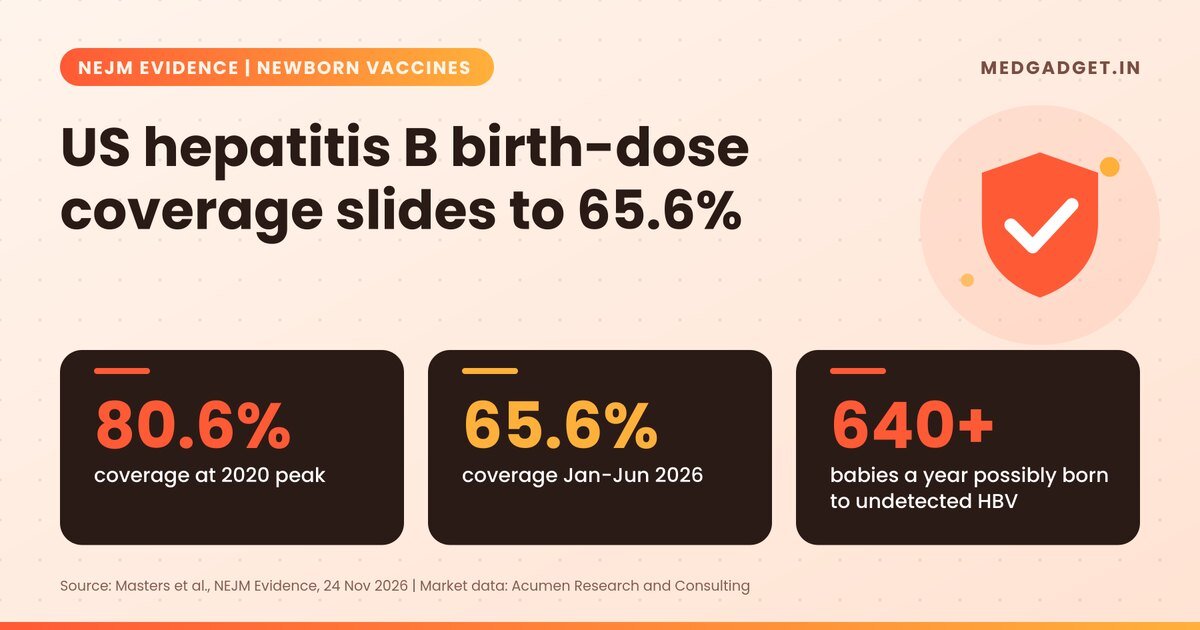
Coverage of the hepatitis B birth dose among US newborns fell to 65.6% in the first half of 2026, down from a peak of 80.6% in 2020, according to a Truveta analysis of more than 1.3 million infants published on 24 November in NEJM Evidence. The decline reached even babies born to mothers known to carry the virus, whose same-day vaccination rate slipped from 97-98% to 93.9%.
Key takeaways on hepatitis B birth dose
- The study linked electronic health records for 1,338,961 infants and 1,075,767 mothers from January 2018 to June 2026.
- Birth-dose coverage within one day of birth peaked at 80.6% in 2020 and fell every year from 2023, reaching 65.6% in January to June 2026.
- Among infants of hepatitis B surface antigen (HBsAg)-positive mothers, coverage dropped to 93.9% in 2026 after holding at 97-98% from 2020 to 2025.
- About one in 10 pregnancies had no documented hepatitis B test, which the authors estimate could mean more than 640 US babies a year born to mothers with undetected infection.
- The decline began in 2023, almost three years before federal advisers dropped the universal birth-dose recommendation in December 2025.
Year-by-year coverage
| Period | Birth-dose coverage (within 1 day) | Change vs 2020 peak |
|---|---|---|
| 2018 | 76.4% | -4.2 points |
| 2020 | 80.6% | Peak |
| 2022 | ~80% | Roughly flat |
| 2023 | 77.9% | -2.7 points |
| 2024 | 75.4% | -5.2 points |
| 2025 | 69.0% | -11.6 points |
| Jan-Jun 2026 | 65.6% | -15.0 points |
Point changes are by our calculation from the published figures. A 15-point fall from 80.6% means roughly 19% fewer newborns are getting the shot on time in relative terms, also by our calculation. The steepest single-year drop came between 2024 and 2025.
Why the high-risk group worries researchers most
Infants born to mothers with hepatitis B are supposed to receive both the vaccine and hepatitis B immune globulin (HBIG) within 12 hours of birth. Without that protection, most infants infected in their first year go on to develop chronic infection, which can lead to cirrhosis and liver cancer decades later. Across the full study period, 92.8% of infants of HBsAg-positive mothers had both products documented within one day, though the dataset could not confirm the tighter 12-hour window.
Lead author Nina Masters of Truveta put the rationale simply: the birth dose exists because “no screening system is perfect”. Co-author Demetre Daskalakis, a former director of the CDC’s National Center for Immunization and Respiratory Diseases, argued that each lost percentage point represents real children left exposed to a preventable infection.
The screening gap behind the estimate
US guidance calls for hepatitis B testing at the first prenatal visit of every pregnancy. In the dataset, 90.5% of pregnancies had a documented test, an improvement from 2018 when 15.6% had none, but 7.6% still lacked a record in 2026. About 0.18% of screened mothers tested positive. Applying the roughly 90% screening rate to 3.6 million annual US births, the authors estimate 360,000 babies a year are born without documented maternal screening and more than 640 to mothers whose infection was missed. They stress these are projections that assume unscreened mothers have the same infection rate as screened ones, not observed counts.
How policy changes fit the timeline
- 2023 to 2025: coverage was already falling under the long-standing universal recommendation.
- December 2025: the Advisory Committee on Immunization Practices replaced universal birth dosing with individual decision-making for infants of HBsAg-negative mothers. Recommendations for infants of positive or unknown-status mothers did not change.
- January 2026: HHS issued a revised childhood immunisation schedule.
- March 2026: a federal district court temporarily blocked the changes, restoring the previous recommendations while litigation continues.
The data cannot separate the effect of each step, but they show the downward trend predates the federal policy shift and continued through the period when the court order was in place.
What it means beyond the US
The study is a useful benchmark for countries, including India, that rely on a birth dose given within 24 hours of delivery under national immunisation programmes. India’s coverage depends heavily on institutional deliveries, and the US experience shows how quickly a long-stable intervention can erode when confidence and messaging weaken. Readers following hepatitis B treatment can also see our explainer on Hibsago (bepirovirsen), and on vaccine development in India, the first Indian Zika vaccine trial.
Market context
Hepatitis B vaccines remain a sizeable global business. Acumen Research and Consulting estimates the market at $6.13 billion in 2024, rising to $10.08 billion by 2033 at a 5.8% compound annual growth rate. It identifies North America as the largest region, Asia-Pacific as the fastest growing and hospitals as the main end-user, which is where birth doses are given. Falling US newborn uptake would weigh most on that hospital channel.
Limitations
The analysis uses records from health systems in the Truveta network, so it may not mirror national coverage exactly, and vaccines given outside those systems may be missed. Documentation of HBIG and vaccine within one day does not prove the 12-hour target was met.
FAQ
What is the hepatitis B birth dose?
It is the first shot of the hepatitis B vaccine series, given within 24 hours of birth to protect newborns from infection passed on during delivery or in early life.
How many US newborns get the hepatitis B vaccine at birth?
In the NEJM Evidence analysis, 65.6% of infants born from January to June 2026 received it within one day of birth, down from 80.6% in 2020.
Is the hepatitis B birth dose still recommended?
For infants of mothers who test positive or whose status is unknown, yes, together with HBIG for exposed babies. For other infants, a December 2025 change to individual decision-making was temporarily blocked by a court in March 2026, restoring the earlier universal recommendation while the case continues.
Why give the vaccine if the mother tested negative?
Tests can be missed, mistimed or wrongly recorded, and infection can come from other household contacts. The birth dose acts as a safety net for those gaps.
Sources: Masters et al., NEJM Evidence, 24 November 2026; Truveta press release via GlobeNewswire; HCPLive; market data from Acumen Research and Consulting. Not medical advice; ask a paediatrician about your child’s vaccines. More in Healthcare Services. Last updated 25 November 2026.