

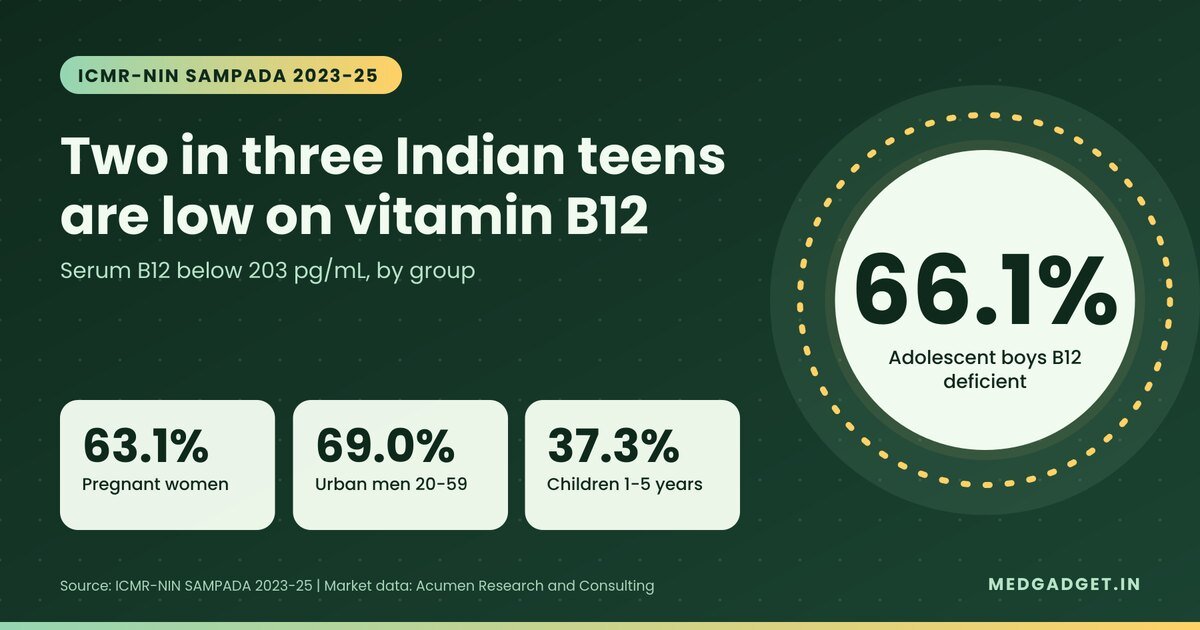
Vitamin B12 deficiency in India is far more widespread than iron or folate deficiency, according to the ICMR-National Institute of Nutrition’s SAMPADA 2023-25 survey: 66.1% of adolescent boys, 65.4% of adolescent girls, 63.1% of pregnant women and 60.4% of men aged 20-59 had serum B12 below 203 pg/mL. The figures, published in the report’s micronutrient tables and widely reported on 25-27 November 2026, come from more than 1.7 lakh blood samples across 183 districts in 35 states and union territories.
Our earlier report on the SAMPADA anaemia results covered the headline that 56% of women are anaemic. This article looks at the part of the survey that has since drawn the most attention: the B12 numbers, what the cut-off means, and why experts disagree on how alarmed to be.
Key takeaways on vitamin B12 deficiency in India
- Roughly two in three Indian teenagers, boys and girls alike, fall below the survey’s B12 cut-off of 203 pg/mL.
- B12 deficiency outnumbers iron deficiency in every age group measured, by a wide margin among boys and men.
- Urban adults are often worse off than rural adults: 69.0% of urban men aged 20-59 were deficient versus 57.1% of rural men.
- Low B12 was about as common in people without anaemia as in those with it, so the survey does not treat B12 as a main driver of India’s anaemia.
- Some nutrition scientists argue the international cut-off may overstate deficiency in vegetarian populations; others want B12 screening added to public programmes.
The numbers by age group
SAMPADA measured serum vitamin B12, red-cell folate and inflammation-adjusted ferritin in a sub-sample of participants. The table below sets B12 deficiency beside iron deficiency for each group, using the report’s own definitions (iron deficiency is serum ferritin below 12 or 15 micrograms per litre depending on age).
| Group | B12 deficient (total) | Rural | Urban | Iron deficient |
|---|---|---|---|---|
| Children 12-59 months | 37.3% | 36.8% | 38.1% | 23.0% |
| Children 5-9 years | 46.5% | 45.0% | 51.0% | 17.6% |
| Adolescent girls 10-19 | 65.4% | 66.5% | 61.7% | 36.3% |
| Adolescent boys 10-19 | 66.1% | 65.3% | 68.6% | 10.0% |
| Women 15-49 (non-pregnant, non-lactating) | 57.4% | 56.5% | 59.6% | 34.1% |
| Men 20-59 | 60.4% | 57.1% | 69.0% | 3.4% |
| Pregnant women | 63.1% | 61.7% | 65.8% | 29.6% |
| Lactating women | 51.8% | 50.9% | 55.2% | 26.6% |
By our calculation, adolescent boys are about 6.6 times more likely to be B12 deficient than iron deficient, and men aged 20-59 roughly 18 times more likely. Among adolescent girls, where iron deficiency is also common, the B12 rate is still about 1.8 times higher. The survey’s oldest adult bands showed lower but still substantial rates, 41.2% for women and 46.8% for men.
Why B12 runs low in India
Vitamin B12 occurs naturally almost only in animal foods: milk, curd, eggs, fish and meat. Plant foods contain little usable B12 unless fortified. Experts quoted by All India Radio pointed to plant-heavy diets and to impaired absorption in the gut, which can follow chronic gastritis, long-term use of some acid-suppressing medicines or metformin, and ageing. Diet alone, they said, does not explain the whole picture.
The urban pattern is notable. Urban men had the highest rate of any adult group at 69.0%. The survey does not explain the gap, and it should not be read as proof that city diets are poorer; differences in diet mix, dairy intake and medication use are all possible, and SAMPADA did not test those causes.
Is 203 pg/mL the right line?
This is where the debate sits. A serum B12 value below 203 pg/mL (about 150 pmol/L) is a common international threshold, but serum B12 is an imperfect marker. Some people below it have no functional deficiency, and some above it do. Anura Kurpad of St. John’s Medical College, Bengaluru, told AIR that cut-offs set in other populations may overstate deficiency among Indian vegetarians, and noted that SAMPADA found no excess of low B12 among people with anaemia.
Chittaranjan Yajnik of KEM Hospital, Pune, takes a more urgent view. His research links low maternal B12 combined with high folate to later fat gain and insulin resistance in children, and he argues that India’s iron and folic acid programmes give B12 too little attention, with no routine B12 screening in public clinics. Both positions can be true: the true burden may be smaller than 66%, and still large enough to matter for pregnancy and child development.
B12 and anaemia: what the survey separates
SAMPADA’s Table 4 breaks deficiencies down by anaemia grade. Among adolescent boys, B12 deficiency was 65.4% in those with no anaemia, against 79.2% in mild anaemia. Among women of reproductive age it was 58.4% without anaemia and 52.4% with moderate or severe anaemia. Iron deficiency, by contrast, climbs steeply with anaemia severity, reaching 61.0% in moderately or severely anaemic women. That pattern is why ICMR concludes iron remains the main nutritional lever for anaemia, while B12 is a separate, population-wide problem.
Market context
Demand for vitamin inputs is rising with awareness of gaps like this. Acumen Research and Consulting sizes the global vitamin ingredients market, which includes the vitamin B segment, at USD 4.3 billion in 2022 and projects USD 7.4 billion by 2032, a 5.6% CAGR, with Asia-Pacific the fastest-growing region. Food fortification and targeted supplementation, rather than unsupervised high-dose pills, are the routes public health experts usually favour.
What it means for readers
- Symptoms that can point to low B12 include persistent tiredness, tingling or numbness in hands and feet, memory or concentration problems, and a sore tongue. They are not specific, so a blood test ordered by a doctor is the way to confirm.
- Women planning pregnancy, strict vegetarians and vegans, older adults and people on long-term metformin or acid-suppressing drugs are the groups doctors most often check.
- Dose and form (tablet or injection) depend on the cause and severity; that decision belongs to a clinician, not a pharmacy shelf.
Frequently asked questions
How common is vitamin B12 deficiency in India?
In ICMR-NIN’s SAMPADA 2023-25 survey, between 37% (toddlers) and 66% (adolescents) of each group had serum B12 below 203 pg/mL, making it the most common micronutrient deficiency measured.
What B12 level counts as deficient?
SAMPADA used serum vitamin B12 below 203 pg/mL. Labs may use slightly different ranges, and doctors sometimes add tests such as homocysteine or methylmalonic acid when results are borderline.
Does B12 deficiency cause anaemia?
Severe B12 deficiency can cause megaloblastic anaemia, but nationally SAMPADA found low B12 about as often in non-anaemic people as in anaemic people. Iron deficiency tracked much more closely with anaemia.
Are vegetarians more at risk of low B12?
Yes, because B12 comes mainly from animal foods; dairy and eggs help, and fortified foods are an option. Absorption problems can also cause deficiency in people who eat meat.
Sources: ICMR-NIN SAMPADA 2023-25 report (Tables 2 and 4); All India Radio reporting with expert comment (26 Nov 2026). Market data: Acumen Research and Consulting. This article is for information only and is not medical advice. More in healthcare services news and our report on front-of-pack food warning labels. Last updated 27 November 2026.