

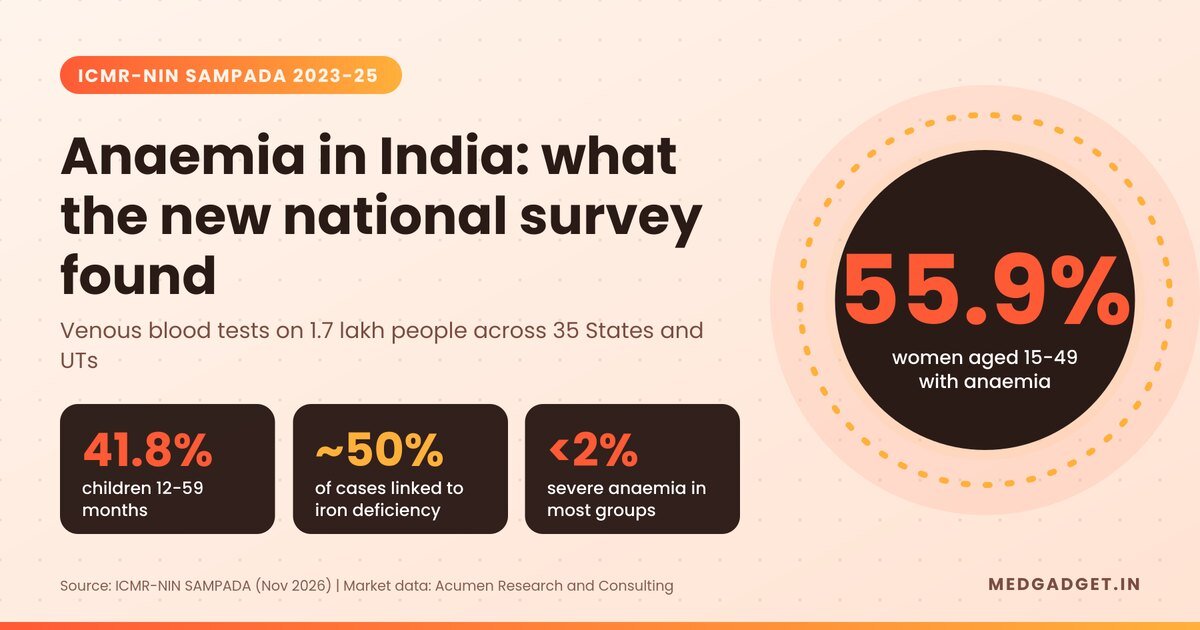
The ICMR SAMPADA anaemia survey, released on November 23, 2026 by the Indian Council of Medical Research and its National Institute of Nutrition (ICMR-NIN), finds that about 56% of Indian women of reproductive age and nearly 42% of children aged 12 to 59 months have anaemia, based on venous blood tests from more than 1.7 lakh people across 35 States and Union Territories. The headline rates for children and adolescent girls sit well below those reported in the last National Family Health Survey, but the burden among adult women has barely moved, and a handful of states still report anaemia in seven of every ten women.
Key takeaways on the ICMR SAMPADA anaemia survey
- SAMPADA 2023-25 covered more than 2 lakh individuals in over 81,000 households across 183 districts, making it one of the world’s largest nutrition surveys.
- Anaemia prevalence: 41.8% in children aged 12-59 months, 31.3% in children aged 5-9, about 46% in adolescent girls, 55.9% in non-pregnant, non-lactating women aged 15-49, and 22-23% in adolescent boys and men.
- Most cases are mild. Severe anaemia was below 2% in most age groups, though it reached about 3% in some groups of women.
- Iron deficiency explains roughly half of anaemia in women, adolescent girls and young children. Vitamin B12 and folate deficiency were about as common in non-anaemic people as in anaemic people.
- State gaps are wide: among women aged 15-49, West Bengal recorded 72.4% and Kerala 29.1%.
How SAMPADA measured haemoglobin differently
The Survey for Assessment of Markers of Population Health, Activity, Diet and Anthropometry (SAMPADA) was run by ICMR under the Department of Health Research between 2023 and 2025. Its most important design choice is how blood was collected. Instead of a finger-prick drop read on a portable meter, field teams drew venous blood and ran it on automated haematology analysers, a method ICMR says offers greater accuracy and reproducibility.
That matters because capillary samples can read differently from venous samples, and researchers have argued for years that finger-prick surveys may overstate anaemia in India. In a sub-sample, SAMPADA also measured iron stores, folate, vitamin B12 and two inflammation markers (C-reactive protein and alpha-1-acid glycoprotein). Those markers let analysts adjust iron results for infection or chronic inflammation, which can otherwise mask or mimic iron deficiency.
SAMPADA versus NFHS-5: the numbers side by side
The table sets SAMPADA against NFHS-5 (2019-21). The age bands are not identical, so read the comparison as directional rather than exact.
| Group | SAMPADA 2023-25 | NFHS-5 2019-21 | Gap (percentage points, by our calculation) |
|---|---|---|---|
| Young children | 41.8% (12-59 months) | 67.1% (6-59 months) | -25.3 |
| Women of reproductive age | 55.9% (15-49, non-pregnant, non-lactating) | 57.0% (15-49, all) | -1.1 |
| Adolescent girls | ~46% (10-19) | 59.1% (15-19) | about -13 |
| Men | 22-23% (20-59) | 25.0% (15-49) | about -2 to -3 |
| Women aged 60+ | 55.7% | Not measured | New estimate |
The striking line is women. Children’s anaemia appears to have fallen sharply, even allowing for the narrower age band, yet women’s prevalence is almost unchanged at more than one in two. Among women aged 15-49, 26.1% had mild, 26.9% moderate and 2.9% severe anaemia, so moderate cases actually outnumber mild ones in this group. Rural and urban rates were close, at 56.3% and 54.9%.
Where anaemia is highest and lowest
State-level point estimates show a gap of more than 40 percentage points. For women aged 15-49, West Bengal (72.4%), Assam (71.9%), Chhattisgarh (71.5%), Punjab (70.5%) and Tripura (70.0%) top the list, while Kerala (29.1%), Himachal Pradesh (31.3%) and Uttarakhand (34.0%) are lowest. Among children aged 12-59 months, Andhra Pradesh recorded 57.5% against Kerala’s 14.5%. For children aged 5-9, Chhattisgarh (59.9%) and Ladakh (59.3%) were highest and Kerala lowest at 9.8%.
Two cautions apply. Confidence intervals overlap for several states, so close rankings are not meaningful. And the older-women results reshuffle the order: Andhra Pradesh (81.7%) and Chhattisgarh (81.5%) lead among women aged 60 and above, while Uttarakhand reports the lowest state estimate at 31.6%.
Iron explains only half of the problem
India’s anaemia programme has leaned heavily on iron and folic acid supplements. SAMPADA supports that focus for some groups but not as a single answer. Iron deficiency accounted for about half of anaemia among women, adolescent girls and children under five, and it was concentrated in those life stages. It was uncommon in adolescent boys, men and older adults, where other causes are more likely.
The survey names infections, inherited haemoglobin disorders such as thalassaemia and sickle cell disease, and inflammation from chronic illness as factors that also need attention. Because B12 and folate deficiency rates were similar in anaemic and non-anaemic people, ICMR concludes those deficiencies contribute little to anaemia nationally. ICMR Director General Dr Rajiv Bahl called the lower prevalence “encouraging” and said the profiling gives an evidence base for Anaemia Mukt Bharat. In practice, the data argue for testing people with moderate or severe anaemia, treating the cause and tracking them until haemoglobin recovers, which is the approach the Anaemia Mukt Bharat 2.0 framework already describes.
Market context: testing at scale
A shift from finger-prick screening to confirmatory venous testing and cause-specific workups would lean on laboratory capacity. According to Acumen Research and Consulting, the global hematology diagnostics market was valued at USD 8.6 billion in 2024 and is projected to reach USD 15.2 billion by 2033, a compound annual growth rate of 6.7%. Acumen notes that consumables such as reagents and stains hold the largest share, and that hospitals are the leading end users, both relevant to a public programme that would need sustained reagent supply in district laboratories.
What is still unclear
The full report is available on the ICMR website, but the public release does not settle how much of the gap with NFHS-5 reflects real improvement and how much reflects the switch to venous blood. Separating the two would need a paired comparison of both methods on the same people. NFHS-6 results, expected to keep the capillary approach for continuity, will be the natural test. For India’s broader regulatory and research landscape, see our coverage of the ICMR medical device development initiative and the recent FSSAI action on Bisleri water, or browse more healthcare services news.
FAQ
What is the SAMPADA survey?
SAMPADA is a 2023-25 national nutrition survey by ICMR and ICMR-NIN that measured anaemia and micronutrient status across all age groups, including school-age children and adults over 60, using venous blood samples.
What percentage of Indian women are anaemic according to ICMR?
About 56%. SAMPADA estimates 55.9% of non-pregnant, non-lactating women aged 15-49, 54.8% of women aged 20-59 and 55.7% of women aged 60 and above have anaemia.
Is anaemia in India going down?
SAMPADA shows lower rates than NFHS-5, most clearly in children. Part of that difference may come from the more accurate venous testing method, so the size of the real decline is not yet certain.
Which state has the lowest anaemia rate?
Kerala recorded the lowest state estimates for women aged 15-49 (29.1%) and for both child age groups. Among women aged 60 and above, Uttarakhand was lowest.
Sources: ICMR-NIN SAMPADA anaemia report and ICMR release (November 23, 2026); NFHS-5 national factsheet. Market data: Acumen Research and Consulting, Hematology Diagnostics Market report. This article is for information only and is not medical advice; speak to a doctor before starting iron or other supplements. Last updated: November 24, 2026.