

Survodutide weight loss reached up to 13.1% on average after 76 weeks, compared with 3.1% on placebo, in the Phase III SYNCHRONIZE-2 trial of adults with obesity or overweight and type 2 diabetes, Boehringer Ingelheim and Zealand Pharma announced on October 1, 2026. The trial met both co-primary endpoints, but gastrointestinal side effects led 18% of survodutide recipients to stop treatment.
Survodutide is an investigational once-weekly injection that activates both the glucagon and GLP-1 receptors. It has not been approved for use, and its efficacy and safety have not been established. According to RTTNews, detailed results were presented at the 62nd European Association for the Study of Diabetes (EASD) Annual Meeting and published in The New England Journal of Medicine.
Key Takeaways: Survodutide Weight Loss in SYNCHRONIZE-2
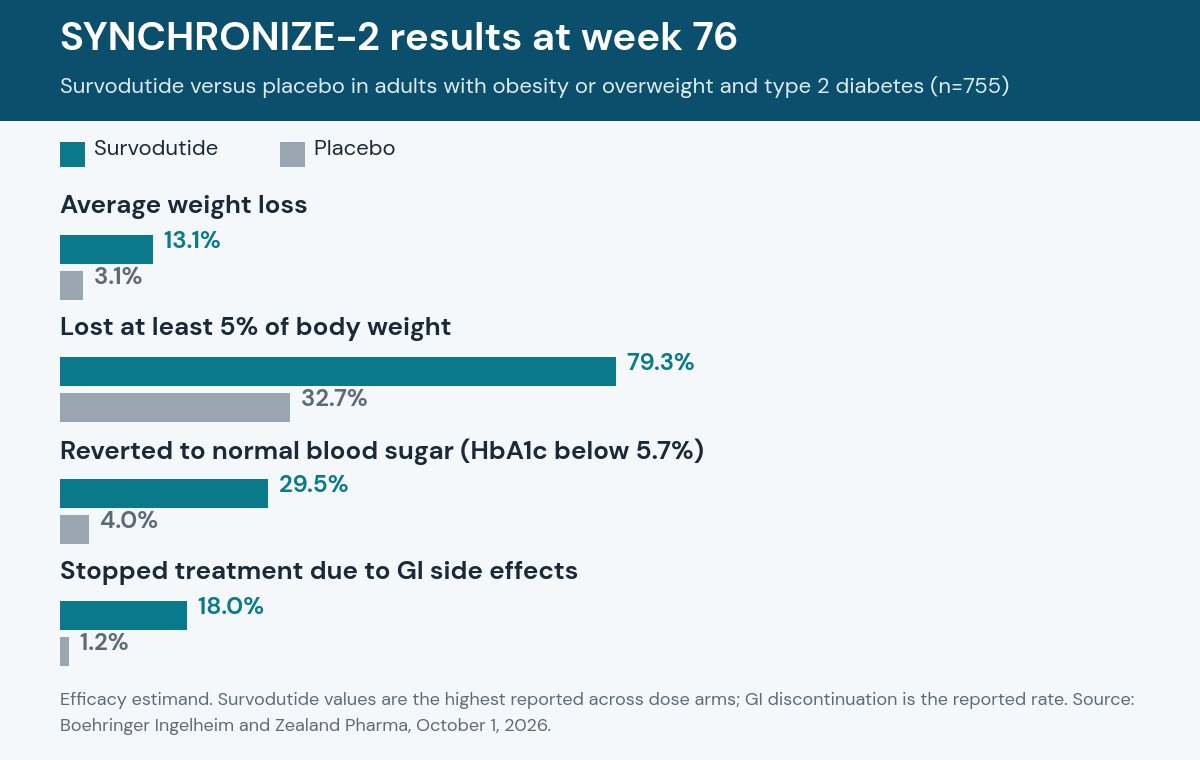
- Average weight loss reached up to 13.1% at 76 weeks versus 3.1% on placebo, measured with the efficacy estimand.
- Up to 79.3% of survodutide recipients lost at least 5% of their body weight, versus 32.7% on placebo.
- HbA1c fell by up to 1.21 percentage points from a baseline of 7.4%, and up to 29.5% of participants reached normal blood sugar levels versus 4.0% on placebo.
- Gastrointestinal events were the most common side effects, and 18% of survodutide patients stopped treatment because of them, versus 1.2% on placebo.
- Survodutide is not approved. Boehringer Ingelheim is also testing it in MASH and has a cardiovascular outcomes trial under way.
What Is Survodutide?
Survodutide (BI 456906) is a dual glucagon/GLP-1 receptor agonist developed by Boehringer Ingelheim, which licensed it from Zealand Pharma. GLP-1 activity helps reduce appetite and improve blood sugar control, while glucagon activity is intended to add to weight loss and reduce liver fat.
SYNCHRONIZE-2 Results at a Glance
The table summarizes company-reported results at week 76 under the efficacy estimand, which estimates the effect if participants had stayed on treatment.
| Measure | Survodutide | Placebo |
|---|---|---|
| Average weight loss at week 76 | Up to 13.1% | 3.1% |
| Participants losing at least 5% of body weight | Up to 79.3% | 32.7% |
| HbA1c reduction from a 7.4% baseline | Up to 1.21 percentage points | Not given in the announcement |
| Reverted to normal blood sugar (HbA1c below 5.7%) | Up to 29.5% | 4.0% |
| Stopped treatment because of GI side effects | 18% | 1.2% |
How the SYNCHRONIZE-2 Trial Was Designed
SYNCHRONIZE-2 is a Phase III, double-blind, placebo-controlled trial that enrolled 755 adults with obesity or overweight and type 2 diabetes. According to ClinicalTrials.gov, participants had HbA1c between 6.5% and under 10% at screening and had been diagnosed at least 180 days earlier. They received a weekly injection of survodutide at 3.6 mg or 6.0 mg, or placebo, for 76 weeks, and two in three participants were assigned to survodutide.
The co-primary endpoints were the percentage change in body weight from baseline to week 76 and the share of participants losing at least 5% of their body weight. The trial met both under two statistical approaches, the treatment-regimen estimand and the efficacy estimand. Secondary endpoints included 10%, 15% and 20% weight-loss thresholds, HbA1c, waist circumference and blood pressure.
Survodutide Side Effects and Tolerability
As with other GLP-1-based therapies, gastrointestinal events were the most common adverse events and were mostly mild to moderate. Nausea, vomiting, diarrhea and constipation occurred more often with survodutide than with placebo. Discontinuations because of GI events reached 18% with survodutide versus 1.2% with placebo, AJMC reported.
Boehringer Ingelheim said discontinuations usually occurred during dose escalation, when the protocol allowed limited flexibility to manage side effects, and that current and upcoming trials allow more flexible titration. In SYNCHRONIZE-1, which enrolled people without diabetes, Fierce Biotech reported that 19% stopped survodutide because of GI side effects versus 2.9% on placebo, and said that rate does not appear to compare favorably with pivotal trials of Lilly’s and Novo’s incretin drugs.
How Survodutide Weight Loss Compares With Other Obesity Drugs
No head-to-head trial has compared survodutide with approved obesity medicines. Trials differ in populations, duration and statistical methods, so cross-trial comparisons are unreliable, as a Second Nature review of SYNCHRONIZE-1 cautions. Unlike semaglutide, which acts on the GLP-1 receptor alone, survodutide also activates the glucagon receptor.
The data do follow a familiar pattern: weight loss is typically harder for people with type 2 diabetes. SYNCHRONIZE-1, in adults without diabetes, reported up to 16.6% average weight loss versus 3.2% on placebo at 76 weeks, compared with up to 13.1% in SYNCHRONIZE-2.
What Researchers and Companies Said About the Results
Dr. Sean Wharton, coordinating investigator of SYNCHRONIZE-2, said obesity and type 2 diabetes are deeply intertwined and that, for people with both conditions, sustained weight loss is often a biological struggle rather than a lack of willpower. Shashank Deshpande, head of Human Pharma at Boehringer Ingelheim, said the results reinforce the company’s belief that obesity should be treated as a complex chronic disease with interconnected health consequences. Zealand Pharma said it was very encouraged by data that pair meaningful weight loss with blood sugar control.
What Comes Next for Survodutide
Boehringer Ingelheim’s survodutide program spans obesity and related metabolic conditions, MASH and type 2 diabetes. The company received FDA Breakthrough Therapy designation for survodutide in MASH, started two Phase III MASH trials, and expects to present results from its cardiovascular outcomes trial, SYNCHRONIZE-CVOT. The announcement did not give a regulatory filing date, so survodutide remains an investigational drug.
In our assessment, the efficacy data are encouraging for people with type 2 diabetes, but tolerability and the effect of more flexible dose titration will shape how survodutide is positioned. Regulators and clinicians will weigh weight loss, blood sugar control, side effects and long-term safety together.
What the Survodutide Results Mean for Patients
Survodutide cannot be prescribed or bought through legitimate channels because it is not approved. People living with obesity and type 2 diabetes should discuss approved treatment options, side effects and monitoring with their own clinician rather than seeking unapproved products. For background, read our explainer on Mounjaro versus Ozempic and Wegovy, our report on Regeneron’s trevogrumab data with semaglutide and our coverage of Novo Nordisk’s oral cardiometabolic drug-discovery deal, or browse our pharmaceutical news.
Frequently Asked Questions About Survodutide Weight Loss
How much weight did people lose on survodutide in SYNCHRONIZE-2?
Average weight loss reached up to 13.1% at 76 weeks versus 3.1% on placebo under the efficacy estimand, and up to 79.3% of participants lost at least 5% of their body weight versus 32.7% on placebo.
Is survodutide approved?
No. Survodutide is investigational, and Boehringer Ingelheim did not announce a regulatory filing date with these results.
What are the side effects of survodutide?
Gastrointestinal events such as nausea, vomiting, diarrhea and constipation were most common and mostly mild to moderate. In SYNCHRONIZE-2, 18% of survodutide patients stopped treatment because of GI events versus 1.2% on placebo.
How is survodutide different from semaglutide?
Semaglutide targets the GLP-1 receptor only. Survodutide targets both the GLP-1 and glucagon receptors, and the glucagon activity is intended to add to weight loss and reduce liver fat. No head-to-head trial has compared them.
What is the SYNCHRONIZE-2 trial?
It is a Phase III, double-blind, placebo-controlled, 76-week trial of weekly survodutide at 3.6 mg or 6.0 mg versus placebo in 755 adults with obesity or overweight and type 2 diabetes.
How we reported this: this article is based on announcements from Boehringer Ingelheim and Zealand Pharma, trial registry entries and trade coverage linked above. Efficacy figures are company-reported. Last updated October 1, 2026. It is for information only and is not medical advice.