

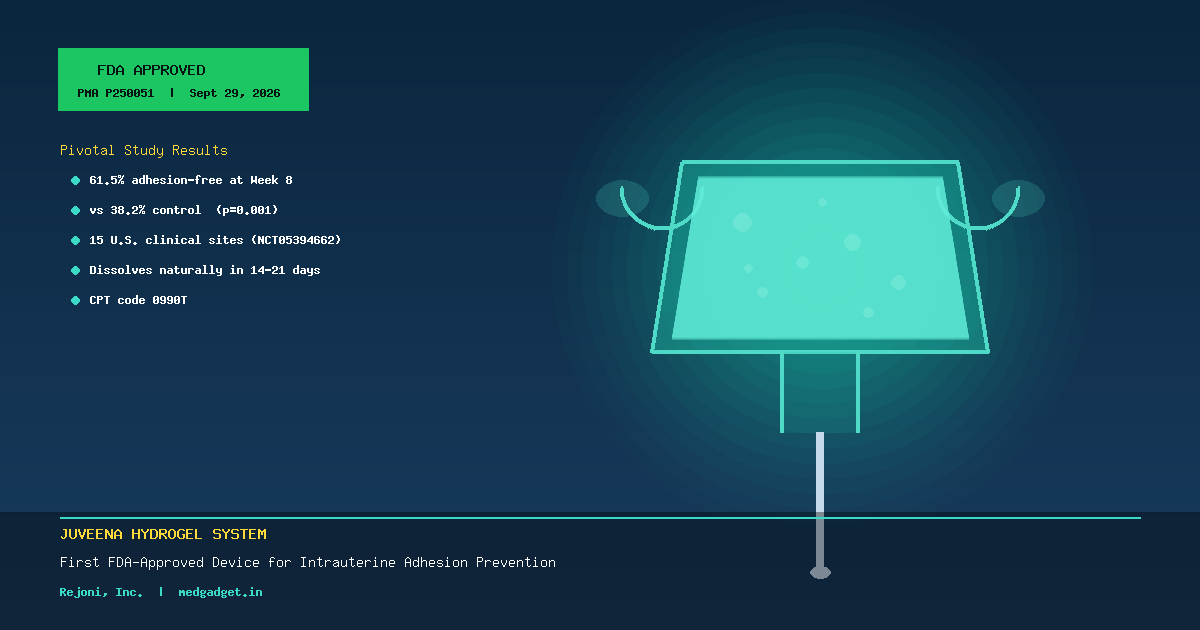
The U.S. Food and Drug Administration has granted Premarket Approval to the Juveena Hydrogel System, a device developed by Rejoni, Inc. to reduce the formation and recurrence of intrauterine adhesions following surgical treatment in women with moderate to severe disease. The PMA designation, numbered P250051, was announced on September 29, 2026, and represents the first FDA-approved device specifically indicated for reducing intrauterine adhesion formation after hysteroscopic adhesiolysis—a gap in the treatment landscape that has persisted for decades despite the condition’s significant impact on women’s health and fertility.
The Problem Juveena Addresses
Intrauterine adhesions, also called IUAs or Asherman’s syndrome in its more severe forms, occur when bands of fibrous or connective tissue form inside the uterine cavity, typically following trauma to the uterine lining. Hysteroscopic adhesiolysis—the surgical procedure that cuts and removes these adhesions—is the standard treatment. The fundamental problem is that adhesions frequently reform after surgery, requiring repeat procedures or leaving patients with persistent symptoms regardless of how well the initial surgery goes.
Symptoms of IUAs range from irregular or absent menstrual bleeding and pelvic pain to infertility, recurrent pregnancy loss, and pregnancy complications including abnormal placentation. Prior to the Juveena approval, no FDA-cleared device existed specifically to prevent adhesion recurrence after adhesiolysis.
How the Device Works
Juveena uses an in situ-forming hydrogel approach. The system consists of a proprietary transcervical catheter and liquid precursors that are delivered into the uterine cavity at the conclusion of the hysteroscopic adhesiolysis procedure. Once placed, the liquid components polymerize and form a soft, conforming hydrogel that fills the uterine cavity and physically separates the uterine walls during the critical early healing period when adhesion reformation is most likely to occur.
The hydrogel is composed of more than 90 percent water and is designed to remain in place for approximately 14 to 21 days before softening, liquefying, and being naturally discharged through the cervix and vagina. No retrieval procedure is required.
The Clinical Data
Approval was supported by the Juveena Pivotal Study (NCT05394662), a multicenter, randomized, subject- and evaluator-blinded controlled trial conducted at 15 U.S. clinical sites. The trial enrolled patients undergoing hysteroscopic adhesiolysis for symptomatic moderate to severe intrauterine adhesions.
In a descriptive subgroup analysis of adhesion-free outcomes, 61.5 percent of women in the Juveena group were completely free of intrauterine adhesions at their week 8 follow-up, compared with 38.2 percent of those in the control group. On a prespecified secondary endpoint measuring adhesion severity at week 8, Juveena showed statistically significant superiority over control with a p-value of 0.001. Severe adhesions were observed in only 6.1 percent of Juveena patients at follow-up, compared to a substantially higher proportion in the control arm.
Pietro Bortoletto, M.D., Reproductive Endocrinologist and Co-Founder, Terra Fertility; Juveena Pivotal Study Investigator
Availability and CPT Coding
Rejoni plans to initiate a limited market release of Juveena beginning at select U.S. centers, consistent with a staged commercial launch. The company has confirmed that the procedure may be reported using CPT Category III code 0990T, providing a billing pathway for clinical sites that adopt the device.
John Nealon, President and Chief Executive Officer, Rejoni, Inc.
The Company Behind It
Rejoni was founded to address a long-standing unmet need in uterine health. Amarpreet Sawhney, PhD, is the founder who guided the device through its early development and PMA filing, while John Nealon currently leads the company as CEO. Rejoni closed a $25 million financing round in mid-2026 to build out its commercial infrastructure ahead of the FDA decision. The 15-site U.S. pivotal trial ran from 2022 through April 2025.
A Milestone in Women’s Health Device Approval
IUAs are not a niche concern. The condition affects millions of women globally, most commonly after uterine procedures such as dilation and curettage, myomectomy, hysteroscopic surgery, or obstetric complications. The absence of any approved adhesion-prevention device to date has meant that clinicians relied on various off-label approaches—none of which carried the evidentiary weight that a randomized pivotal trial provides.
The Juveena approval is likely to prompt hysteroscopic surgeons across gynecology and reproductive endocrinology to revisit their post-adhesiolysis protocols as the device becomes commercially available.